Anterior pelvic tilt exercises can help you practice pelvic control and strengthen the muscles around your hips and core. Five useful starting movements are the half-kneeling hip flexor stretch, pelvic tilt, dead bug, glute bridge, and plank.
If you’re over 40 and concerned about an arched lower back or stiff hips, start with this: your posture alone does not tell the whole story. How you move, how you feel, and what you can comfortably do matter.
At High Definition Training, we coach adults over 40 in the Bronx, especially women who want to build strength and feel more confident moving their bodies. Our approach emphasizes gradual progress and coaching tailored to each person.
TL;DR
- Anterior pelvic tilt (APT) is a forward tilt of the pelvis that often comes with an arched lower back. It is common, and a tilt alone does not prove you have a problem.
- A 2020 review found no overall evidence that non-surgical treatment reduces excessive APT, so aim for better hip, glute and core control and less pain, not a “perfect” angle.
- A solid routine: half-kneeling hip flexor stretch, pelvic tilt, dead bug, glute bridge and plank, about 8 to 12 minutes, then practice the same control in hinges and squats.
- Give it about a month. If nothing improves, see a physical therapist. Shooting pain, numbness, tingling or weakness means seeing a doctor right away.
What Is Anterior Pelvic Tilt?
Anterior pelvic tilt describes a forward rotation of the pelvis. It can make the lower back appear more arched.
A photograph cannot tell you whether that position is causing pain or whether particular muscles are weak. People have different natural spinal curves, and the pelvis moves throughout the day.
A 2020 systematic review found insufficient strong evidence to establish that nonsurgical treatments reliably reduce excessive anterior pelvic tilt. That does not mean exercise is pointless. It means promising to “fix” everyone’s posture with a few stretches goes beyond the evidence.
A more useful goal is to build movement options, strength, and confidence.
So the goal is practical:
- Move your pelvis through its full range, instead of living at one end of it.
- Strengthen the muscles that hold you in a good position under load.
- Reduce the aches that brought you here.
If you chase a number on a photo, you’ll be disappointed. If you chase better control, you’ll usually feel the difference in your back, hips and knees.
Why women over 40 notice it more
The cause is rarely one thing. Years at a desk, a commute, and regularly wearing high heels can all contribute, according to HealthCentral. In midlife, many women also start strength training after a long break, or for the first time, and the glutes and core are the first places they find gaps. That is normal, and it is very trainable.
Which muscles tend to be tight and which are weak
The usual pattern, as Healthline summarizes it, is weakness in the abs, hamstrings and glutes, with tightness in the quads and lower back muscles. NASM, the personal trainer certification body, frames the fix in three parts:
- Lengthen the overactive muscles, such as the hip flexors.
- Activate the underactive ones, such as the glutes and core.
- Integrate the result into real movements like hinges, carries and squats.
That order is the backbone of the routine below.
Before You Start Anterior Pelvic Tilt Exercises
Choose a comfortable space and begin with an easy version of each movement.
You should be able to breathe throughout the exercise. Avoid forcing your lower back flat, aggressively tucking your pelvis, or pushing through pain.
Notice:
- Can you gently move your pelvis forward and backward?
- Can you perform the movement without holding your breath?
- Does reducing the range make it more comfortable?
These observations help guide exercise choices. They do not diagnose a condition.
The exercises, one at a time
Move slowly and keep everything pain-free. A stretch should feel like a pull, never a pinch.
1. Half-kneeling hip flexor stretch
Kneel on one knee with the other foot in front, on a pad if the floor is hard. Tuck your tailbone under as if pulling your belt buckle toward your chin, squeeze the glute on the kneeling side, and shift forward slightly until you feel the front of that hip lengthen. NASM’s version pairs the stretch with exactly this posterior tuck and glute squeeze, which is what makes it work. Without the tuck, you just arch your back more. Hold 30 seconds per side, twice.
2. Pelvic tilt
Lie on your back, knees bent, feet flat. The Cleveland Clinic’s posture guide describes rounding the pelvis to bring your lower back toward the floor while engaging the abs. Exhale as you tilt, hold two or three seconds, then return to neutral. Ten slow reps. This teaches you to find and control the movement before you load it.
3. Dead bug
Lie on your back with arms up toward the ceiling and knees bent over your hips. Keep your lower back gently pressed toward the floor, then lower one arm and the opposite leg a few inches. Return, switch sides. If your back arches off the floor, shorten the range. Six to eight reps per side.
4. Glute bridge
From the same position, tuck the pelvis slightly, press through your heels and lift your hips until your body makes a line from shoulders to knees. Stop there. Going higher usually means the lower back is doing the work. Squeeze the glutes for two seconds at the top. Ten to twelve reps. Bridge variations show up on Baptist Health’s list of common exercises for these muscle imbalances, alongside half-kneeling stretches, planks and controlled squats.
5. Plank with intentional pelvic position
Set up on forearms and toes, then tuck your tailbone slightly and squeeze your glutes so your ribs and hips stay stacked. Hold 15 to 30 seconds. Shorter, tidier holds beat long sagging ones. If your lower back sags or aches, drop to your knees.
From floor drills to real life
Floor drills only matter if they carry over. NASM recommends integrating pelvic control into hip hinges, loaded carries and squats. Here is how that looks in practice.
Hip hinge
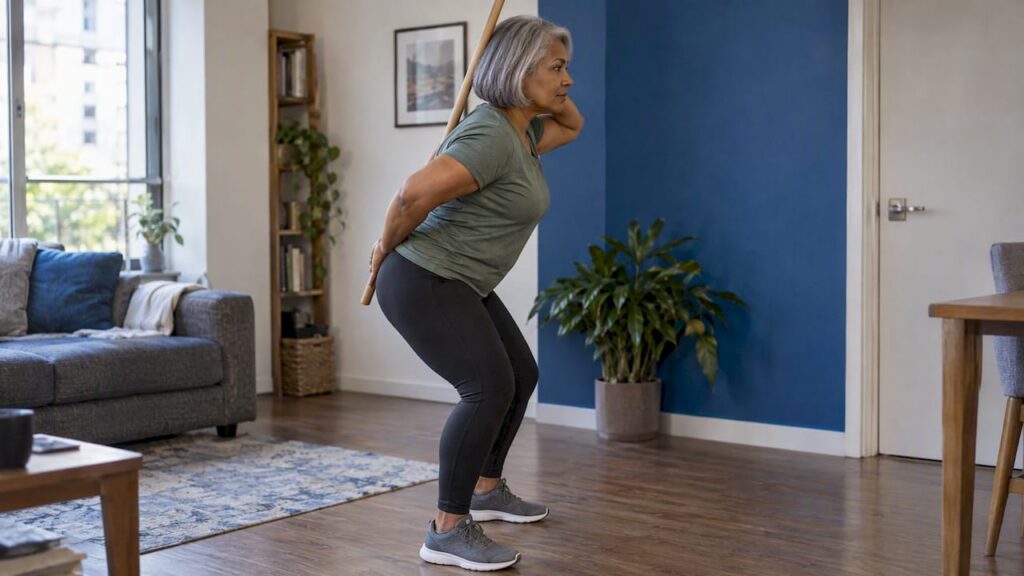
Stand with a dowel or broomstick along your spine, touching the back of your head, upper back and tailbone. Push your hips back while the stick keeps all three contact points. If your lower back lifts off the stick, you’ve gone past your range. Add light dumbbells or a kettlebell only when this feels easy.
Squat
A box or bench squat lets you control depth. Keep ribs stacked over hips, brace lightly, and stand by driving the floor away. If you have knee discomfort, shorten the range and slow down. When you can do ten clean reps, hold a weight at your chest. Our guide to strength training for women over 40 explains how we build up from there.
Loaded carry
Hold a dumbbell in one hand and walk 20 to 30 steps with your ribs down and your pelvis level. Switch hands. Carries train the trunk muscles that keep your pelvis steady while you move, which is what daily life asks of them. Balance and trunk control go hand in hand, and balance training exercises for seniors show how to build both safely.
How often and how long
NASM suggests 8 to 12 minutes of targeted corrective work in your warm-up, plus brief daily mobility or activation work, practiced consistently over weeks or months.
Studies on this are small and focused on specific groups. A 2025 randomized trial of 34 people with lower cross syndrome used 12 supervised sessions over four weeks and saw better functional scores and posture ratings. A 2026 trial of 60 collegiate sprinters found improved pelvic alignment after eight weeks of supervised training three times a week. These were supervised programs in specific groups, so don’t expect identical results from a few stretches at home.
A sample week
| Day | What to do | Time |
|---|---|---|
| Monday | Full routine (all five exercises), then hinges or squats in your workout | 10 to 12 min |
| Tuesday | Hip flexor stretch and pelvic tilts | 3 to 5 min |
| Wednesday | Full routine plus a loaded carry | 10 to 12 min |
| Thursday | Hip flexor stretch and glute bridges | 3 to 5 min |
| Friday | Full routine, then hinges or squats | 10 to 12 min |
| Weekend | Walk, stand up often, optional pelvic tilts | As you like |
Stretch or strengthen?
A 2024 systematic review found moderate-certainty evidence that stretching does not treat muscle imbalance, and that strengthening was superior to stretching overall, though it was not significantly effective in the lumbar and lumbopelvic regions. In plain terms: the stretch alone won’t do much. Use it as a short primer so you can get into better positions, then spend most of your time strengthening the glutes, hamstrings and abs.
How to progress without hurting yourself
Move forward only when the current step feels easy and you can keep the pelvic position. A sensible order:
- Learn the position: pelvic tilts and bridges.
- Add control: dead bugs and planks.
- Load it: hinges and box squats with light weight.
- Challenge it: single-sided work, carries, then heavier lifts.
The Cleveland Clinic advises warming up, increasing intensity gradually, and stopping to rest if something hurts. Sharp pain is a stop sign, not something to push through.
Common mistakes
- Stretching without tucking. The hip flexor stretch only works with the glute squeeze and pelvic tuck.
- Overcorrecting. Tucking so hard your glutes grip all day isn’t the goal. You want a pelvis that moves, not one that is locked.
- Skipping the load. Bodyweight drills are the start. Strength shows up when you add weight with good position.
- Ignoring the desk. Ten minutes of exercise won’t cancel eight hours of sitting. Stand and walk every half hour or so.
- Chasing a look. Judging progress by a side photo is how people stay frustrated.
Our perspective on pelvic tilt
We have coached real adults over 40 in the Bronx since 2007, and the pattern is consistent. Most women who come in worried about their pelvic tilt are not broken. They are deconditioned in the glutes and trunk, a bit stiff in the hips, and often afraid of loading a squat or deadlift because someone told them their posture is “wrong.”
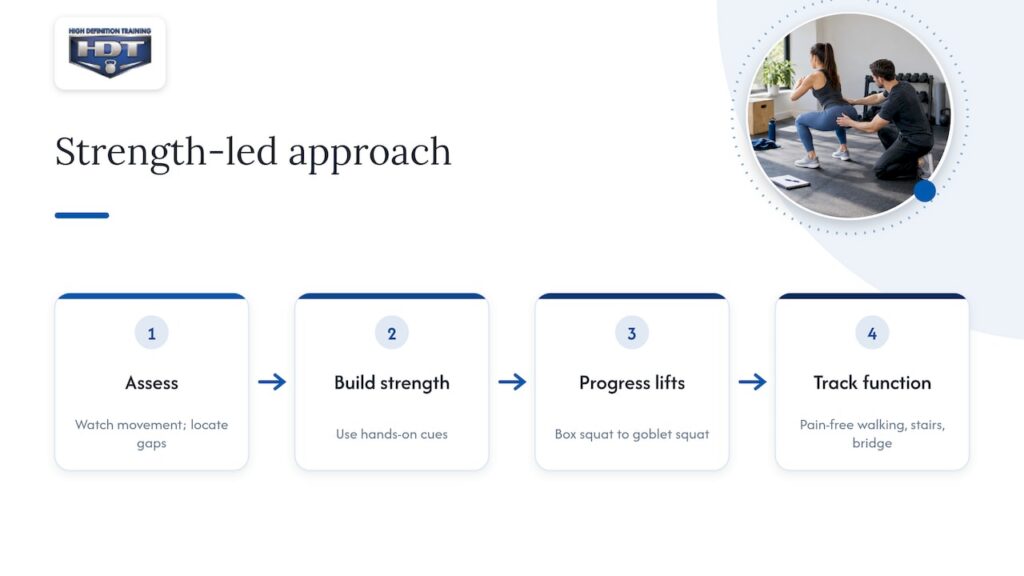
So we don’t try to force a number. We watch how you move, find where control drops out, and build strength from there with hands-on cues. Often the fix for a “tilted” look is a patient progression: a box squat becomes a goblet squat, a hinge with a dowel becomes a light deadlift. We also check recovery. Some clients need more days between sessions, and pushing through tired, sore hips makes the arch worse.
The research agrees with that approach: tilt angle is a poor target and strength and comfort are better ones. Track what you can do, such as pain-free walking, stairs, a 10-rep bridge, a clean hinge, and let the posture follow.
— Angel Perez
Train with a coach who sees how you move
If you’d rather not guess whether you’re doing these right, we can help. High Definition Training works with adults over 40 in Throgs Neck and Pelham Bay, with a pressure-free first assessment and hands-on coaching that adjusts each exercise to your body. Our 60-Day Transformation is a structured way to start, and you can see the personal training, semi-private and small-group options to find what fits your schedule.

If power and speed are part of your goals, our guide to safe power training over 40 covers how we introduce it.
When to see a professional
Give consistent practice about a month. HealthCentral advises seeing a physical therapist if you notice no progress after roughly that long. See a doctor right away for shooting pain, numbness, tingling or weakness in the legs, since those can point to a nerve problem, not a muscle one.
Surgery is rare. The Cleveland Clinic says it may be suggested if physical therapy doesn’t help and pain stays intense, or if a severe tilt is damaging joints in the spine or hips.
FAQ
Can you really fix anterior pelvic tilt?
The evidence is not encouraging for changing the angle itself. A 2020 review found no overall evidence that non-surgical treatment reduces excessive tilt. What you can improve is strength, control and comfort, and that is a goal worth training for.
What is the best exercise for anterior pelvic tilt?
No single move does it all. If you pick one, make it the glute bridge, then add the half-kneeling hip flexor stretch with a posterior tuck. Together with dead bugs and planks, they cover the weak and tight areas.
Which muscles are weak with anterior pelvic tilt?
Typically the abs, glutes and hamstrings, while the quads and lower back muscles feel tight. Healthline describes this as an association, not a rule, so test how your own body moves instead of assuming.
How long until I notice a difference?
Plan on several weeks of consistent work. NASM describes progress over weeks or months, and trials ran four to eight weeks with supervision. If you see no change after about a month, check in with a physical therapist.
Sources
- Non-surgical interventions for excessive anterior pelvic tilt (review)
- Cleveland Clinic: Pelvic Tilt
- HealthCentral: How to Fix Anterior Pelvic Tilt
- Healthline: 5 Anterior Pelvic Tilt Exercises
- NASM: Pelvic Tilt for Personal Trainers
- Cleveland Clinic: Exercises To Improve Posture
- Baptist Health: Anterior Pelvic Tilt
- Balance Training for Seniors
- Clinical Utility of Functional Muscle Screening (2025 trial)
- Integrated Neuromuscular Training versus Janda-Based Corrective Exercise (2026 trial)
- Effects of Stretching or Strengthening Exercise on Spinal Alignment (2024 review)
- Cleveland Clinic: Thigh Muscles