

Mobility After 40: 5 Powerful Moves to Feel Better
Mobility after 40 starts with a practical plan: a daily 10- to 15-minute mobility routine built around five key moves, paired with two to three weekly resistance sessions. The National Institute on Aging points to consistency and habit as bigger drivers of results than any single workout, and that lines up with what we see coaching women through this exact transition at High Definition Training.
TL;DR
- Consistent 10 to 15 minute routines for mobility after 40 focus on key moves to improve joint health and flexibility in women.
- Resistance training two to three times weekly enhances functional fitness and supports joint stability, especially during menopause-related hormonal changes.
- Proper technique and slow, controlled movement are critical to avoid pain and injury, with modifications recommended for existing joint issues or injuries.
- Regular assessment and tracking progress help identify when to adjust routines or seek professional guidance, especially if pain or instability persists.
- Combining mobility and strength work with cardiovascular activity is essential for maintaining bone density, muscle support, and overall vitality.

Table of Contents
- 5 key moves for mobility after 40
- How to structure your week for mobility after 40
- Why strength training belongs in your mobility plan
- Staying safe: mistakes, red flags, and modifications
- A 10 to 15 minute routine for mobility after 40
- How coaching sharpens these progressions
- Hormonal shifts and joint health in midlife
- Work, caregiving, and the mobility gap
- Mobility alongside bone density and heart health
- Tracking progress with mobility after 40
- Why mobility after 40 and strength belong together
- Getting hands-on coaching for your mobility and strength goals
- Where these recommendations come from
- Sources
- Frequently asked questions
5 key moves for mobility after 40
This plan for mobility after 40 covers five areas: the thoracic spine, hips, hamstrings, shoulders, and ankles. Each one takes under two minutes and can be scaled up or down depending on how your body feels that day.
Cat-cow
On hands and knees, arch and round your spine slowly for 8 to 10 breaths, moving with the inhale and exhale rather than against it. It loosens the thoracic spine and lower back, which tend to lock up from sitting. Regress by keeping the range small and pain-free; progress by pausing at end range for 2 seconds each direction. Watch for shrugging the shoulders toward the ears, a common compensation that steals range from the spine.
World’s Greatest Stretch
From a low lunge, rotate your torso toward the front leg and reach that arm toward the ceiling, holding 3 to 5 seconds per side for 6 to 8 reps. It opens the hips, hamstrings, and the thoracic spine in one movement. Regress by dropping the back knee lower for support; progress by adding a reach overhead.
90/90 hip rotations
Sit with both legs bent at 90 degrees, one in front and one to the side, then rotate knees side to side for 30 to 60 seconds. This targets internal and external hip rotation that often fades with age. Keep your chest tall rather than leaning back to cheat the range.
Thoracic open-book
Lying on your side with knees stacked, rotate your top arm across your body and open it toward the floor behind you, 6 to 10 reps per side. This restores rotation lost from desk work. Progress by slowing the tempo to 4 seconds per rep.
Ankle dorsiflexion drill
In a half-kneeling position, drive the front knee over the toes without lifting the heel, 10 reps per side. Limited ankle range often shows up as knee pain during squats. Regress with a smaller range; progress by adding a slight pause at the end.
Pro Tip: For mobility after 40, move slowly enough to breathe through each rep, not so fast that momentum does the work.
How to structure your week for mobility after age 40
Consistency is the priority when working on mobility after 40, rather than relying on occasional long sessions. The Physical Activity Guidelines for Americans recommend at least 150 minutes of moderate aerobic activity weekly, plus muscle-strengthening work on two or more days, with balance training highlighted for older adults. A simple weekly frame:
- Mobility: 10 to 15 minutes, most days of the week, either as a stand-alone habit or a warm-up before other training.
- Resistance training: 2 to 3 sessions per week, spaced with at least one rest day between sessions targeting the same muscle groups.
- Aerobic activity: spread across the week in whatever form you enjoy, walking, cycling, or swimming.
Working on mobility after 40 before a strength session primes the joints you are about to load. A separate mobility session later in the day, even five minutes on the floor while watching television, still counts and helps you accumulate the daily total. Our home workout plan for women over 40 breaks this weekly structure down further for anyone training outside a gym.
Why strength training belongs in your mobility plan
A systematic review of resistance training in older women covering studies from 2010 to 2020 found that multiple sessions per week of resistance training produce consistent gains in functional fitness measures such as timed up-and-go, chair stand, and gait speed. Strength and mobility after 40 are closely linked: a weak hip typically moves less well under load.
A practical strength-training starting list to support mobility after 40:
- Box squat or supported squat: builds the hip and knee strength needed for daily tasks like standing from a chair.
- Hip hinge progression: starting with a dowel or light kettlebell, teaches safe bending patterns that protect the lower back.
- Banded rows: strengthen the upper back and counteract the forward shoulder posture common from desk work.
- Push variations: incline push-ups or wall push-ups build pressing strength without overloading the shoulder joint early on.
- Single-leg stability work: even a simple staggered stance builds the balance that prevents falls later.
To support mobility after 40, start with 4 to 6 compound moves, 2 to 3 sessions per week, prioritizing technique before adding load. Our guide on starting strength training over 40 walks through specific starting weights and progression timelines.
Staying safe: mistakes, red flags, and modifications
When training for mobility after 40, sharp pain, numbness, tingling, or swelling during any mobility or strength move means stop and check with a professional rather than pushing through. A recent injury, surgery, or a joint that gives out unexpectedly are also reasons to get guidance before continuing a routine on your own.
- Reduce range before reducing effort: a smaller, pain-free range done consistently beats a full range that hurts.
- Use support: a wall, chair, or resistance band can take pressure off a joint while you build strength around it.
- Watch for compensation: shifting weight to one side or arching the lower back to fake range usually means the move needs to be regressed.
- Progress load slowly: adding resistance before technique is consistent is one of the most common causes of setbacks.
Pro Tip: Space sessions targeting the same joint at least 24 to 48 hours apart, since recovery is when the actual adaptation happens.
A 10 to 15 minute routine for mobility after 40
This sequence hits all five moves in order, moving from the spine down to the ankles, and takes about 12 minutes at a comfortable pace.
- Cat-cow: 8 reps, gentle version keeps the range small; progressed version adds a 2 second pause at each end.
- World’s Greatest Stretch: 6 reps per side, gentle version skips the overhead reach; progressed version adds it.
- 90/90 hip rotations: 45 seconds, gentle version uses hands on the floor for support; progressed version keeps the torso upright unassisted.
- Thoracic open-book: 8 reps per side, gentle version uses a smaller rotation; progressed version slows to 4 seconds per rep.
- Ankle dorsiflexion drill: 10 reps per side, gentle version uses a wall for balance; progressed version adds a light pause at end range.
Use this routine for mobility after 40 before a strength session to prime your joints, or on its own on rest days to keep the habit going.
How coaching sharpens these progressions
At High Definition Training, assessments for mobility after 40 start with simple, repeatable metrics: a timed up-and-go check, a 30 second chair stand, and a basic range-of-motion screen for the hips and shoulders. These give a baseline that makes later progress visible rather than guessed at.
- Squat modification for knee discomfort: Coach Angel often shortens the range and adds a box for depth control until the movement feels stable.
- Box squat to weighted squat: once bodyweight form holds steady across sets, a light dumbbell or kettlebell gets added before barbell work is ever considered.
- Shoulder-friendly rows: for clients with limited overhead reach, banded rows with a scapular retraction cue keep the posterior shoulder working without forcing painful range.
Hormonal shifts and joint health in midlife
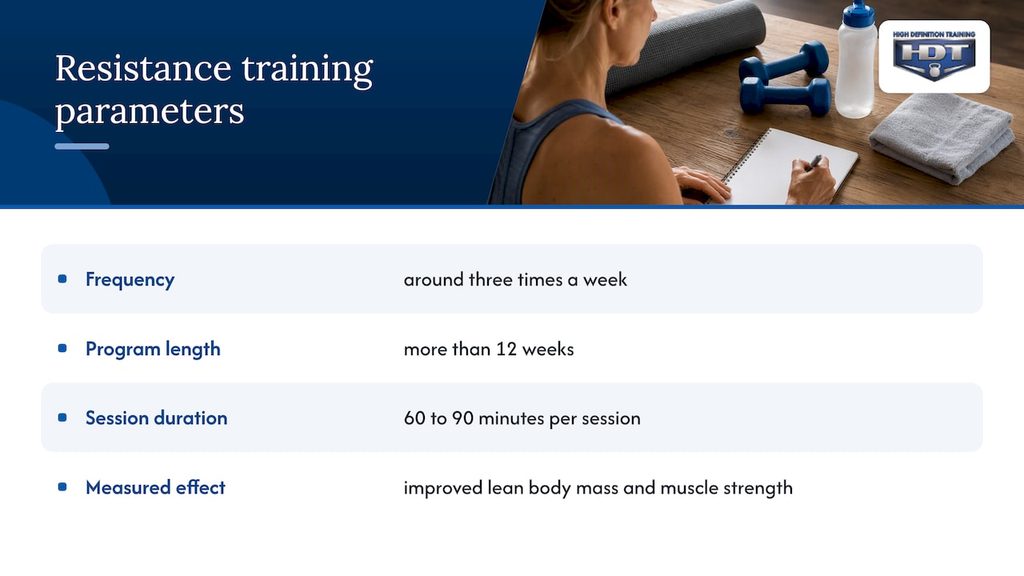
Menopause and the years surrounding it bring hormonal changes that affect joint and connective tissue health, which is part of why mobility work often feels different in your 40s and 50s than it did a decade earlier. A meta-analysis on exercise in menopausal women found that resistance training performed around three times a week improved lean body mass and muscle strength in peri- to postmenopausal women, with the strongest effects seen in programs lasting more than 12 weeks at 60 to 90 minutes per session.
This matters for mobility after 40 because muscle supports the joints around it. Weaker hip and shoulder musculature during this transition can make the same stretch that used to feel easy now feel restricted, not because the joint itself changed overnight but because the muscles supporting it lost some capacity. Resistance training addresses this directly rather than working around it.
Joint stiffness reported during this life stage is also often tied to reduced activity rather than an unavoidable consequence of age. Supporting mobility after 40 with resistance training, even at a modest frequency, gives the muscles around your joints a reason to stay capable, which in turn keeps your mobility work more productive. Women who skip strength work during this window sometimes find that pure stretching plateaus. That is a signal to add load, not to stretch harder.
Work, caregiving, and the mobility gap
Many women in their 40s and 50s are managing full-time work, caregiving for children or aging parents, or both at once, and mobility is often the first habit to disappear when time gets tight. Long hours at a desk shorten the hip flexors and round the shoulders, while caregiving tasks like lifting, bending, and carrying add repetitive strain without the balancing effect of structured movement.
Making time for mobility after 40 is not about finding more time; it is about protecting a small amount of it. A 10 to 15 minute mobility routine fits into a lunch break, a morning before the household wakes up, or the few minutes after putting kids to bed. Our piece on ergonomics in your fitness plan covers how small changes at a desk or during caregiving tasks reduce the compensations that build up over a workday.
Stress itself also affects mobility, since chronically tense muscles, particularly around the neck, shoulders, and hips, resist stretching more than relaxed ones. A short daily routine for mobility after 40, done at a consistent time, works partly because it becomes a break from that tension rather than one more task competing for attention.
Mobility alongside bone density and heart health
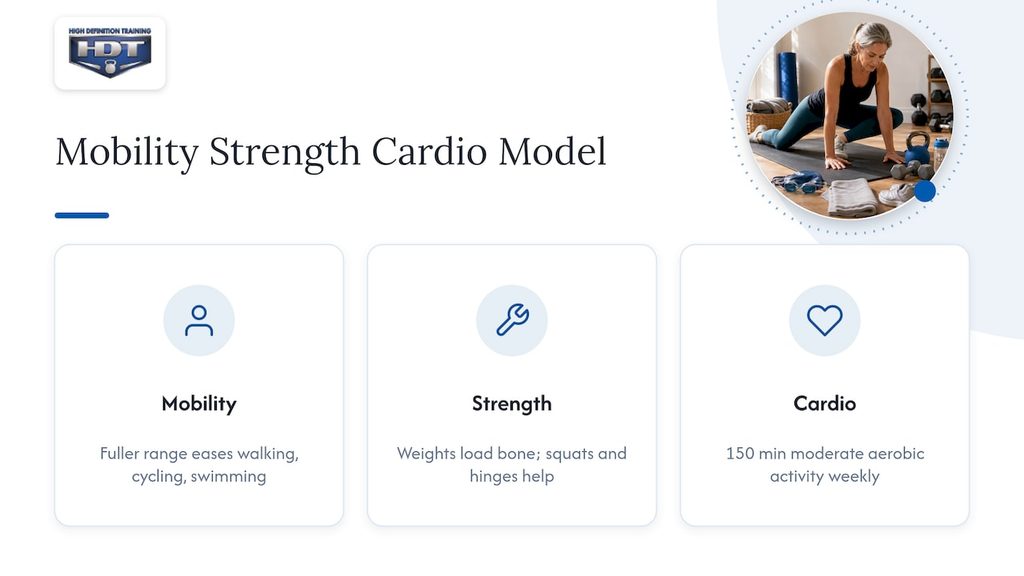
Mobility after 40 does not operate in isolation from the rest of your health. Bone density naturally declines during and after the menopause transition, and the same resistance training that supports joint mobility also loads bone in ways that stretching alone cannot. Weight-bearing moves like the squats and hip hinges described earlier serve double duty: building strength and challenging bone at the same time.
Cardiovascular health fits into this picture too. The Physical Activity Guidelines call for 150 minutes of moderate aerobic activity weekly, and better mobility supports that goal in a practical way: a hip or shoulder with fuller range makes walking, cycling, and swimming more comfortable and sustainable over the long run. Poor mobility often quietly limits aerobic activity long before it causes pain, since a stiff ankle or hip changes gait mechanics enough to make walking feel more effortful than it should.
Thinking of mobility, strength, and cardiovascular activity as three legs of the same stool, rather than three separate to-do items, makes the whole routine easier to sustain. None of the three fully substitutes for the others.
Tracking progress with mobility after 40
When tracking mobility after 40, simple, repeatable checks work better than vague impressions of feeling “looser.” Retesting a 30 second chair stand or timing how long a single-leg balance holds every few weeks gives an actual number to compare against, rather than relying on memory. The same applies to range: noting how far a hip rotates or how deep a squat feels at the start of a program creates a baseline worth revisiting monthly.
Persistent or worsening pain, swelling that doesn’t settle within a day or two, or a joint that feels less stable over time are signs that self-guided mobility work has reached its limit. A systematic review of resistance training outcomes noted measurable functional improvements within several weeks of consistent training, so a lack of any progress after a similar stretch of time, especially alongside ongoing discomfort, is also worth raising with a physical therapist or a qualified coach rather than pushing through independently.
Why mobility after 40 and strength belong together
Most advice treats mobility after 40 and strength as separate boxes to check. In practice, the women who see the most change are the ones who stop separating them and just show up consistently for both. A stiff joint and a weak muscle around it are usually the same problem described two different ways.
Work with a coach when pain persists past a few sessions or when your history includes surgery, a chronic condition, or an injury that makes self-guided progression risky. Otherwise, expect small, measurable wins, an easier chair stand, a deeper squat, within the first several weeks, long before anything dramatic shows up in the mirror.
— Angel Perez
Getting hands-on coaching for your mobility and strength goals
Reading about mobility after 40 only gets you so far when a knee, shoulder, or hip already has a history. The 60-Day Transformation at High Definition Training starts with a no-pressure assessment built specifically for adults over 40, so your plan reflects your actual joints and history rather than a generic template.

High Definition Training
The first assessment includes simple strength and mobility checks, along with a conversation about any past injuries or limitations, so bring comfortable clothing and a list of any current aches.
Choose from personal training, semi-private, or small-group formats depending on how much one-on-one attention you want.
This fits women over 40 who want measurable strength and mobility gains with a coach adjusting each move to their body rather than a one-size-fits-all program.
Explore training formats and pricing to find the option that matches how much support you’re looking for.
Where these recommendations come from
The guidance on mobility after 40 in this article draws on the National Institute on Aging, the Physical Activity Guidelines for Americans, and two systematic reviews on resistance training in older and menopausal women.
Sources
- Health benefits of exercise and physical activity | National Institute on Aging
- The impact of resistance training on body composition, muscle strength, and functional fitness in older women (2010–2020)
- Physical Activity Guidelines for Americans, 2nd edition
Frequently asked questions
Is it possible to improve flexibility at 40?
Yes, flexibility and mobility after 40 can improve with consistent practice. The National Institute on Aging notes it’s never too late to build strength, balance, and flexibility, even later in life.
What is the 3-3-3 rule for exercise?
There is no single established “3-3-3 rule” backed by exercise science organizations, and definitions vary across fitness sources. A more reliable frame is the guideline of at least 150 minutes of weekly aerobic activity plus muscle-strengthening work on two or more days, as recommended in the Physical Activity Guidelines for Americans.
Which exercise is most anti-aging?
No single exercise earns that label, but resistance training has some of the strongest evidence behind it for preserving strength and function with age. A review of resistance training in older women found consistent improvements in functional measures like gait speed and chair stand performance after regular strength sessions.
Can I reshape my body at 40?
Body composition can change meaningfully at 40 and beyond through consistent resistance training and daily movement. A meta-analysis on exercise in menopausal women found that regular resistance training improved lean body mass and muscle strength in peri- and postmenopausal women, particularly in programs lasting longer than 12 weeks.
How much time should I spend on mobility after 40 each week?
A daily 10- to 15-minute routine covers most needs, paired with 2 to 3 resistance sessions weekly for strength. This combination reflects the approach High Definition Training uses with clients seeking better mobility after 40 and lasting strength.