
Losing fat comes down to five moves working together: a modest calorie deficit, more daily walking, resistance training at least twice a week, simple tracking of food and weight, and consistent sleep. Skip resistance training, and you’ll lose muscle along with fat. The Physical Activity Guidelines, the CDC, and Mayo Clinic all back this framework, and coaches at High Definition Training build it into every client’s first 60 days.
TL;DR:
- Building a moderate calorie deficit of 250 to 500 calories daily promotes steady fat loss of about one pound per week without risking muscle loss.
- Increasing daily steps gradually by 250 to 1,000 steps each week supports fat burning without causing injury or burnout.
- Resistance training at least twice a week is crucial for preserving muscle mass and maintaining metabolic rate during weight loss.
- Tracking food intake, activity, and sleep helps identify and correct subtle causes of stalled progress or plateaus.
- Adjusting calorie intake and activity levels every four to six weeks prevents metabolic slowdown and keeps fat-loss momentum.
Table of Contents
- What Are the Essential Steps for Fat Loss?
- How Many Steps Do You Need for Fat Loss Each Day?
- What Should You Eat to Support Fat Loss?
- Why Does Tracking and Accountability Matter for Fat Loss?
- How Do Sleep and Stress Affect Fat Loss?
- An 8-Week Starter Plan for Real Progress
- Understanding Metabolic Rate and Metabolic Adaptation
- Common Pitfalls That Cause Weight-Loss Plateaus
- Why Consistency Beats Perfection in Fat Loss
- How to Adjust Your Strategy as You Lose Weight
- What Is a Safe Rate of Fat Loss?
- How Do You Manage Cravings and Emotional Eating?
- What a First Session at High Definition Training Actually Looks Like
- Ready to Put These Steps Into Practice?
- Sources
- FAQ
What Are the Essential Steps for Fat Loss?
Fat loss stops feeling mysterious once you break it down into a sequence of steps rather than a single, overwhelming goal. Here’s the order that works, step by step.
- Clarify your motivation and set one measurable goal. Instead of “lose weight,” aim for a concrete, realistic target that produces meaningful health benefits. That’s a realistic, evidence-backed target, and even that modest a loss meaningfully improves markers like blood pressure and blood sugar.
- Measure your baseline before you change anything. Write down your current weight, waist circumference, average daily steps, and typical hours of sleep. You need a starting line to know if the plan is working.
- Build a modest calorie deficit, not a drastic one. Aim for roughly 250 to 500 calories below maintenance per day. That pace typically produces about a pound of fat loss per week without triggering the muscle loss and rebound hunger that come with crash diets.
- Raise your daily movement, starting with steps. Set a personalized steps target based on your current average, then add scheduled cardio sessions on top of that baseline activity.
- Start resistance training at least twice a week. This is the step most fat-loss plans skip, and it’s the one that protects the muscle you already have while you’re eating less.
- Track your food, activity, and weekly weight. You don’t need a spreadsheet obsession. A simple log takes minutes and tells you what’s actually happening versus what you think is happening.
- Protect your sleep and manage stress deliberately. Poor sleep undermines every other step on this list, which is why it gets its own section below.
- Review your numbers every 1 to 2 weeks and adjust as needed. If the scale hasn’t moved in two to three weeks, something in steps three through five needs a small tweak, not a total overhaul.
A few things make or break this sequence:
- Weigh yourself at the same time of day, ideally first thing in the morning, to reduce noise from water fluctuations.
- Log food honestly, including the bites and tastes that don’t feel like they count.
- Treat week one as data collection, not a test you can fail.
How Many Steps Do You Need for Fat Loss Each Day?
A daily step goal tailored to your current average, with gradual increases, effectively supports fat loss. If you’re walking 3,000 steps a day right now, jumping straight to 10,000 is a recipe for shin splints and quitting by Thursday.
Add 250 to 1,000 extra steps per day each week until you land on your target. Someone starting at 4,000 steps might hit 7,500 by week six just by adding two 10-minute walks to their routine. Short walking bouts, like a lap around the block after each meal, add up just as well as one long walk and are often easier to stick with.
Steps alone aren’t the whole picture of the activity. The Physical Activity Guidelines recommend regular moderate aerobic activity each week for health, with higher volumes often beneficial for weight-loss maintenance.
Fat-loss activity benchmark: research summarized in the NCBI Bookshelf finds that sustained moderate-to-vigorous activity for several hours weekly predicts better long-term maintenance by offsetting metabolic slowdown associated with weight loss.
Resistance training belongs in this picture just as much as cardio does. Two full-body sessions a week, hitting the major muscle groups with moves like squats, rows, and presses, is the minimum Mayo Clinic recommends for preserving muscle during weight loss. Start with two to three sets of 8 to 12 reps at a weight that feels challenging by the last two reps, not the first two.
Pro Tip: Pair your walk with your grocery run or your commute. The steps that survive long term are the ones stitched into a task you were already doing, not a separate workout you have to talk yourself into.
Why does the resistance piece matter so much? Muscle tissue burns more calories at rest than fat tissue does, so protecting it during a deficit helps keep your metabolic rate from dropping further than it needs to.
What Should You Eat to Support Fat Loss?
A calorie deficit is what causes fat loss, full stop, but the composition of your food determines whether you can sustain that deficit without feeling miserable. Roughly 250 to 500 fewer calories than you burn each day translates to about a pound of fat lost per week, a pace that’s slow enough to preserve muscle and fast enough to feel like progress.

Protein and fiber do the heavy lifting here. Higher-protein, higher-fiber diets help control hunger and preserve lean mass during a calorie deficit, which means you feel fuller on fewer calories and lose less muscle along the way.
A few tactics make this easier to apply at every meal:
- Use the plate method: half vegetables, a quarter lean protein, a quarter whole grains or starchy vegetables.
- Swap sugary drinks and juice for water or unsweetened seltzer. Liquid calories add up fast and don’t fill you up.
- Build two or three meal templates you can repeat without decision fatigue, then rotate the protein and vegetables.
- Reduce alcohol and blended coffee drinks, which are two of the sneakiest sources of extra calories in an otherwise solid plan.
Rule of thumb: a sustained 250 to 500 calorie daily deficit produces roughly one pound of fat loss per week for most adults, a pace generally considered both sustainable and effective for keeping muscle intact.
If you’re on medication for diabetes or blood pressure, pregnant, over 65, or managing a chronic condition, talk to your doctor before starting a new deficit or exercise program. Calorie needs and safe activity levels can shift with certain medications and health conditions, and a quick check-in can prevent avoidable problems.
Why Does Tracking and Accountability Matter for Fat Loss?
Self-monitoring is one of the strongest predictors of who actually loses weight and keeps it off. Logging food and activity consistently takes under 15 minutes a day once it becomes a habit, and that small daily investment gives you the data to catch problems before they become three-month plateaus.
Accountability multiplies the effect of tracking. That can look like a coach who reviews your numbers weekly, a workout partner, a small group, or simply a standing Sunday check-in with yourself. Working with an accountability partner tends to keep people consistent over the weeks when motivation alone would lead them to quit.
When the scale stalls, troubleshoot in this order:
- Recheck your food log for portion creep. Most stalls come from calories drifting up slowly, not dramatically.
- Confirm your actual step count against your target. Life gets busy, and activity slips first.
- Look at sleep and stress before touching your calories again.
- Make one small adjustment at a time. Cut 100 to 150 calories or add one more walk, not both at once.
Pro Tip: If you fall off track for a few days, restart with your very next meal, not “next Monday.” The gap between a slip and a spiral is usually just one decision.
How Do Sleep and Stress Affect Fat Loss?
Short sleep disrupts the hormones that regulate hunger and fullness, which is a big part of why a rough night often leads to overeating the next day. Chronic stress works the same way, pushing cravings toward high-calorie comfort food and making the whole process feel harder than it needs to be.
A few habits move the needle fast:
- Keep your bedroom dark and cool, somewhere in the mid-60s Fahrenheit if you can manage it.
- Cut screens an hour before bed—the light and the scrolling both delay sleep onset.
- Avoid heavy meals within two to three hours of bedtime.
- Try a 4-4-4 breathing pattern (inhale four seconds, hold four, exhale four) when stress spikes, or take a short walk instead of reaching for a snack.
- If sleep problems or stress feel unmanageable on your own, a doctor or therapist is worth involving. This isn’t a sign the plan failed.
An 8-Week Starter Plan for Real Progress
This is the rough arc High Definition Training coaches have used with adults over 40 since 2006, adjusted for whatever a given body can handle that week.
- Weeks 1 and 2: Establish your baseline numbers, start logging food and steps, and walk 10 to 20 minutes daily. One resistance session per week, focused entirely on form.
- Weeks 3 and 4: Increase walking volume toward your step target, add a second resistance session, and tighten up one or two easy food swaps you identified in your log.
- Weeks 5 and 6: Progress your resistance training, either more weight or more reps, and add short walking intervals or a few extra cardio minutes.
- Weeks 7 and 8: Focus on consistency over intensity, then set a new SMART goal or move into a 12-week block built around strength.
Coaches modify along the way constantly. Knee discomfort during squats gets a box-squat regression. Shoulder mobility limits? Shift a press to a different angle or use a resistance band. Clients who report high fatigue get an extra rest day instead of being pushed through it, because recovery is part of the program, not a break from it.
Pro Tip: Track effort, not just numbers. A session that feels harder than usual on normal weight is often the earliest sign you need an extra recovery day, well before soreness or fatigue show up on paper.
Understanding Metabolic Rate and Metabolic Adaptation
Your metabolic rate is the number of calories your body burns at rest to function, and it decreases somewhat as you lose weight. A smaller body needs fewer calories to maintain itself, and your body also becomes modestly more efficient at using energy after sustained calorie restriction. Researchers call this metabolic adaptation, and it’s the main reason a plan that worked beautifully in month one can stall by month three even when you haven’t changed a thing.
You can’t eliminate metabolic adaptation, but you can blunt it. Resistance training helps because muscle tissue is more metabolically active than fat tissue, so preserving it during a deficit keeps your resting metabolic rate from dropping as much as it would with diet alone. Sustained activity in the 250-300 minutes-per-week range, rather than a single intense workout followed by a sedentary rest of the day, appears to offset adaptation more effectively over the long run.
The practical fix is periodic adjustment, not panic. As you lose weight, your calorie needs genuinely shrink, so the deficit that worked at 180 pounds may need a small recalibration at 165. Rather than cutting calories aggressively every time the scale pauses, make modest adjustments, roughly 100 to 150 calories, or add one more walk to your week. Watch your trend over two to three weeks rather than reacting to any single day’s number, since normal weight fluctuates a pound or two just from water and sodium.
Common Pitfalls That Cause Weight-Loss Plateaus
Most plateaus trace back to one of a handful of repeat offenders. Recognizing which one applies to you turns a frustrating stall into a quick fix.
Portion creep is the most common culprit. Meals that started with accurate portions slowly grow over a few months as measuring cups get put away and “a serving” comes to mean whatever fits on the plate. A second frequent issue is activity compensation, where people unconsciously move less throughout the day to make up for a hard workout, canceling out the calorie burn without realizing it.
Underestimating liquid calories ranks close behind. A daily latte, a couple of glasses of wine, or fruit juice with breakfast can add several hundred calories that never make it into a food log because they don’t feel like “food.” Weekend drift matters too. Five perfect days followed by two loose ones is a common pattern that erases an entire week’s deficit.
Then there’s the plateau that isn’t actually a plateau: normal weight fluctuation from sodium, hormones, or water retention masking real fat loss happening underneath. This is exactly why tracking trends over two to three weeks, rather than obsessing over one weigh-in, matters so much.
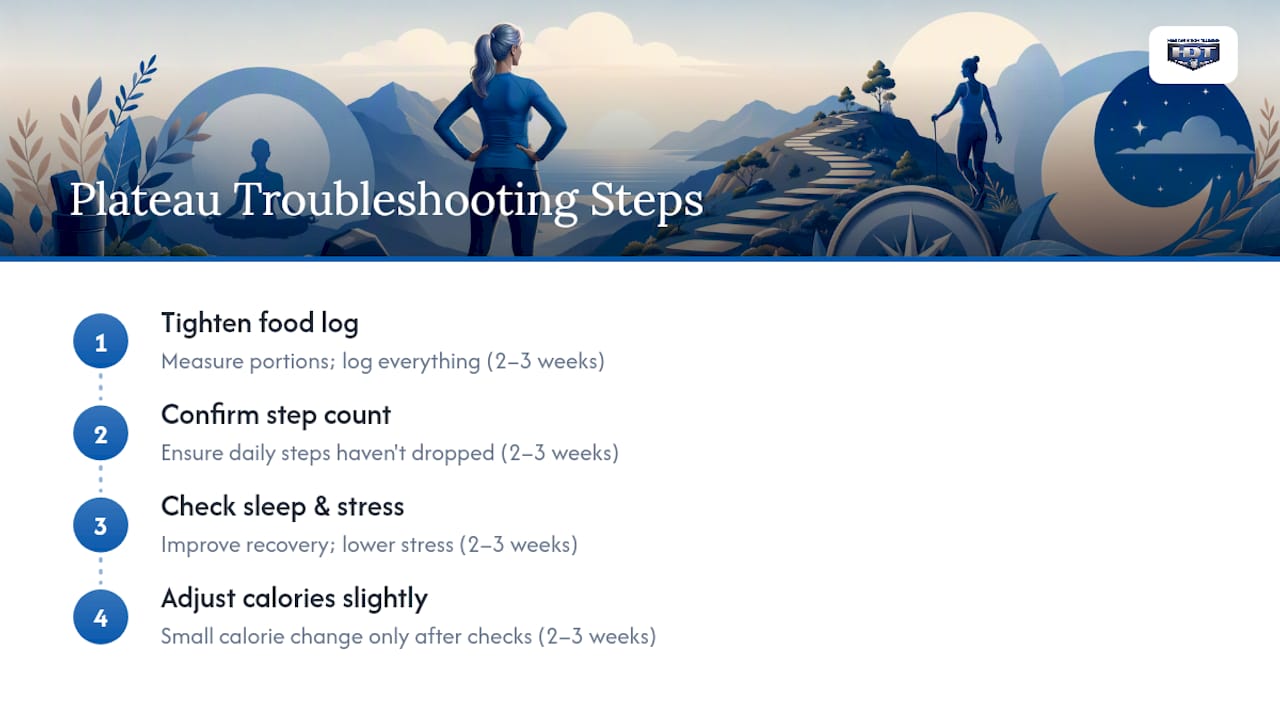
When a genuine plateau hits, work through it in order: tighten the food log first, confirm your step count hasn’t quietly dropped, check sleep and stress, and only then adjust calories by a small margin. Most plateaus resolve within two to three weeks of one deliberate change.
Why Consistency Beats Perfection in Fat Loss
The people who keep fat off long term aren’t the ones who never slip. They’re the ones who treat a bad day as data, not a verdict on the whole plan. Research on long-term weight-loss maintenance consistently points to small, sustainable habit changes and steady external support as the pattern that separates people who keep the weight off from people who regain it.
Consistency also compounds in a way that feels invisible week to week. A pound a week doesn’t look dramatic on a Tuesday, but 12 weeks of that same modest deficit adds up to meaningful, visible change, and it’s a pace your body can sustain without the muscle loss and rebound that come with aggressive crash approaches.
Patience matters as much as effort, particularly with strength and mobility gains, which often show up on a scale, in a mirror, or in how your clothes fit before they show up as a bigger number on a lift. Adults who’ve spent years sedentary sometimes need six to eight weeks to build the base fitness that makes further progress visible. Expecting dramatic weekly change sets up a false sense of failure exactly when the body is quietly adapting in the right direction.
How to Adjust Your Strategy as You Lose Weight
The plan that gets you through the first ten pounds usually isn’t the plan that gets you through the next ten. As your bodyweight drops, your maintenance calorie needs drop with it, so a deficit that felt sustainable early on can turn into a maintenance-level intake if you never revisit the numbers.
Reassess every four to six weeks rather than daily. Recalculate your baseline calorie needs against your current weight, not your starting weight, and adjust your deficit by a modest 100 to 150 calories if progress has stalled for two to three consecutive weeks. On the activity side, bodies adapt to a fixed walking routine and a fixed set of resistance exercises. Add a modest amount of weight or reps to your lifts every couple of weeks, and consider swapping steady walking for occasional interval-style walks as your fitness improves.
Your goals should shift too. That shift keeps the process feeling purposeful instead of like an endless chase for a lower number.
What Is a Safe Rate of Fat Loss?
About 1 pound per week, from a 250 to 500-calorie daily deficit, is the range most health guidance points to as sustainable. Faster loss is possible in the short term, but it usually comes at the cost of muscle mass, energy levels, and the kind of extreme hunger that makes a plan collapse within a month.
Watch for warning signs that a rate is too aggressive: constant fatigue, irritability, losing your period if you menstruate, hair thinning, or dizziness. Any of these suggest the deficit is too steep or too calorie-restrictive for what your body can handle right now. Very low-calorie approaches, extended fasting beyond what a doctor has approved, and stimulant-based “fat burners” all carry real risk without proportional benefit for most people, and none of them replace the fundamentals of activity and food quality covered above.
A modest 5 to 10% loss of total bodyweight already delivers meaningful health improvements, including better blood pressure and blood sugar markers, well before anyone reaches a number they’d consider dramatic. That’s worth remembering on the days progress feels too slow to matter.
How Do You Manage Cravings and Emotional Eating?
Cravings aren’t a willpower failure. They’re frequently a signal, sometimes about genuine hunger from an under-fueled day, sometimes about stress, boredom, or a habit loop built around a specific time or feeling. Treating every craving as the same problem is where most people go wrong.
Start by naming what’s actually driving it. Physical hunger builds gradually and responds to real food; emotional hunger tends to hit suddenly and demands something specific, usually sweet, salty, or fried. If it’s the latter, a five-minute pause, a glass of water, or a short walk often lets the urge pass without a fight.
Emotional eating tends to cluster around predictable triggers: a stressful commute, a lonely evening, boredom after dinner. Once you spot your own pattern, you can build a specific replacement for that exact moment, a phone call, a short walk, a hobby that occupies your hands, rather than relying on generic willpower to override it every single time.
It also helps to stop treating any single food as forbidden. Rigid all-or-nothing rules tend to backfire into all-or-nothing eating. Planning for the occasional treat inside your overall calorie deficit keeps a normal indulgence from spiraling into a guilt-driven binge that undoes a week of progress in one sitting.
What a First Session at High Definition Training Actually Looks Like
Every client starts with a real assessment: current weight, basic mobility screens, and a look at how they move through a squat, a hinge, and a push before any weight is added. From there, sessions build gradually. A client with knee discomfort gets a box squat regression instead of skipping lower-body work entirely, and beginners learning to deadlift start with a hip-hinge pattern using a kettlebell before touching a bar. Coaching in small groups means real hands-on correction, not a generic printout, and that’s often what turns a shaky first week into a habit that sticks past 40.
— Angel Perez
Ready to Put These Steps Into Practice?
Reading a plan and having someone watch your squat form are two different things, and the gap between them is where most fat-loss attempts quietly fall apart. High Definition Training offers a structured 60-day transformation designed for adults over 40 in Throgs Neck and Pelham Bay who want to apply the steps in this article to their own bodies, not a generic template.

The program benefits anyone who has tried the calorie-deficit-plus-walking approach solo and stalled, especially if joint discomfort or limited mobility made starting resistance training feel intimidating. Your first visit includes a comprehensive fitness assessment, covering baseline weight, waist measurement, mobility screens, and a review of your current activity, so your plan is built around your actual starting point rather than a generic template. From there, you’ll know your resistance training schedule, your personalized steps target, and what to track week to week.
Small-group sessions at High Definition Training mean hands-on coaching without the one-on-one price tag, and the community that comes with training alongside other adults over 40 tends to make consistency easier than going it alone. Check class times and format or review pricing for the 60-Day Transformation and reach out for a pressure-free consultation to see if the program fits where you’re starting from.
This article is general information, not a substitute for advice from a qualified doctor. Consult a qualified healthcare professional about your own circumstances before acting on anything here.
Sources
- Exercise: 7 benefits of regular physical activity | Mayo Clinic
- Physical Activity Guidelines for Americans, 2nd edition
- Physical Activity and Weight Loss Maintenance – NCBI Bookshelf
- Healthy weight | CDC
FAQ
How many steps do I need for fat loss?
A daily step goal tailored to your current average, with gradual increases, effectively supports fat loss. Build up gradually, adding 250 to 1,000 steps a day each week, rather than jumping straight to a high target.
What is the 30/30/30 rule for fat loss?
This popular social media framework emphasizes protein at breakfast and consistent morning movement, which matter more than exact numbers.
Why do I keep gaining weight even though I’m trying?
Gradual weight gain despite effort usually traces back to portion creep, underestimated liquid calories, poor sleep, or activity that’s quietly dropped over time. A short logging period, even five to seven days, typically reveals the actual gap between what you think you’re eating and doing versus reality.
How can I lose 40 pounds safely?
A commonly recommended safe pace of fat loss is about 1 pound per week through a moderate daily calorie deficit, resulting in gradual, sustainable weight loss over several months. Combining that deficit with resistance training twice a week, as programs like High Definition Training’s 60-Day Transformation build in from day one, helps preserve muscle and keeps the loss sustainable rather than a quick rebound.