
TL;DR:
- Beginner strength workouts focus on functional bodyweight movements to develop muscles, bones, and balance for women over 40.
- Building strength with simple exercises like squats, push-ups, and bridges is essential before adding weights, with progress achieved through consistent, gradual overload over at least 12 weeks.
- Regular three-day weekly sessions and proper form help prevent injury and promote long-term strength and functional improvements.
Beginner strength workouts are structured resistance training sessions built around simple, functional movements that develop muscle, bone density, and balance from the ground up. For women over 40, these workouts are not optional extras. They are the most direct way to protect your body against the muscle loss and bone thinning that accelerate after menopause. The industry term for this type of training is resistance training, and the best programs start with bodyweight exercises before adding any external load. High Definition Training designs every beginner program around this principle: master the movement first, then add weight.
1. What are examples of beginner strength workouts?
The best examples of beginner strength workouts are exercises that mirror what your body already does every day—sitting down and standing up, pushing a door open, picking something off the floor. These functional movements build real strength that carries over into your daily life.
Start with these foundational exercises:
- Sit-to-stand squat. Sit on a chair, then stand up without using your hands. This trains your quads, glutes, and core. Aim for 3 sets of 10 repetitions.
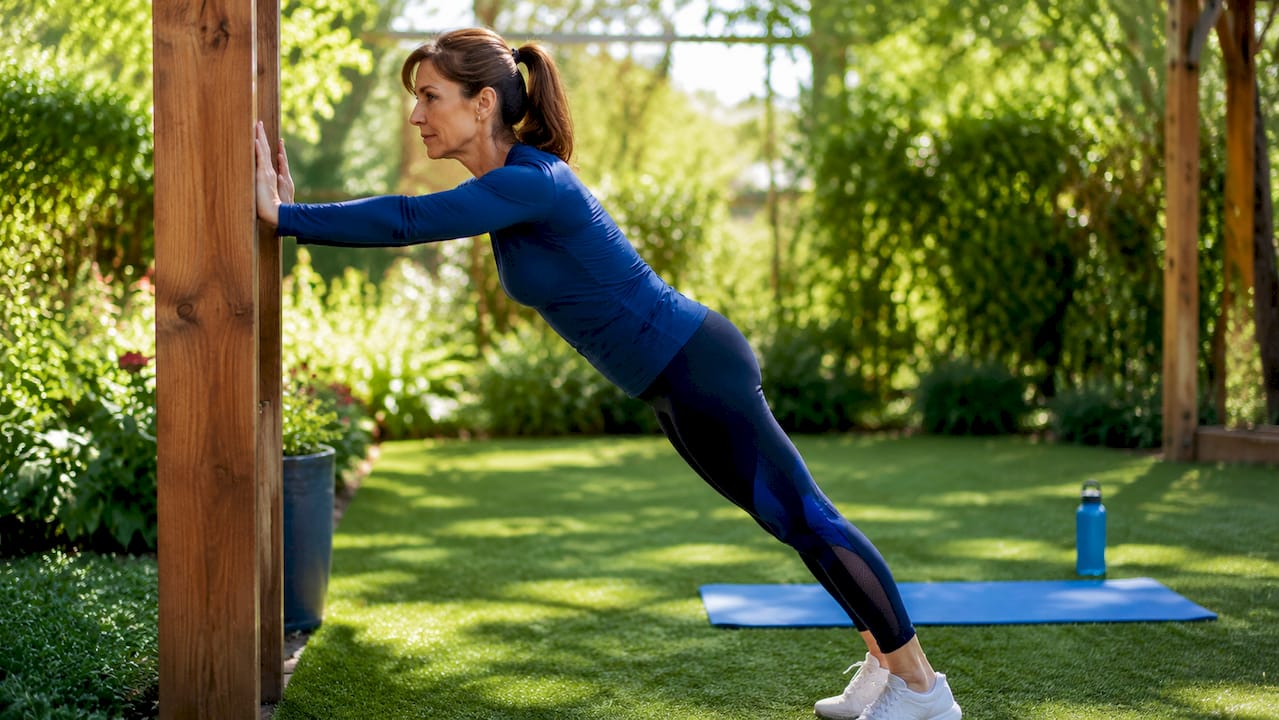
- Wall push-up. Stand facing a wall, place your hands at shoulder height, and push away. This builds chest, shoulder, and triceps strength with zero pressure on the floor. Start with 3 sets of 8 repetitions.
- Floor bridge. Lie on your back with knees bent, then press your hips toward the ceiling. This activates your glutes and lower back, two areas critical for posture and pain prevention. Do 3 sets of 12 repetitions.
- Standing calf raise. Stand near a wall for balance and rise onto your toes. This strengthens your lower legs and improves ankle stability. Try 3 sets of 15 repetitions.
- Dead bug. Lie on your back, arms pointing to the ceiling, knees bent at 90 degrees. Lower one arm and the opposite leg toward the floor, then return. This is one of the safest core exercises for beginners.
Functional movements like sitting and standing are the most effective starting point for women over 40. They reduce injury risk while building the coordination your body needs before any weight is added.
Pro Tip: Master every bodyweight movement with clean form before you pick up a single dumbbell. Two weeks of bodyweight-only training will make your first weighted session far safer and more productive.
2. How to progress beginner workouts safely with weights
The standard progression timeline is 2–4 weeks of bodyweight training before adding external resistance. After that, light dumbbells in the 5–15 lb range are the right starting point for most women over 40. Going heavier too soon is the most common mistake beginners make.
Once you are ready to add weight, these exercises build naturally on your bodyweight foundation:
- Dumbbell goblet squat. Hold one dumbbell at your chest and squat. This keeps your torso upright and teaches proper squat mechanics better than a barbell ever could for a beginner.
- Dumbbell bent-over row. Hinge forward at the hips, hold a dumbbell in each hand, and pull them toward your ribcage. This builds your upper back and counteracts the forward posture most people develop from sitting.
- Romanian deadlift. Hold dumbbells in front of your thighs and hinge at the hips while keeping your back flat. This trains your hamstrings and glutes through a full range of motion.
- Dumbbell shoulder press. Press dumbbells from shoulder height to overhead. This builds shoulder strength needed for reaching, lifting, and carrying.
Prioritizing technical competence over maximal effort during early weeks reduces injury risk and builds the movement patterns that support long-term progress. The weight on the dumbbell matters far less than the quality of the repetition.
Progressive overload does not require dramatic weight jumps. Adding reps, reducing rest time, or increasing weight in small increments are all valid ways to keep your body adapting. Each of these methods challenges your muscles without overwhelming your joints.
Pro Tip: Write down every workout. Record the exercise, sets, reps, and weight used. Tracking is the single most reliable way to implement progressive overload and see exactly when you are ready to progress.
3. How often and how long should beginners train?
A 3-day-per-week program with 45–60 minute sessions is the most effective structure for beginners. That frequency gives your muscles enough stimulus to grow while leaving adequate time for recovery between sessions.
A practical weekly schedule looks like this:
- Monday: Full-body strength session (45–60 minutes)
- Wednesday: Full-body strength session (45–60 minutes)
- Friday: Full-body strength session (45–60 minutes)
- Tuesday, Thursday, Saturday, Sunday: Rest or light walking
Rest days are not wasted days. Muscle repair and growth happen during recovery, not during the workout itself. Skipping rest days does not speed up results. It slows them down.
Delayed onset muscle soreness typically reduces after 2–3 weeks of consistent 3-day-per-week training. That initial soreness is normal and temporary. Pushing through it with consistent attendance is what separates people who build lasting strength from those who quit after two weeks.
A minimum 12-week program is necessary to build a real foundation. Twelve weeks gives your nervous system time to adapt, your muscles time to grow, and your habits time to solidify. Anything shorter produces results that disappear the moment you stop.
4. What are common myths about strength training for women over 40?
The biggest myth is that strength training requires complex machines or heavy weights. It does not. A chair, a wall, and your own bodyweight are enough to build meaningful strength in the first month. Complexity is not a sign of effectiveness.
Here are the most common misconceptions, and the facts that replace them:
- “I will bulk up.” Women over 40 have lower testosterone levels than men, making significant muscle bulk physiologically unlikely without years of dedicated effort and specific nutrition.
- “I need a gym.” Household items like water bottles or bags filled with goods substitute effectively for dumbbells. Strength training for beginners at home is fully achievable with minimal equipment.
- “I am not getting stronger yet.” Early strength gains are primarily neurological, not muscular. Your brain is learning to recruit muscle fibers more efficiently. Visible muscle change comes later, after the nervous system adapts.
- “I need to feel destroyed after every session.” Soreness is not a measure of workout quality. A well-designed beginner session leaves you tired but functional, not unable to walk the next day.
- “Form matters less when the weight is light.” Form matters most when the weight is light. That is when the movement pattern gets locked into your nervous system. Poor form practiced with light weight becomes dangerous form practiced with heavy weight.
Consistency beats intensity every time at the beginner stage. Showing up three times a week with good form and moderate effort produces better results than one brutal session followed by a week of recovery. A home workout plan for women over 40 built on these principles is more effective than any complicated program you cannot sustain.
Simple tracking tools, whether a notebook or a free app, keep you honest and motivated. Inconsistent training is a primary cause of early dropout, and tracking creates the accountability that prevents it. Knowing you lifted 8 lbs last week makes it easy to decide whether to try 10 lbs this week.
Key Takeaways
The most effective beginner strength workouts for women over 40 are built on functional bodyweight movements, consistent 3-day-per-week training, and patient progression from bodyweight to light dumbbells over a minimum 12-week program.
| Point | Details |
|---|---|
| Start with bodyweight | Master sit-to-stand squats, wall push-ups, and floor bridges before adding any weight. |
| Progress after 2–4 weeks | Move to 5–15 lb dumbbells only after bodyweight form is solid and consistent. |
| Train 3 days per week | Sessions of 45–60 minutes with rest days between provide the best stimulus-to-recovery ratio. |
| Commit to 12 weeks | Sustainable strength and habit formation require a minimum 12-week program. |
| Track every session | Recording reps, sets, and weights is the most reliable way to apply progressive overload. |
What I have learned training women over 40 in the Bronx
Most women who walk through the door at High Definition Training say the same thing: “I waited too long.” They spent years assuming strength training was for younger people, or for people who already knew what they were doing. That assumption costs real time and real health.
The fear of injury is the most common barrier I see. It is also the most misplaced one. The exercises that cause injury are the ones done with too much weight, too soon, with no attention to form. The sit-to-stand squat does not hurt anyone. The wall push-up does not hurt anyone. Starting simple is not a compromise. It is the correct strategy.
What surprises most women is how quickly they feel different. Not necessarily look different, but feel different. Climbing stairs gets easier. Carrying groceries feels lighter. That shift happens within the first few weeks, long before any visible muscle change. That early functional improvement is what keeps people coming back.
The women who make the most progress are not the ones who train the hardest. They are the ones who train the most consistently. Three sessions a week, every week, for three months. That is the formula. Professional guidance on sustainable fitness routines makes that consistency far easier to maintain because you are not guessing what to do next.
Strength training after 40 is not about chasing a younger body. It is about building a stronger, more capable version of the one you have right now. That is worth starting today.
— Angel
Strength training programs at High Definition Training
High Definition Training offers personalized strength training programs built specifically for women over 40 in the Throgs Neck and Pelham Bay areas of the Bronx. Every program starts with a fitness assessment, then builds a structured plan around your current ability, schedule, and goals.
Expert trainers at High Definition Training prioritize form and safe progression above all else. Sessions run 45–60 minutes, three days per week, matching the schedule that research confirms works best for beginners. If you are ready to start with a program designed for your body and your life, view available classes and take the first step toward building real, lasting strength.
FAQ
What are the best beginner strength exercises for women over 40?
The sit-to-stand squat, wall push-up, floor bridge, and dead bug are the best starting exercises. They build functional strength using movements your body already knows, with minimal injury risk.
How many days a week should a beginner do strength training?
Three days per week is the recommended frequency for beginners. Sessions of 45–60 minutes with rest days between each session provide enough stimulus for progress without overloading the body.
How long before beginners see results from strength training?
Functional improvements like easier stair climbing and better posture appear within 2–4 weeks. Visible muscle changes take longer, typically after 8–12 weeks of consistent training.
Do I need equipment to start strength training at home?
No equipment is needed for the first 2–4 weeks. After that, household items like water bottles or filled bags work as light resistance, and dumbbells in the 5–15 lb range are the recommended next step.
Why am I not getting stronger even though I am training consistently?
Early strength gains are neurological, not muscular. Your nervous system is learning to recruit muscle fibers more efficiently before visible muscle growth begins. Consistent practice over 4–8 weeks is what drives this adaptation.
Recommended
- Home Workout Plan for Women Over 40 That Works
- Strength Training for Career Women
- Why Professional Women Need Strength Training After 40
- Real Examples of Sustainable Fitness for Women Over 40
Ready to Build Real Strength?
Join our supportive community of women over 40 in the Bronx. Book your free No Sweat Intro today and let’s discuss how we can help you achieve your goals safely and effectively.