Progressive overload for women means gradually increasing the demands of strength training as your abilities improve. That can mean adding a little weight, completing more controlled repetitions, or improving your range of motion rather than making a large jump in weight.
For women over 40, the goal is a repeatable plan: choose a challenging starting point, protect your technique, track your workouts, and adjust your next step to your recovery. You do not have to lift the heaviest weight in the room. You need a clear way to recognize when you are ready for more.
This guide explains five ways to progress, how to choose your starting weights, and how to use a sample 12-week plan. It also covers how High Definition Training approaches individualized coaching for adults over 40 in Throgs Neck and Pelham Bay.
TL;DR:
- Progressive overload for women can involve small increases in weight, repetitions, or movement demands, with technique and recovery guiding the next step.
- Women over 40 should prioritize slower, conservative load increases, with attention to joint health and recovery, while maintaining consistency across weekly sessions.
- Track effort, form, and discomfort so you can recognize progress and adjust before technique breaks down.
- Adequate protein intake and proper energy balance are essential to support muscle repair and maximize strength gains.
- Hormonal changes influence training perception and recovery, but consistent progression remains effective for building muscle and strength at any age.
Table of Contents
- What Is Progressive Overload for Women, and Why Does It Work?
- 5 Ways to Apply Progressive Overload for Women
- How Do You Choose the Right Starting Weight and Rep Range?
- Progressive Overload for Women: A Sample 12-Week Plan
- Progressive Overload for Women Over 40: What Changes?
- Why Do Plateaus Happen, and How Do You Fix Them?
- How HDT Coaches Progressive Overload for Women
- How Do Hormones Affect Training Progression?
- What Should You Eat to Support Your Training?
- What Helps Women Stay Consistent With Training?
- Coaching Notes and Encouragement From Angel Perez
- Ready to Start Progressive Overload for Women With HDT?
- Sources
- FAQ
What Is Progressive Overload for Women, and Why Does It Work?
Muscle grows in response to mechanical tension. When you lift a weight that challenges your muscle fibers near the end of a set, you create microscopic stress that the body repairs by adding contractile protein, making the muscle slightly stronger and more resilient than before. Repeat that stimulus week after week, always nudging the demand up a notch, and you get a compounding effect. Skip the nudging and your body has no reason to change. That is the basic case for progressive overload in one paragraph, and it holds whether you are 28 or 68.
A 2026 randomized trial compared progressive and non-progressive training in young women over eight weeks.
What the eight-week trial reported: Triceps muscle thickness increased 22.9% in the progressive-training group, compared with 11.6% in the non-progressive group. These are results for a specific muscle measurement in the young women studied, not a promise that every woman will double her whole-body muscle growth. The finding should not be presented as a predicted result for women over 40.
That is not an isolated finding. A systematic review and meta-analysis pooling data from healthy young women found that resistance training reliably improves lean mass and strength, and that women who trained with higher weekly volume and more sets per muscle group tended to see larger hypertrophy gains than those who trained with less. Volume and progression are literally doing the heavy lifting here.
This matters for a specific reason: many women train hard but never progress the stimulus. They show up, do the same three sets of twelve with the same 15-pound dumbbells for months, and wonder why their arms look the same as they did in January. Effort without progression is just maintenance. The muscle adapted to that load a long time ago and has no incentive to change further. Progressive overload for women turns the focus from attendance alone toward a measurable training progression.
5 Ways to Apply Progressive Overload for Women
Adding weight to the bar is the most obvious lever, but it is not the only one, and leaning on it exclusively is how many women stall out or get hurt. You have at least five tools available, and the appropriate choice depends on your goal, movement quality, and recovery.
- Add load in small increments. Once every rep of your target set becomes manageable, add a modest amount of weight rather than jumping straight to the next dumbbell size up.
- Increase reps or sets. If you did three sets of eight last week, try three sets of ten this week, or add a fourth set. Weekly volume drives hypertrophy just as much as raw weight does.
- Slow the tempo down. A three-second lowering phase during a squat or row increases time under tension without changing the weight on the bar, which is a great option on days when your joints need a break from heavier loads.
- Extend your range of motion. Deepening a squat, using a fuller stretch on a lat pulldown, or switching from a partial push-up to a full one raises the difficulty without touching the weight rack.
- Reduce rest or restructure your sets. Shortening rest periods between sets or pairing two exercises as a superset increases the workout’s metabolic demand.
Coaching tip: Do not force a weight increase when a movement causes joint pain or your technique deteriorates. Adjust the exercise, load, or range of motion with appropriate guidance. Progressive overload for women should leave room for modification, not pressure to make every session harder.
Using more than one progression variable can help when a particular approach stalls. When straight weight increases stop feeling sustainable, most women assume they have hit a wall. Usually, they’ve exhausted one lever while ignoring four others sitting right there unused.
How Do You Choose the Right Starting Weight and Rep Range?
For progressive overload for women, start with what ACE Fitness calls the last-two-reps test: pick a weight that makes the final two or three repetitions of a set genuinely difficult to complete with good form, not a weight you could keep going with for another five reps. If you finish a set of twelve feeling like you could have done twelve more, the weight is too light to drive real adaptation.
Rep ranges should match your primary goal:
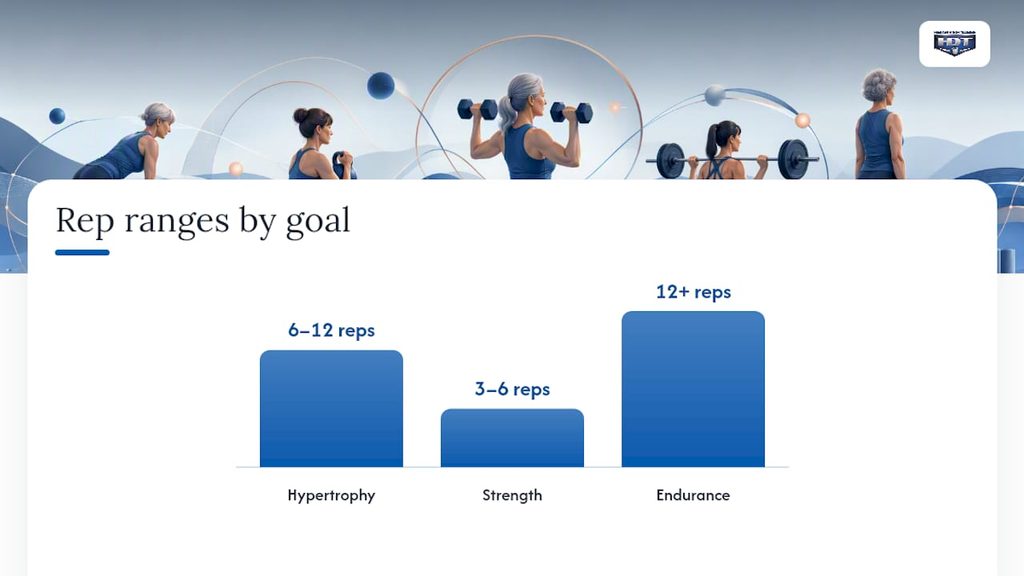
- Hypertrophy (building visible muscle): 6 to 12 reps per set, 3 to 4 sets, moderate to moderately heavy load.
- Strength (getting stronger, not necessarily bigger): 3 to 6 reps per set, 3 to 5 sets, heavier load and longer rest.
- Muscular endurance: 12 or more reps per set, lighter load, shorter rest between sets.
Consider increment size carefully. ACE Fitness recommends progressing load in roughly 5% jumps once you can complete all prescribed reps with room to spare. In practical terms, that usually means adding 1 to 2.5 pounds for upper-body movements like rows or shoulder presses, and 2.5 to 5 pounds for lower-body movements like squats or deadlifts, once your technique is solid at the current weight. Jumping straight from a 10-pound dumbbell to a 20-pound dumbbell because the 10 felt easy is how form breaks down.
For progressive overload for women, know when to add reps instead of weight. If your last set felt challenging but your form stayed controlled, another repetition may be the next step. Save the weight increase for when you reach the top of your chosen rep range across your working sets with reliable technique. A planned lighter week is another programming tool; its timing should reflect the person and the training block, rather than a requirement to progress on a fixed calendar.
Progressive Overload for Women: A Sample 12-Week Plan
A structured block gives you somewhere to aim instead of guessing week to week. This sample plan for progressive overload for women is a coaching template, not a research-tested protocol or an individualized prescription. It can be adapted to a gym or to suitable home equipment. Choose exercise variations and working weights that match your current ability, and adjust the timetable when your recovery or technique calls for it.
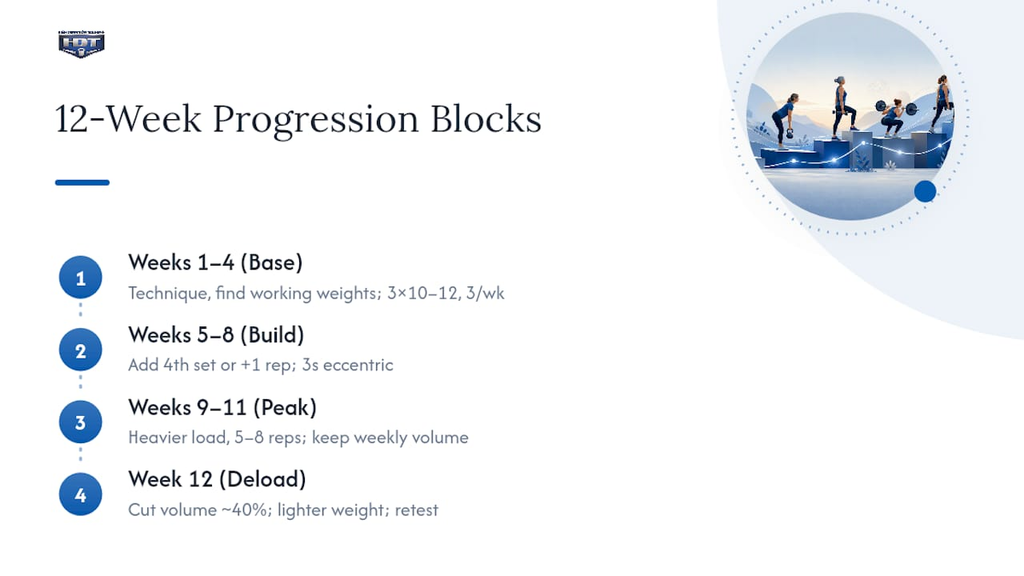
Weeks 1 to 4, the base block: Focus on technique and establishing your working weights. Three sessions a week, three compound lifts (squat, hinge, and press or pull pattern) plus two accessory movements, 3 sets of 10 to 12 reps. Your only job here is to nail form and find the weight that makes those last reps genuinely challenging.
Weeks 5 to 8, building tension and volume: Add a fourth set to your compound lifts, or add one rep per set every other week if recovery and technique support the change. A controlled three-second lowering phase on one lift can provide another progression to practice. This is the building phase of the sample template, not a research-established deadline for visible results.
Weeks 9 to 11, the peak block: Shift your compound lifts toward the lower end of your rep range (5 to 8 reps) at a heavier load, while keeping your total weekly volume roughly stable. This is the phase where strength gains typically become obvious.
Week 12: deload and reassess. Cut volume by about 40%, keep the same movements, and use lighter weights. Retest your working weights the following week to set your next block.
A sample session looks like this: 8 to 10 minutes of warm-up, including joint mobility work; three compound lifts; two accessory exercises targeting smaller muscle groups; then five minutes of cool-down stretching. At home, a goblet squat becomes a bodyweight squat with a slow three-count descent, a barbell row becomes a resistance band row anchored to a door, and a bench press becomes a push-up progression on an elevated surface. Our home workout plan for women over 40 explains these substitutions in more detail.
Progressive Overload for Women Over 40: What Changes?
Progressive overload for women over 40 still starts with the individual. Age alone does not establish your working weight or how quickly you must progress. Training history, movement quality, joint symptoms, and recovery all belong in the decision. The aim is to build a plan you can keep following, rather than force the same weekly weight increase on everyone.
The NSCA position statement on resistance training for older adults discusses resistance training as part of maintaining physical function with age. For the sample approach in this article, two to three weekly sessions are a practical starting framework to individualize, not a fixed prescription for every woman over 40.
Heavier loading is not automatically off the table after 40. The LIFTMOR randomized controlled trial studied supervised high-intensity resistance and impact training in postmenopausal women with low bone mass and reported improvements in bone mineral density and physical function. Its supervised setting matters: the study should not be used to suggest that every person with osteoporosis should begin heavy lifting or impact exercise independently. Our guide on starting strength training over 40 explains the introductory coaching approach.
A few practices make the biggest difference for recovery in this age group:
- Aim for roughly 0.7 to 1 gram of protein per pound of body weight daily to support muscle repair.
- Prioritize sleep. Tissue repair happens overnight, not during the workout itself.
- Plan lighter training periods when appropriate rather than waiting until fatigue has accumulated.
- Increase load more conservatively than reps or volume, since tendons take longer to catch up than muscle does.
When low bone density or a diagnosed injury affects your training, discuss exercise selection and progression with the relevant qualified professional.
Why Do Plateaus Happen, and How Do You Fix Them?
When reviewing progressive overload for women, look for three habits that may contribute to a plateau. First, the comfort-weight trap: sticking with a load that feels safe and familiar long after it has stopped being challenging. Second, progressing too fast, adding weight before your form is reliable at the current load, which stalls you out with an injury instead of a plateau. Third, not tracking anything, so you have no idea whether last week’s set was actually harder than this week’s.
The fix for all three is the same discipline: regress if form breaks down, fix the movement pattern, then progress again. Never push through a technique failure hoping strength will paper over it.
Learn to tell fatigue from injury. Muscle fatigue feels like a dull, generalized burn that eases within a day or two. A sharp, localized pain that lingers, or joint pain that shows up during movement itself, is a red flag: back off and modify, not push through.
- Log the exercise, weight, reps, and how the last two reps felt (easy, moderate, hard).
- Note any pain or discomfort by location, not just “it hurt.”
- Track your deload weeks in the same log so you can see patterns over months, not just weeks.
Coaching tip: A short training log makes progressive overload for women easier to evaluate. Record the load, repetitions, and how the set felt. Progress can happen without a log, but recording your sessions removes much of the guesswork from the next decision.
How HDT Coaches Progressive Overload for Women
Coaching progressive overload for women at High Definition Training starts by observing how a client actually moves, not by handing her a generic weight chart. Coaches establish a baseline squat, hinge, and press pattern, note any joint limitations, and use that to set starting loads that fit her body that day, not a formula pulled from a spreadsheet.
A coaching example is a client with knee discomfort who needs a different starting point for squatting. Rather than assuming that all squats must be avoided or that discomfort should be pushed through, the coach can assess an appropriate variation, such as a box squat at a comfortable depth. Movement control comes before increasing resistance. The same individualized logic applies when adapting pressing movements for shoulder limitations or introducing hip-hinge mechanics to a beginner. This is an illustration of the assessment process, not a treatment prescription for a diagnosed injury.
Progressive overload for women at High Definition Training is tracked using both strength and mobility metrics, not weight alone, and deload weeks are deliberately built into the schedule rather than left to chance. That structure lets you adjust recovery time between sessions for clients who need it, rather than running everyone through an identical weekly template regardless of how their joints respond.
How Do Hormones Affect Training Progression?
Menstrual symptoms can change how a workout feels, but progressive overload for women should not be tied to a universal rule about which cycle phase is best for increasing weight. A systematic review and meta-analysis of menstrual-cycle phase and exercise performance found small average differences, substantial variation between studies, and generally low-quality evidence. Its authors recommended a personalized approach rather than general cycle-based performance rules. Track your own symptoms, effort, and recovery, then adjust the session when necessary.
Menopause changes the picture more permanently. Declining estrogen is linked to faster loss of muscle mass and bone density, which is exactly why the LIFTMOR findings on supervised high-intensity training matter so much for this stage of life. Progressive overload for women remains relevant after menopause. If anything, the case for staying consistent with it gets stronger, since the muscle and bone you build now offset losses that would otherwise accelerate. The practical adjustment is patience: progression may need to happen a notch slower, and recovery windows may need to stretch a little longer, but the underlying method holds.
What Should You Eat to Support Your Training?
Progressive overload for women needs nutritional support, including protein for muscle repair. A commonly cited target for women actively strength training is somewhere around 0.7 to 1 gram of protein per pound of body weight per day, spread across meals rather than loaded into one sitting. Spreading it out, roughly 20 to 30 grams per meal, gives your body a steady supply for the repair process that happens for a day or two after each session.
Energy balance matters just as much as protein grams. Training in a significant calorie deficit while trying to build muscle sends your body mixed signals: it is being asked to build new tissue while running short on fuel. Women pursuing visible strength and muscle gains generally see better results eating at maintenance calories, or in a small surplus, rather than trying to lose fat and build muscle at the same time. If fat loss is the priority right now, a modest deficit is fine, but expect the muscle-building side of progressive overload for women to slow until you’re eating closer to maintenance.
Hydration and micronutrients, particularly iron and calcium given how common shortfalls are for women, round out the picture, but protein and total energy intake are the two levers that actually move the needle on whether your training translates into visible change.
What Helps Women Stay Consistent With Training?
One concern that can interfere with progressive overload for women is uncertainty about how training might change your body. Start with your actual goals rather than dismissing that concern. Agree with your coach on the outcomes to track, choose an appropriate plan, and use technique and effort to guide working weights. The aim is to make the next step understandable, not to make you feel judged for having questions.
Motivation can hold up better when it is tied to something measurable instead of something you feel. A woman who tracks that her squat went from an empty bar to 65 pounds over ten weeks has evidence her effort is working, even on a day the mirror is uncooperative. That is why logging sessions matters as much for morale as it does for programming; watching numbers move is often the difference between quitting in week six and continuing to train in month six.
A supportive training community can also help. Training alongside other women working through the same hesitations, the same “am I doing this right” moments, tends to normalize effort that might otherwise feel intimidating alone in a gym full of strangers. Our piece on why professional women need strength training after 40 digs further into the scheduling and confidence barriers that most often come up for busy clients.
Coaching Notes and Encouragement From Angel Perez
Progressive overload for women is not a contest to set a personal record every week. Show up, log your sets, and let manageable improvements build over time. Learning to trust the movement and the coaching process can be an important early step, even before the working weight changes.
Track your sessions. Prioritize form over the number on the plate every single time. And celebrate the small wins, the extra rep, the smoother squat depth, because those are the signals that the plan is working before the mirror catches up.
For a plan built around your current ability, joints, and schedule, work with a coach who can assess your starting point and explain the next step.
— Angel Perez
Ready to Start Progressive Overload for Women With HDT?
Reading about progressive overload for women and having someone assess your squat depth, your shoulder mobility, and your actual starting weight are two different things. High Definition Training’s 60-Day Transformation program is built specifically to address that gap: adults over 40 in Throgs Neck and Pelham Bay get a hands-on assessment first, then a progression plan built around what your joints can actually handle right now, not a generic template.
In your first 60 days, expect a movement assessment, a starting-weight baseline set using the same last-two-reps standard covered above, and a week-by-week progression through small-group or one-on-one coaching. Coaches track both strength numbers and mobility markers session to session, and schedule deload weeks deliberately, not by chance. The aim is progressive overload for women with an individualized plan, not pressure to increase weight before you are ready. If you are ready to stop guessing at your starting weight and want a coach to watch your form instead of a spreadsheet, check out current classes and programs to see what fits your schedule.
Sources
- PubMed — 2026 trial on progressive overload vs non-progressive training
- PubMed — Moderators of resistance training effects in healthy young women (systematic review & meta-analysis)
- ACE Fitness — A woman’s guide to gaining muscle with weight training
- NSCA – Resistance Training for Older Adults: Position Statement
- LIFTMOR randomized controlled trial
- Menstrual-cycle phase and exercise performance: systematic review and meta-analysis
FAQ
What Is the 3-3-3 Rule in the Gym?
The phrase “3-3-3 rule” is used in different ways, so ask which workout structure is being described rather than treating it as a universal standard. Progressive overload for women depends on an appropriate starting point and a planned progression, not on following a particular slogan.
How Many Times a Week Should a Woman Over 50 Strength Train?
Two to three sessions per week is the starting framework discussed in this article. Progressive overload for women over 50 should still be individualized around training experience, symptoms, exercise selection, and recovery rather than a fixed weekly number for everyone.
How Much Weight Should You Add for Progressive Overload?
For progressive overload for women, a common, practical guideline is adding roughly 1 to 2.5 pounds for upper-body exercises and 2.5 to 5 pounds for lower-body exercises once you can complete all prescribed reps with solid form, in line with ACE Fitness guidance on roughly 5% load increases.
What Is a Good Example of Progressive Overload for Women?
A simple example of progressive overload for women is completing 3 sets of 10 squats with 20 pounds, then using a small weight increase in a later session once the original load is manageable with controlled technique. Another option is keeping the weight the same and adding a repetition. Choose the change that fits the training goal; changes in sets, tempo, or range of motion are not automatically equivalent to each other.
Does Progressive Overload for Women Work Differently Than for Men?
The basic idea is the same: gradually adjust the training demand as the person adapts. Progressing your training does not require a separate universal rule for increasing weight. Training experience, goals, bone health, symptoms, and recovery help determine the appropriate progression. Those individual factors matter more than assuming that every woman needs the same program.