
TL;DR:
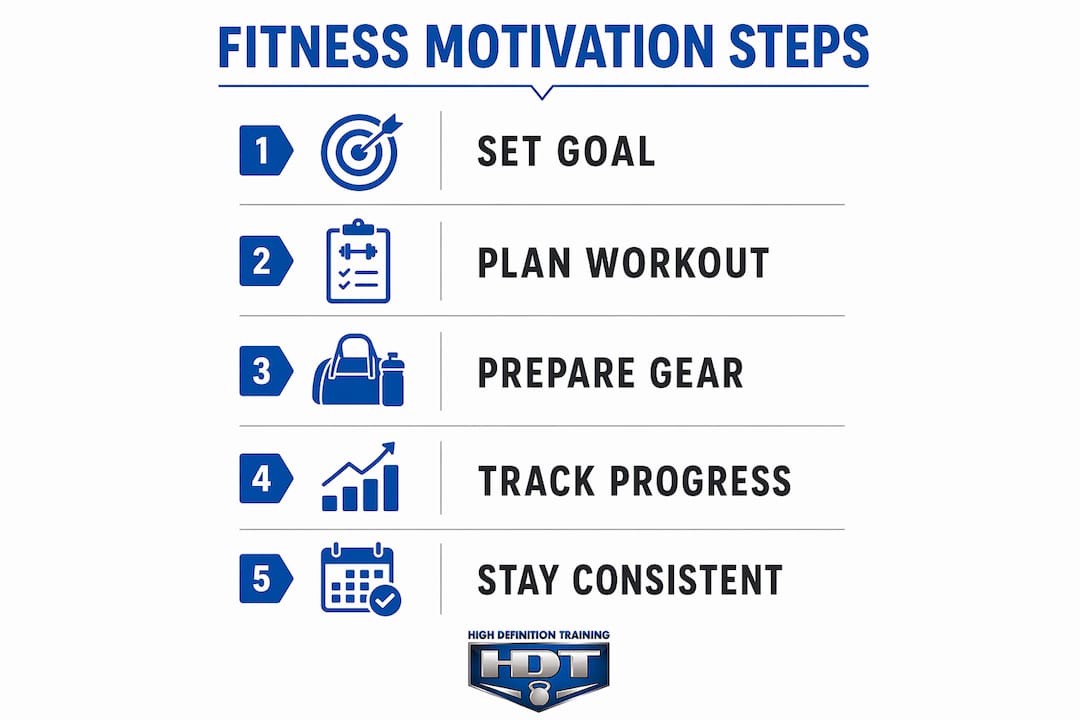
- The key to maintaining fitness after 40 is designing consistent systems that do not rely on motivation alone.
- Building structured routines, tracking progress, and adjusting volume are essential to overcoming biological and behavioral challenges.
The most reliable way to stay motivated with fitness over 40 is to stop relying on motivation entirely. Schedule two strength sessions and three 30-minute walks this week, lock them into your calendar like appointments, and tell one person about your plan. That’s it. That’s the system.
Start today — copy this checklist:
- Block two 30-minute strength sessions on your calendar (Tuesday and Thursday work well)
- Add three 30-minute walks on the remaining days (Monday, Wednesday, Friday)
- Lay out your workout clothes the night before each session
- Text a friend, trainer, or group chat: “I’m training Tuesday at 7 AM”
- Write one goal for the next four weeks — something specific and measurable
One-week micro-plan (copy either version):
| Day | Home version | Gym version |
|---|---|---|
| Monday | 30-min brisk walk | 30-min walk or light cardio |
| Tuesday | 20-min bodyweight strength | 30-min strength session |
| Wednesday | 30-min walk + stretching | 30-min walk |
| Thursday | 20-min bodyweight strength | 30-min strength session |
| Friday | 30-min walk | 30-min walk |
| Saturday | Active rest (yoga, light movement) | Active rest |
| Sunday | Full rest | Full rest |
Within four to six weeks of following this plan consistently, most women notice improved energy, better sleep, and measurable strength gains. That’s a realistic first milestone — not a complete body overhaul, but real, trackable progress.
Why does staying motivated get harder after 40?
The short answer: your body’s internal reward system for exercise changes, and it’s not your fault. Declining estrogen and progesterone directly reduce dopamine receptor sensitivity, which means the post-workout “feel good” signal that used to pull you back to the gym fires less reliably. Cortisol, the stress hormone, also becomes harder to regulate, so a tough workout that once left you energized can now leave you wiped out for two days.
Sarcopenia, the gradual loss of muscle mass that accelerates after 40, compounds the problem. You lose roughly 3–8% of muscle mass per decade after 30, and that loss speeds up after menopause. Less muscle means a slower metabolism, less functional strength, and a body that feels harder to move. The fix is resistance training, which is why every credible exercise guideline for midlife women puts strength work at the center.
Life context matters just as much as biology. Caregiving responsibilities, disrupted sleep, career pressure, and the general cognitive load of midlife all drain the mental energy that used to make lacing up your sneakers feel easy. These aren’t excuses — they’re design constraints. Understanding them tells you what to build around.
Physical activity drops by roughly 50% during the early menopause transition, according to longitudinal activity-monitor data from a University of Colorado study. That’s not a willpower failure. It’s a measurable physiological shift that requires a structural response.
The mindset shift that fitness requires after 40 isn’t about trying harder. It’s about designing smarter systems that work with your biology instead of against it.
Why consistency beats motivation and how to build it
Structure is the real driver of adherence after 40, not inspiration. When the internal dopamine reward for exercise becomes less reliable, external systems replace that reward. That means your calendar, your environment, and your social commitments do the motivating — not how you feel on a given Tuesday morning.
These tools actually work:
- Calendar blocking: Treat workouts as non-negotiable appointments. A session that isn’t scheduled doesn’t happen.
- The 5-minute rule: Commit only to starting. Put on your shoes and do five minutes. Stopping after five is allowed. You rarely stop.
- Default environment: Set your workout clothes out the night before. Remove the friction between waking up and starting.
- Visible tracking: A simple check-mark calendar on your fridge or a streak counter in a free app creates a tangible reward loop.
- Micro-goals: Score effort, not outcome. “I showed up and moved for 20 minutes” counts as a win.
Quick wins matter more than you might expect. Effort-based scoring — where you give yourself credit for showing up regardless of performance — keeps the reward loop intact on low-energy days. A week where you hit four out of five planned sessions is a success, not a failure.
Pro Tip: Combine calendar blocking with an activation protocol: the night before, set your clothes and shoes by the door, write the first exercise of your workout on a sticky note, and commit only to starting. This two-minute setup removes the biggest barrier — the decision to begin.

What does a sustainable weekly workout plan look like?
Two to three strength sessions per week, combined with two to three low-impact cardio sessions, is the sweet spot for most women over 40. More than that and recovery suffers; less and you lose the stimulus for muscle and bone adaptation.
Beginner template (weeks 1–4):
| Day | Session type | Duration | Focus |
|---|---|---|---|
| Monday | Walk | 30 min | Aerobic base, stress relief |
| Tuesday | Strength (home or gym) | 25–30 min | Full-body compound moves |
| Wednesday | Walk or rest | 30 min | Active recovery |
| Thursday | Strength (home or gym) | 25–30 min | Full-body compound moves |
| Friday | Walk | 30 min | Aerobic base |
| Saturday | Yoga or stretching | 20 min | Mobility, recovery |
| Sunday | Rest | — | Full recovery |
Intermediate template (weeks 5–12):
| Day | Session type | Duration | Focus |
|---|---|---|---|
| Monday | Strength | 40 min | Lower body + core |
| Tuesday | Walk or low-impact cardio | 30 min | Active recovery |
| Wednesday | Strength | 40 min | Upper body + core |
| Thursday | Walk or cycling | 30 min | Aerobic base |
| Friday | Strength | 40 min | Full body / power |
| Saturday | Yoga or mobility | 20–30 min | Recovery |
| Sunday | Rest | — | Full recovery |
A quick note on the 3-3-3 rule, which comes up often in gym discussions: it refers to training three days per week, three exercises per session, and three sets per exercise. For beginners over 40, it’s a reasonable starting framework — manageable volume, enough stimulus, and low injury risk. The intermediate template above builds on that base by adding a third strength day and increasing session length as your body adapts.
For home-based workout progressions that match these templates, the structure translates directly to bodyweight or resistance-band work with no equipment required.
Why strength training changes everything after 40
Strength training is the non-negotiable foundation for fitness after 40. Aerobic exercise alone won’t protect your muscle mass, your bone density, or your metabolism. A large cross-sectional study found that resistance training was associated with 56% lower odds of sarcopenia, while aerobic-only exercise showed no significant protective effect.
Beginner compound moves (home or gym):
- Squat: Bodyweight squat → goblet squat → barbell back squat
- Hip hinge: Glute bridge → Romanian deadlift → conventional deadlift
- Push: Wall push-up → incline push-up → floor push-up → dumbbell press
- Pull: Resistance band row → dumbbell row → cable row
- Core: Dead bug → plank → pallof press
Start with two sets of 10–12 reps per exercise. Add a third set in week three. Increase load by the smallest available increment when you can complete all reps with clean form. That’s the whole progression model for the first eight weeks.
For postmenopausal women, volume awareness matters more than intensity alone. A 20-week controlled trial found that postmenopausal women needed larger training volumes to achieve body-composition changes similar to those seen in premenopausal women. Practically, that means working toward multiple sets per muscle group per week over time, not just lifting heavier.
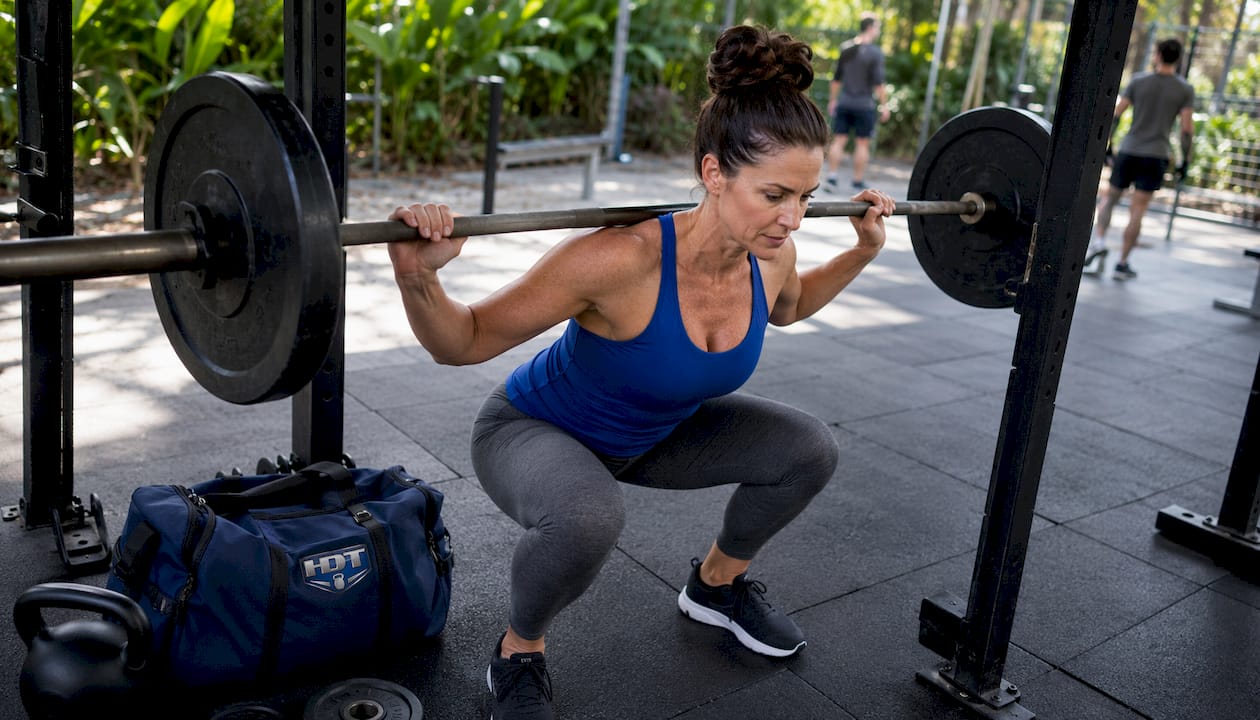
Safety first: learn the movement pattern before adding load. If a joint hurts (not muscle fatigue — actual joint pain), stop and consult a professional. Recovery windows of 48 hours between strength sessions for the same muscle group are standard for this age group. Movement quality and injury prevention are the two factors that determine whether you’re still training six months from now.
Pro Tip: Track your weekly sets per muscle group in a simple notebook or notes app. Aim to add one set per muscle group every two weeks rather than jumping in load. Gradual volume increases outperform sudden intensity spikes for postmenopausal clients.
What should you eat to support energy and training?
Protein and blood-sugar stability are the two nutrition levers that most directly affect training energy and recovery after 40. Prioritizing both doesn’t require a strict diet; it requires a few consistent habits.
Aim for roughly 20–25g of protein per meal, with a protein-containing snack or meal within two hours of your workout. Practical guidance recommends timed protein intake near training to support the anabolic response, which becomes less efficient with age. Good sources: Greek yogurt, eggs, cottage cheese, chicken, canned salmon, edamame, or a simple protein shake.
Quick meal and snack ideas:
- Pre-workout: banana + 2 tablespoons almond butter, or Greek yogurt with berries
- Post-workout: 2 scrambled eggs on whole-grain toast, or cottage cheese with fruit
- Lunch: large salad with grilled chicken, chickpeas, olive oil, and a boiled egg
- Dinner: salmon with roasted vegetables and quinoa
Blood-sugar stability means pairing carbohydrates with protein or fat at every meal, avoiding long gaps between eating, and limiting high-sugar snacks that spike and crash energy. You don’t need to count macros — notice whether your energy is steady or rollercoaster.
Vitamin D and calcium are commonly recommended for bone health in midlife women. Both are worth discussing with your doctor, especially if you live in a northern climate where sun exposure is limited. Don’t self-prescribe doses; get your levels checked first.
How do recovery and sleep affect your motivation?
Sleep is a training variable. Lose it, and your next-day activation drops sharply, not because you’re lazy, but because sleep deprivation directly reduces the neurochemical signals that make starting feel possible. Protecting sleep is as important as the workout itself.
Recovery checklist:
- Set a consistent sleep and wake time, even on weekends
- Get natural light within 30 minutes of waking (this anchors your circadian rhythm)
- Avoid screens for 30–60 minutes before bed
- Keep your bedroom cool and dark
- Add 10–15 minutes of daily non-exercise movement (walking, stretching) to reduce cortisol without taxing recovery
On high-stress or high-symptom days — hot flashes, poor sleep, joint stiffness — swap your strength session for a 20-minute walk or a gentle yoga flow. This isn’t skipping. It’s adaptive training. Showing up with a modified session keeps the habit intact and prevents the all-or-nothing spiral.
Working with a fitness coach for women over 40 is one of the simplest ways to stay consistent.
How do you choose the right accountability structure?
Choose the delivery model that matches your need for external structure. That’s the only real decision here.
Group training works best if you need a scheduled time, a social environment, and the mild social pressure of showing up when others expect you. The accountability is built in. The tradeoff is less individualization.
One-on-one coaching is the right choice if you have specific injuries, significant deconditioning, or need a program built entirely around your schedule and limitations. A good coach tracks your volume, adjusts your plan every few weeks, and catches form errors before they become injuries. The benefits of personalized training programs are most pronounced for women over 40 who have been out of training for a year or more.
When evaluating a coach or program, look for: NASM, ACE, or NSCA certification; demonstrated experience with midlife clients; a written progression plan; explicit recovery guidance; and a community component. For a direct comparison of delivery formats, private training versus group classes breaks down the tradeoffs in practical terms.
What’s the best way to restart after falling off?
Restart small and make it public. Those two moves do more than any motivational speech.
Seven-day micro-commitment (copy this):
- Day 1: Walk for 10 minutes. Text someone that you did it.
- Day 2: Walk for 15 minutes. Lay out your workout clothes for Day 3.
- Day 3: Do one set of five squats, five push-ups, five glute bridges. Done.
- Day 4: Walk 20 minutes.
- Day 5: Repeat Day 3 workout, add one more set.
- Day 6: Walk 20–30 minutes.
- Day 7: Rest and plan next week’s two strength sessions.
The all-or-nothing trap is the biggest obstacle to restarting. Missing one session doesn’t break a habit — deciding that missing one session means you’ve failed does. The behavioral research is clear: activation protocols and reduced friction are what get you back on track, not renewed willpower.
What does the research say about the midlife adherence gap?
The adherence gap in midlife fitness is behavioral, not a character flaw. That’s the core finding from sports-medicine and behavior-change research. Women over 40 don’t fall off their routines because they lack discipline — they fall off because the internal reward system that once drove exercise behavior becomes less reliable, and most programs aren’t designed to compensate for that.
Activity monitors in a University of Colorado study tracked a ~50% decline in spontaneous activity over the first 3–4 years of the menopause transition. That figure reframes the problem: the gap isn’t about effort, it’s about designing systems that don’t depend on spontaneous motivation.
Key Takeaways
| Point | Details |
|---|---|
| Habit over motivation | Schedule sessions like appointments and use the 5-minute rule to start on low-energy days. |
| Strength is non-negotiable | Resistance training is associated with 56% lower odds of sarcopenia; aerobic-only exercise showed no significant protective effect. |
| Volume awareness matters | Postmenopausal women often require more than 6–8 sets per muscle group per week to achieve body-composition changes. |
| Protect sleep | Sleep loss reduces next-day activation; consistent sleep timing and morning workouts support adherence. |
| High Definition Training | Offers 60-day transformation programs and small-group coaching in the Bronx, built specifically for women over 40. |
What actually works with clients over 40
The conventional wisdom says motivation is the problem. After working with women over 40 in the Bronx, the real pattern is different: motivation isn’t missing — it’s just unreliable. The clients who make the most consistent progress aren’t the ones who feel most fired up on day one. They’re the ones who show up on the days they don’t feel like it, because the structure makes showing up easier than not.
Strength and consistency, built for women over 40 in the Bronx
Women over 40 in Throgs Neck and Pelham Bay have a specific option that most fitness content doesn’t account for: a gym built entirely around their needs, not retrofitted for them.
High Definition Training
Offering a 60-Day Transformation program, small-group training, and one-on-one coaching designed specifically for adults over 40 in Throgs Neck and Pelham Bay.
FAQ
Why is it hard to stay fit after 40?
Declining estrogen reduces dopamine receptor sensitivity, which lowers the internal reward signal from exercise. Combined with life stressors like disrupted sleep and caregiving, this creates a measurable drop in spontaneous activity that requires external structure to overcome.
What is the 3-3-3 rule at the gym?
The 3-3-3 rule refers to training three days per week, performing three exercises per session, and completing three sets per exercise. It’s a practical starting framework for beginners over 40 that keeps volume manageable while building the habit.
How do I get my energy back in my 40s?
Consistent strength training two to three times per week, protein at every meal (roughly 20–25g), stable blood sugar, and a fixed sleep schedule are the four levers with the most direct impact on daily energy.
How many times a week should a woman over 40 go to the gym?
Two to three strength sessions per week, combined with two to three low-impact cardio or walking sessions, is the evidence-supported target.
Does High Definition Training work for women who haven’t exercised in years?
Yes. High Definition Training’s onboarding process is specifically designed for adults returning to fitness after a long break, with a pressure-free intro session, personalized programming, and hands-on coaching to ensure safe progression from the start.