Strength training for career women over 40 is a proven method to build muscle, increase bone density, boost metabolism, and sharpen mental resilience. This strength-training career women’s guide covers everything you need: the right equipment, how to structure your program, how to progress safely, and how to stay consistent when work gets overwhelming. The American College of Sports Medicine (ACSM) recognizes resistance training as one of the most effective interventions for women in midlife. You do not need hours in the gym or a perfect schedule. You need a plan built around your actual life.
What does a strength training career guide for women actually cover?
Strength training is the practice of using resistance, such as barbells, dumbbells, or bodyweight, to challenge your muscles and drive adaptation progressively. For women over 40, this is not optional fitness advice. It is a direct response to the physiological changes that come with perimenopause and beyond, including muscle loss, declining bone density, and a slower metabolism.
Women should aim for 2–3 strength sessions per week, 30–60 minutes each, to improve bone density and metabolism, with noticeable strength gains in 2–4 weeks. That frequency is achievable even with a demanding career, two kids, and a commute. The ACSM and Trainer Studio both confirm that two sessions per week is the minimum effective dose, with three sessions per week being the sweet spot for most women.
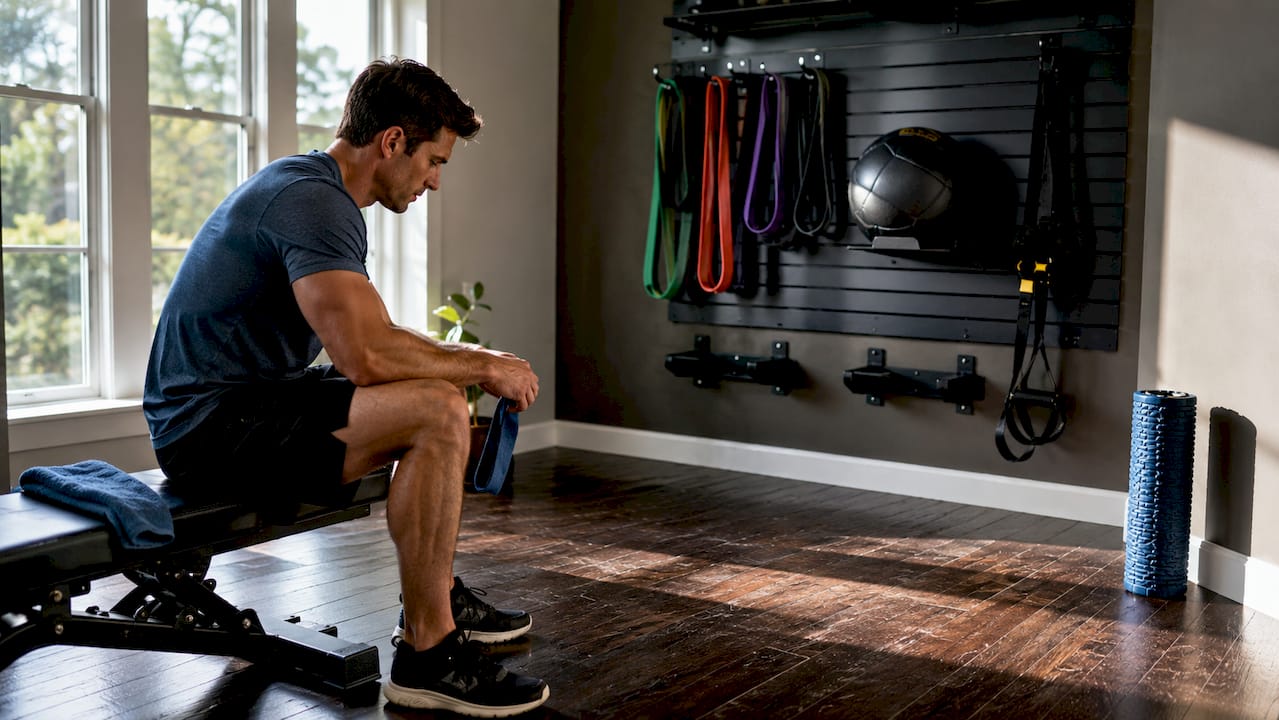
The mental benefits are just as real as the physical ones. Strength training builds what researchers at BizTech Weekly describe as “health capital”, a reserve of physical and mental grit that directly supports leadership performance in high-pressure jobs. Women who train consistently report better focus, lower anxiety, and stronger confidence in professional settings.
What equipment and mindset do you need to start?
The barrier to entry for strength training is lower than most people think. You do not need a fully equipped commercial gym to get strong.
Minimal equipment that works:
- Barbell and weight plates: The most effective tool for progressive overload on squats, deadlifts, and presses.
- Dumbbells: Versatile for unilateral work, accessory exercises, and home training.
- A bench: Needed for pressing movements and step-ups.
- Resistance bands: Useful for warm-ups, mobility work, and travel days.
- Body weight: Enough to start building movement patterns before adding load.
| Equipment | Best for | Space needed |
|---|---|---|
| Barbell set | Main compound lifts | Dedicated space |
| Dumbbells | Accessories, home use | Minimal |
| Resistance bands | Travel, warm-ups | None |
| Body weight | Beginners, travel | None |
The biggest myth holding women back is the fear of getting bulky. Building significant muscle mass requires a caloric surplus and hormonal profiles not typical for most women. Strength training primarily promotes body recomposition, increasing your muscle-to-fat ratio without dramatic size increases. That fear is not based on physiology.
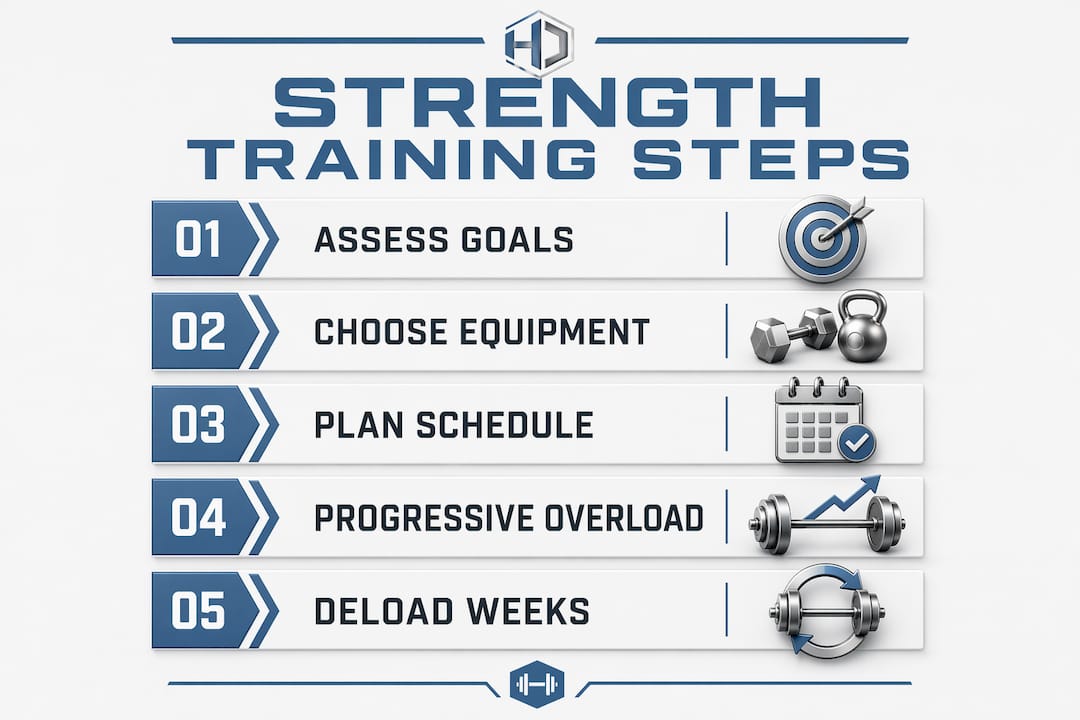
Pro Tip: Before your first session, learn three terms: progressive overload (adding challenge over time), RPE (Rate of Perceived Exertion, a 1–10 scale of effort), and reps in reserve (how many more reps you could have done). These three concepts will guide every workout decision you make.
How do you design a program that fits a busy career?
The most effective program for a career woman is not the most complex one. It is the one you will actually do.
Begin with a full-body routine focusing on four movement patterns that engage 8–10 major muscle groups: knee-dominant (squats, lunges), hip-dominant (deadlifts, hip thrusts), push (overhead press, bench press), and pull (rows, lat pulldowns). Vanderbilt Health confirms this approach is the most efficient way to train 2–3 days per week without leaving major muscle groups undertrained.
Here is how to structure each session:
- Warm-up (5–10 minutes): Light cardio, mobility drills, and activation work for glutes and core.
- Main lift (15–20 minutes): One primary compound movement, 3–4 sets of 5–8 reps.
- Secondary lift (10–15 minutes): A complementary pattern, 3 sets of 8–12 reps.
- Accessories (10–15 minutes): 2–3 isolation or stability exercises, 2–3 sets of 10–15 reps.
- Cool-down (5 minutes): Light stretching and breathing.
A 3-day minimalist program with 45–55-minute sessions suits busy professionals and accommodates missed sessions without disrupting the program. Peak Performance Supply designed this structure specifically for demanding schedules, built around compound lifts and progressive overload.
Pro Tip: Use a rolling structure instead of fixed days. Completing your three sessions within any 10-day window, rather than Monday, Wednesday, and Friday every week, removes the guilt of a missed day and keeps your program moving forward.
What are the best techniques and progression strategies?
Progression is the engine of strength training. Without it, you are just exercising. With it, you are building a stronger body every month.
Rep ranges that produce results:
- Main lifts (squat, deadlift, press, row): 5–12 reps per set, close to failure.
- Accessory exercises: 8–20 reps per set, moderate fatigue.
- Warm-up sets: 50–60% of working weight, never to failure.
Prioritize progressive overload with 5–12 reps for main lifts and 8–20 reps for accessories, challenging muscles near failure rather than light toning. This is the mechanism that counteracts muscle loss after 40. Light weights with high reps do not create the mechanical tension needed for adaptation.
Use RPE to guide your effort. Training at RPE 7–8, meaning you feel 1–3 reps left in the tank, produces consistent strength gains. Going lighter than that falls into what coaches call the “gray zone,” where effort is too low to drive adaptation but high enough to create fatigue.
| Progression method | How it works | When to use it |
|---|---|---|
| Load progression | Add weight to the bar | When you complete all reps with good form |
| Volume progression | Add a set | When load increases feel too large |
| Density progression | Do same work in less time | During busy weeks with shorter sessions |
A planned deload week every 4–6 weeks reduces volume and intensity by 40–50%, which is critical for recovery and new strength gains. Skipping deloads is one of the most common mistakes high-achieving women make. They push through fatigue and plateaus, then wonder why they stopped progressing. The deload is not a break from training. It is part of the training.
How do you stay consistent when life gets in the way?
Consistency is the only variable that guarantees long-term results. Perfect programming means nothing if you skip three weeks every time a work deadline hits.
Strategies that actually work:
- Protect two sessions per week as non-negotiable. Two sessions beat zero every time. Drop the third if needed, but never drop below two.
- Keep a travel kit. Resistance bands and a bodyweight circuit take 30 minutes and require no gym equipment.
- Schedule workouts like client meetings. Block them in your calendar with the same commitment.
- Adjust intensity, not frequency, during high-stress periods. Reduce your working weight by 20% and keep showing up.
A rolling workout structure over a 7–10-day window, rather than fixed weekly days, improves adherence for women with variable work schedules and prevents an all-or-nothing mindset. Missing Tuesday does not mean the week is ruined. You do Tuesday’s session on Thursday and keep moving.
“Consistency trumps perfect planning. Minimalist, short workouts performed regularly outperform skipped ideal sessions every time.” — Peak Performance Supply.
Reframe strength training as a professional tool, not a personal luxury. The physical discipline of training under load, recovering, and showing up again maps directly onto the mental discipline required in leadership. Women who train report sharper decision-making, better stress tolerance, and more confidence in high-stakes meetings. That is not a coincidence.
Key Takeaways
Strength training for career women over 40 works best when it is built around four movement patterns, trained 2–3 times per week, progressed intentionally, and protected from all-or-nothing thinking that derails busy professionals.
| Point | Details |
|---|---|
| Train 2–3 times per week | Two sessions is the minimum effective dose; three is the sweet spot for most women. |
| Use four movement patterns | Squat, hinge, push, and pull. Cover 8–10 major muscle groups efficiently. |
| Progress with intention | Add load, volume, or density over time. Never stay comfortable for more than two weeks. |
| Deload every 4–6 weeks | Reduce volume by 40–50% to recover and break through plateaus. |
| Use a rolling schedule | Complete sessions within a 10-day window to stay consistent despite unpredictable weeks. |
What I have learned training women over 40 in the Bronx
Most women who walk into a gym for the first time after 40 are not afraid of hard work. They are afraid of wasting time. They have careers, families, and responsibilities that do not pause for a missed workout. What I have seen at Highdefinitiontraining, working with women in Throgs Neck and Pelham Bay, is that the biggest shift is not physical. It is mental.
The women who make the most progress are not the ones with the most time. They are the ones who stop waiting for the perfect schedule and start training with what they have. A 40-minute session on a Wednesday night beats a skipped 90-minute session every single time. I have watched clients go from barely squatting body weight to pulling 135 pounds off the floor in under six months. Not because they had perfect genetics or unlimited time. Because they showed up consistently and added a little more weight every few weeks.
The myth I fight hardest is that strength training is something you earn the right to do once you are already fit. You do not need to lose weight first. You do not need to get in shape before you start lifting. The lifting is what gets you in shape. Start where you are. Add weight when you can. Rest when you need to. That is the whole program.
— Angel
How High Definition Training Can Help You Get Started
Career women in the Bronx do not need a generic gym membership. They need a program built around their schedule, their body, and their goals.
Highdefinitiontraining works with women over 40 in the Throgs Neck and Pelham Bay areas of the Bronx, offering personalized strength training programs designed for busy professionals. Every program is built around the four movement patterns covered in this guide, with flexible scheduling that fits real life. Whether you are brand new to lifting or returning after years away, the coaching at Highdefinitiontraining meets you exactly where you are and moves you forward from there.
FAQ
How often should women over 40 strength train each week?
Women over 40 should train 2–3 times per week, with sessions lasting 30–60 minutes. Two sessions per week is the minimum effective dose for improving bone density and metabolism.
Will strength training make women over 40 look bulky?
No. Building large muscle mass requires a caloric surplus and hormonal conditions not typical for most women. Strength training produces body recomposition, more muscle, and less fat, without significant size increases.
What is the best rep range for women new to strength training?
Use 5–12 reps for main compound lifts and 8–20 reps for accessory exercises. Both ranges should feel challenging near the end of each set, around RPE 7–8.
How do you maintain a strength training program during a busy work period?
Reduce working weight by 20% and protect at least two sessions per week. A rolling 10-day schedule removes the pressure of fixed training days and prevents missed sessions from derailing your program.
What is a deload week, and does it matter?
A deload week reduces training volume and intensity by 40–50% for one week every 4–6 weeks. It prevents burnout and allows your nervous system to recover so you can continue making strength gains.