Strength training for bone density after 40 starts with a plan, not a competition to lift the most weight. Heavy lifting means choosing resistance that is challenging for you and progressing as your technique and capacity improve. At High Definition Training, that principle guides our coaching for women over 40 who want real strength, not guesswork. This guide explains what the research shows, how to judge your working weights, and how to build a routine around your starting point.
TL;DR:
- Strength training for bone density should be progressive and individualized; beginners do not need to start with maximal or near-maximal loads.
- A supervised resistance-and-impact trial reported a 2.9% increase in lumbar-spine bone density; that is a study result, not a personal guarantee. Research source
- Building muscle takes consistent training. Getting stronger does not mean you will suddenly develop a physique you did not intend.
- Use a warm-up, controlled technique, and gradual progression. Modify exercises around your health history rather than pushing through symptoms.
- Track your strength and function over time. Pair training with adequate nutrition, sleep, and a plan you can repeat.
Table of Contents
- What Lifting Heavy Means in Strength Training for Bone Density
- Why Strength Training for Bone Density Matters After 40
- Will Lifting Heavy Make Me Bulky? Myths and Real Risks
- How Do You Know You’re Lifting Heavy Enough?
- Sample Programs for Strength Training for Bone Density
- Safety and Form Cues for Strength Training for Bone Density
- Recovery and Nutrition That Support Heavy Lifting
- What Progress Actually Looks Like Week to Week
- How High Definition Training Applies This for Women Over 40
- A Coach’s Honest Take on Lifting Heavy After 40
- Get Coached Progression With High Definition Training
- Sources
- FAQ
What Lifting Heavy Means in Strength Training for Bone Density
“Heavy” is relative to your current capacity, not to a number on a plate or a percentage of your body weight. Two women lifting the same proportion of their body weight are not necessarily working at the same relative intensity. Their experience, technique, and maximum strength can be very different.
For strength training for bone density, do not confuse one loading range with a universal prescription. Heavier loads are useful for developing maximal strength, but muscle growth can occur across a wider range of loads when sets are sufficiently challenging. A program may combine heavier, lower-repetition work with moderate-load sets of 6 to 12 reps, depending on your experience and goals. Loading research
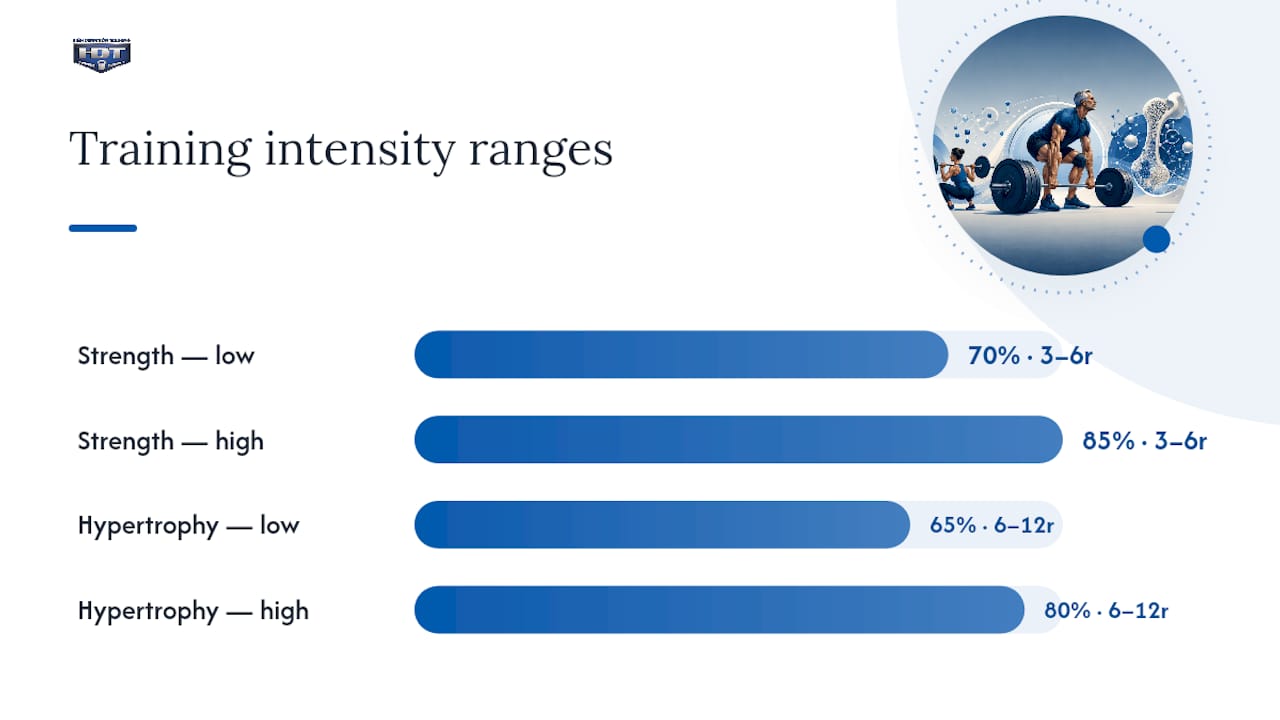
You do not need a barbell and a calculator to find a sensible starting weight. Ask whether you can complete the planned reps with control and how many more good reps you could do. For a challenging working set, a coach may use roughly 1 to 3 reps in reserve; beginners can leave more while learning. Strength training for bone density begins with appropriate loading, not exhaustion.
Progression should be small and deliberate. As a coaching example, an increase of 2.5 to 5 pounds on a lower-body exercise or 1 to 2.5 pounds on an upper-body exercise may be appropriate once all planned sets are controlled. These are options, not mandatory weekly increases; the starting load and your response matter.
Different exercises need different-sized increases. In strength training for bone density, choose the smallest practical step that preserves control rather than forcing the same jump on every lift.
A few practical rules make this easier to apply:
- If the smallest available increment is too large, use suitable fractional plates or adjustable equipment, or keep the same weight longer. Do not improvise an unstable setup.
- For paired dumbbell exercises, use matching weights unless your coach has deliberately prescribed an offset-loading exercise. Do not alternate mismatched dumbbells simply because the next pair feels too heavy.
- When you are not ready to add weight, build reps within the planned range. Once all sets reach the top with control, discuss a small load increase.
- Log every session. Memory lies; a notebook or app doesn’t.
For strength training for bone density, do not force a jump just because your gym lacks smaller increments. Repeat the current load or adjust the exercise with your coach. Slow progress with controlled technique beats rushing a weight you cannot manage.
Why Lifting Heavy Matters for Women’s Health and Aging
The single biggest reason to lift heavy after 40 has nothing to do with how you look. It’s what happens to your skeleton.
The LIFTMOR trial put postmenopausal women through eight months of heavy resistance training at 80 to 85% of 1RM and found something most cardio-based programs can’t touch: lumbar spine bone density increased 2.9%, and femoral neck density rose 1.8%, while the control group lost bone over the same period. That’s not a minor footnote. Bone loss after menopause is one of the clearest predictors of fracture risk later in life, and heavy loading is one of the few interventions that reverses the trend instead of just slowing it.
Heavy lifting is one of the few interventions shown to increase bone density in postmenopausal women rather than merely slow its decline — the LIFTMOR trial recorded lumbar spine gains of 2.9% over eight months in women training at 80 to 85% of 1RM.
Strength itself matters just as much as the bone underneath it. A review covering 38 studies on resistance training in older women found consistent improvements in muscle mass, strength, and functional fitness. This kind of strength lets you carry groceries up three flights or get off the floor without using your hands. That functional capacity is exactly what tends to erode with age, according to CDC data tracking declines in physical function, which makes resistance training less of a fitness trend and more of a preventive health strategy.
There’s a metabolic angle too. Research summarized by PoinT GO on lifting heavy for women points to improved insulin sensitivity in postmenopausal women who train with heavy loads, with some studies reporting reductions in fasting insulin. Add in the mental health lift that comes from watching yourself get objectively stronger week over week, and heavy lifting starts to look less like a gym choice and more like preventive medicine.
Will Lifting Heavy Make Me Bulky? Myths and Real Risks
Not automatically. Getting stronger and building some muscle are intended training outcomes; an unwanted bodybuilder-level appearance is not an inevitable result of picking up heavier weights.
Muscle development is gradual and individual. Your training volume, food intake, genetics, and consistency all influence what changes you notice. Strength training for bone density does not require making maximum muscle size your goal. Tell your coach what you want to improve, and use your progress reviews to keep the plan aligned with that goal.
Pregnancy, menopause symptoms, and a history of injury can change what is appropriate for an individual. During pregnancy, discuss your exercise plan with your obstetric care team. At any life stage, tell your coach about symptoms, recovery difficulties, and relevant medical advice before increasing your workload.
In my coaching, three avoidable habits deserve attention:
- Adding weight too soon: increasing the load before you can repeat the movement with control.
- Skipping preparation: jumping into working sets without first practicing the movement and building up to the planned load.
- Ignoring recovery: treating fatigue or worsening symptoms as something to push through rather than a reason to reassess.
For strength training for bone density, use the same practical habits: track your sessions, warm up, and schedule recovery as part of the program, not as an afterthought.
How Do You Know You’re Lifting Heavy Enough?
Three checkpoints can guide your working weight during strength training for bone density. None requires a fancy app, and none should override pain, dizziness, or medical restrictions.
- Quality cues. Your final reps can feel challenging, but keep the movement controlled. Stop the set when you can no longer maintain the technique your coach has established. A held breath is not proof that a set is effective.
- RPE or RIR. On a resistance-training RPE scale, effort ratings can help estimate reps in reserve. Roughly RPE 7 to 9 can correspond to 3 to 1 additional good reps. These are estimates, especially for beginners; lower-effort practice sets still have a purpose.
- Rep speed. Reps may slow as effort rises, but speed alone cannot tell you whether a load is useful or safe. Use it alongside technique, the planned task, and your own feedback.
Once those checkpoints are consistent, choose a progression method with your coach:
- Load progression: add a small amount when the current weight and target reps are consistently manageable, rather than increasing automatically every week.
- Double progression: stay at the same weight and add reps each session until you hit the top of your rep range across all sets, then increase the weight and drop back to the bottom of the range.
- Workload distribution: a coach may spread training across another day when appropriate. Adding a day also changes recovery demands; it is not an automatic solution to a plateau.
There is no single 10% rule or mandatory deload schedule that guarantees injury prevention. In strength training for bone density, review performance, symptoms, and recovery before deciding whether to increase, repeat, or reduce the workload.
Autoregulation means adjusting the planned session to how you are actually performing and feeling. Keep notes about sleep, stress, symptoms, and effort, including cycle-related symptoms when relevant to you. Use your own observations rather than assuming that every woman needs the same cycle-based schedule.
Pro Tip: Keep a simple effort-rating column next to your weight and reps. Review several weeks with your coach before drawing conclusions from one difficult day.
Sample Programs for Strength Training for Bone Density
You do not need a complicated spreadsheet to start. You need a repeatable plan and a way to decide when to progress. The examples below preserve the squat, hinge, push, pull, and core structure of a general strength routine; they are not the LIFTMOR protocol or an individualized osteoporosis treatment plan.
Beginner example: weeks 1 to 8, 2 to 3 nonconsecutive sessions per week. Begin with fewer sets or easier variations when needed. Strength training for bone density should match your assessment, not force you to complete every line immediately.
- Squat pattern (goblet squat or box squat): 3 sets of 8 to 10 reps
- Hip hinge (Romanian deadlift or hip thrust): 3 sets of 8 to 10 reps
- Push (dumbbell chest press or push-up variation): 3 sets of 8 to 10 reps
- Pull (seated row or lat pulldown): 3 sets of 8 to 10 reps.
- Core (plank or dead bug): 2 controlled sets; stop before you lose position or breathing control.
Use a small load increase only after the top of the rep range is consistently controlled. In strength training for bone density, repeating a successful week can be more useful than rushing the next weight. For more on getting started, read our beginner strength workout guide.
Optional next block: weeks 9 to 16. Progress to this only when your training history and assessment support it; completing eight weeks does not automatically make someone an intermediate lifter.
- Weeks 9 to 11: emphasize strength, using sets of 4 to 6 controlled reps at a suitable effort.
- Weeks 12 to 14: emphasize moderate-load work, using sets of 8 to 12 controlled reps.
- Week 15: use a lighter week if needed; reducing sets by roughly 40% is one possible coaching adjustment, not a required formula.
- Week 16: review working weights, technique, and recovery before planning the next block. A maximal lift is not required.
Individual adjustments for women over 40:
- Use a brief movement-specific warm-up, then lighter practice sets before your working sets. Add mobility work where the assessment identifies a need.
- Let technique, symptoms, and recovery determine the rate of progression rather than your birthday or a fixed weekly rule.
- Use single-limb accessories, such as supported split squats or single-arm rows, when they suit your needs and ability.
- Rest until you can repeat the next set with control. Challenging compound lifts may require longer breaks than lighter accessory work.
When equipment is limited, discuss suitable alternatives rather than abandoning the routine. Our home workout plan for women over 40 offers another starting point. Keep the same principle for strength training for bone density: match the exercise and progression to the person.
Safety and Form Cues for Strength Training for Bone Density
Learn a bracing and breathing strategy that fits your movement and health history. Do not assume that straining harder protects your spine or pelvic floor. Stop or modify a lift if it produces leaking, pelvic pressure, or pain, and discuss persistent symptoms with a healthcare professional or pelvic-health physical therapist. Bladder-control symptoms
For strength training for bone density, these are starting cues to discuss with your coach, not a remote assessment of your form:
- Squat: use a stable foot position, let the knees track comfortably with the feet, and choose a depth you can control.
- Hip hinge: move from the hips and keep the load close while maintaining the trunk position you have practiced.
- Overhead press: use a comfortable range without forcing the movement or compensating through your lower back.
A box squat, landmine press, or chest-supported row may provide a useful alternative for some people, but no variation automatically fixes knee, shoulder, or back pain. Known osteoporosis or vertebral fractures require particular care with exercise choice and spinal loading. Osteoporosis exercise guidance supports individualized adaptations. Our posture guide discusses another part of movement coaching.
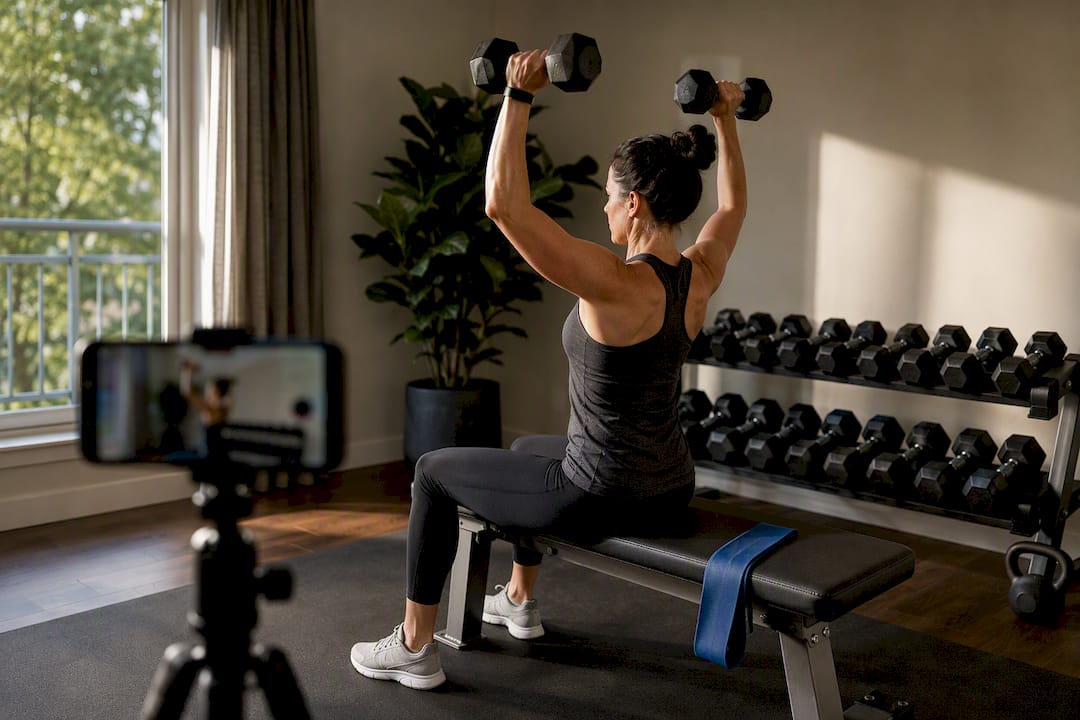
Pro Tip: With your coach’s guidance, film a working set from a useful angle and review it together. Video can support feedback, but it does not replace an assessment or diagnose an injury.
Recovery and Nutrition That Support Heavy Lifting
Training provides a stimulus; recovery supports your ability to return and train well again. My coaching advice for strength training for bone density is to plan meals, rest days, and sleep with the same intention you bring to your sessions.
Protein supports muscle adaptation to resistance training. A large meta-analysis in healthy adults found no further average increase in fat-free-mass gains beyond about 1.6 grams per kilogram per day. For a 150-pound woman, that is approximately 109 grams daily. It is a reference point, not a prescription for everyone; discuss individual needs and relevant medical conditions with a dietitian or clinician.
Sleep is another practical priority. CDC guidance recommends at least seven hours for adults aged 18 to 60, with age-specific ranges thereafter. Aim for enough good-quality sleep rather than treating a short night as something to compensate for with more training.
- Protect a regular opportunity for adequate sleep, particularly around demanding training days.
- Keep a consistent sleep and wake schedule where possible.
- Tell your coach about a difficult sleep week so the session can be adjusted when needed.
When fat loss is also a goal, discuss how your food intake and training workload fit together. Keep strength training for bone density focused on a sustainable routine rather than using every session to chase calorie burn. If performance or recovery deteriorates, review the plan instead of automatically pushing harder.
What Progress Actually Looks Like Week to Week
Your first signs of progress may be cleaner movement, better confidence, or more reps at a familiar weight. Visible changes vary, so avoid treating a fixed two-, six-, or twelve-week deadline as a promise. In strength training for bone density, gym performance and bone-density measurements are different outcomes: a lifting personal record does not prove that your bone density has increased.
Track progress with more than the scale:
- Rep personal records at a given weight (more reps at the same load means real strength gain)
- A periodic review of working weights; estimated strength measures may be useful without requiring a maximal attempt.
- Functional tests, like how many unassisted sit-to-stands you can do in 30 seconds
- A written training log showing weight, reps, and RPE over time
Non-scale wins count too. Record changes in everyday tasks, confidence, and how you feel, without assuming every benefit will appear for every person. Your healthcare professional can advise on bone-health assessment and when repeat measurements are appropriate.
How High Definition Training Applies This for Women Over 40
At High Definition Training, strength training for bone density starts with a conversation and movement assessment, not a competition with the person beside you. We review your training history, goals, movement, and relevant joint or medical concerns before choosing a starting point. Medical restrictions and bone-health advice belong in that discussion.
Programming from there is individualized:
- Clients managing knee discomfort may use a box squat or a comfortable range, depending on assessment and appropriate medical guidance.
- Beginners can practice the hip-hinge pattern with body weight and light loads before progressing.
- Pressing variations, including landmine, half-kneeling, or banded work, are selected according to the person rather than assumed to suit every shoulder.
- Starting weights come from the assessment, not a guess, and get logged so progress is measurable session to session.
- Some clients need more recovery between sessions than others, and programming adjusts rest days accordingly, rather than forcing a fixed schedule.
Our guide to starting strength training over 40 explains the importance of building a foundation. To discuss whether the 60-Day Transformation Program fits your wider goals, contact High Definition Training. It is not presented here as a bone-density treatment or as equivalent to the research trial.
A Coach’s Honest Take on Lifting Heavy After 40
My message to women in our Bronx studio is simple: do not judge your potential by how much you lift in week one. For strength training for bone density, I want a routine you can repeat, technique you understand, and a sensible reason for every increase. Showing up consistently matters more than proving something on your first day.
Being over 40 is not a reason to write yourself off. It is a reason to be intentional about how you train. Start with what is appropriate today, ask for support when you need it, and give yourself credit for progress that goes beyond appearance.
Start strength training for bone density where your body is today, not where you think it should be.
— Angel Perez
Get Coached Progression With High Definition Training
You do not have to figure out strength training for bone density from articles and videos alone. High Definition Training offers hands-on coaching, a movement assessment, and a plan that can be adjusted as you build experience. We focus on helping you understand your exercises and your next step, rather than leaving you to guess.
Talk with High Definition Training about your goals
Our small-group and personal training sessions serve women in Throgs Neck and Pelham Bay. The starting conversation is pressure-free, whether you are new to weights or returning after time away. Ready to explore strength training for bone density with a plan built around you? Contact High Definition Training to arrange your assessment, or explore our training options.
Sources
- Watson et al. (2018). LIFTMOR randomized controlled trial
- Schoenfeld et al. (2021). Loading recommendations for strength and hypertrophy
- Brooke-Wavell et al. (2022). Exercise and physical activity for osteoporosis
- NIH/NIAMS. Exercise for Your Bone Health
- CDC/NCHS. Physical Activity Among Adults Aged 18 and Over: United States, 2020
- Morton et al. (2018). Protein supplementation and resistance-training adaptations
- CDC. About Sleep
- NIDDK. Symptoms and Causes of Bladder Control Problems
FAQ
How Heavy Should Strength Training for Bone Density Be?
It depends on your health history, experience, and the exercise. The closely supervised LIFTMOR trial used high loads in selected postmenopausal women, but that does not make its loading prescription suitable for every beginner. Start with an assessment and progress individually. Exercise guidance
Is 50 Pounds Heavy for a Woman to Lift?
It depends on the lift and your training history. Fifty pounds might be manageable for one exercise and too demanding for another. In strength training for bone density, relative effort, technique, and medical considerations matter more than the number alone.
Is 40 Pounds Heavy to Lift for a Woman?
Forty pounds can feel very different in a squat and an overhead press. Judge the planned exercise by your control and effort, not by whether a number sounds impressive.
What’s the Heaviest Weight a Woman Can Lift?
There is no single useful number for everyone. Your appropriate working weights depend on the lift, experience, health, and current capacity. A maximum-weight challenge is not the goal of this guide.
Do I Need Experience Before Lifting Heavy?
You do not need years of experience to begin strength training for bone density, but you do need an appropriate starting point. Practice the squat, hinge, push, and pull patterns before making them demanding. A coached assessment helps guide exercise selection; known osteoporosis, fractures, or concerning symptoms may also require clinical advice.
Recommended
- How to Start Strength Training over 40: Women’s Guide
- Beginner Strength Workouts for Women Over 40: A Guide
- Types of Strength Training for Longevity: Women Over 40
- Home Workout Plan for Women Over 40 That Works
This article is general education, not an individual exercise prescription or a substitute for osteoporosis care. Discuss relevant diagnoses, previous fractures, pregnancy, or concerning symptoms with your healthcare professional.