You slept four broken hours. The hot flashes were back, or work kept you up, or your mind simply would not switch off. Now it is session day and you are wondering whether to train, push through or stay home.
For adults over 40, and especially women in perimenopause and menopause, this is not an occasional problem. Sleep disruption is common during the menopausal transition (and closely tied to menopause metabolism), and short or poor sleep can reduce how strong you feel and how hard an effort seems. The answer is rarely “skip it” or “push through.” It is usually “adjust it.” Strength training when tired can still be productive. Here is how we do that at High Definition Training.
Want a coach who adjusts to how you feel on the day? Call HIGH DEFINITION TRAINING at (917) 432-9418 to get started.
Why a Bad Night Changes Your Workout
Strength training when tired is not the same as training on a good day. Research on sleep and strength suggests that inadequate sleep tends to affect how hard exercise feels and your capacity for demanding, repeated efforts more than your ability to produce one short, strong effort. In practice, that means:
- Weights you lifted easily last week may feel heavier
- Your concentration and coordination may dip, so technique slips sooner
- Long, grinding sets and intense conditioning feel much harder than usual
- Your mood and motivation may be lower before you even start
None of this means the session is wasted. It means the session plan should match the body that showed up today.
Step 1: A Quick Readiness Check
Smart strength training when tired starts with information. At the start of the session, your coach asks a few simple questions:
- How many hours did you sleep, and how well?
- On a scale of 1–10, how is your energy right now?
- Is anything sore, stiff or painful beyond normal?
- How stressful has the last day or two been?
- Have you eaten and had water today?
Then the warm-up gives more information. If movements loosen up and you start to feel better, that is a good sign. If everything feels heavy and uncoordinated after ten minutes, we adjust further.
Step 2: Choose One of Three Session Options
Based on your answers, your coach picks one of three approaches to strength training when tired:
Option A – Train as Planned
Energy is decent after the warm-up. You complete the planned session, with the coach watching technique closely in the later sets.
Option B – Train, but Lighter
You are tired but able to train. We keep the same exercises so the habit and movement practice continue, but adjust the dose:
- Reduce the load by roughly 10–20%, or keep the load and cut a set
- Leave more reps “in the tank,” ending sets well before failure
- Lengthen rest periods between sets
- Replace demanding conditioning with steady, moderate work or a longer cool-down
- Avoid trying for a personal best
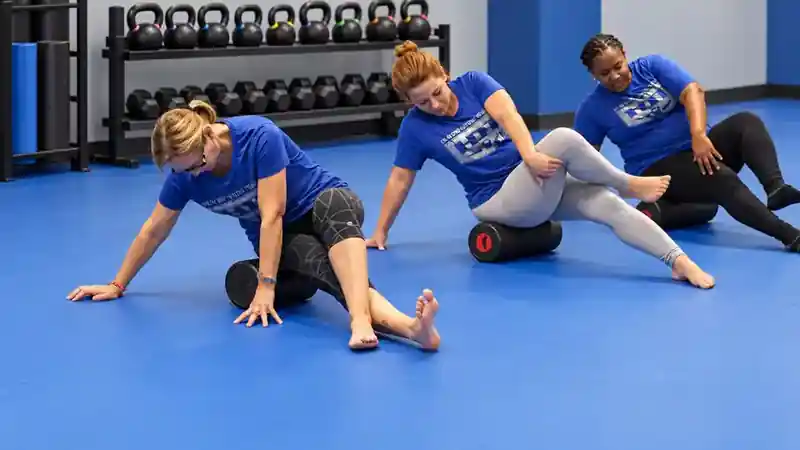
Option C – Swap to a Recovery Session
You are exhausted, unwell or in pain. The session becomes a mobility session, light technique practice, easy walking or cycling, and breathing work. You still show up, still move, and still keep your routine, without adding stress your body cannot absorb today.
Why We Rarely Just Cancel
Strength training when tired keeps the routine alive. Consistency is what produces results over months, and your routine is easier to protect than to rebuild. A lighter session keeps the habit alive, maintains your movement practice and often improves energy and mood. Many people leave an adjusted session feeling better than when they arrived.
When rest is the right call: stay home and rest if you have a fever, an illness below the neck (chest congestion, body aches), dizziness, chest pain, or new pain you cannot explain, and speak with your doctor about anything that worries you.
Adjusting for Menopause-Related Sleep and Energy Changes
When poor sleep becomes a pattern rather than a one-off, we look at the whole week, not just one session:
- Session timing: some members feel better training in the morning; others need the evening. Our schedule has both.
- Weekly structure: keeping the hardest session on the day you typically feel best.
- Recovery between sessions: at least one rest or easy day between demanding strength sessions.
- Daily habits: regular wake time, daylight exposure, limiting late caffeine and alcohol, and enough protein across the day.
- Medical support: persistent insomnia, night sweats or fatigue deserve a conversation with your doctor. Exercise supports health, but it is not a treatment for every symptom.
How Tired Days Fit Long-Term Progress
Strength training when tired is a skill, not a failure. Progress is built from the average of many weeks, not from any single session. A plan that bends on tired days and pushes on good days produces steadier long-term results than one that demands peak effort every time. That is the idea behind progressive overload done well: increase the challenge when your body is ready, hold steady when it is not.
Which HDT Program Fits Weeks When Energy Is Unpredictable?
Every HDT program adjusts sessions to how you feel on the day, so strength training when tired is built into the plan. If low energy, poor sleep or menopause symptoms are a regular part of your life, the format you choose can make adjusting even easier:
- 60-Day Transformation ($700 for the 60-day program): the starting point for first-time clients aged 40 and over, combining training, nutrition guidance and accountability while we learn how your body responds to training.
- Semi-private training (starting at $440): an individual plan with individualized coaching for up to six clients per appointment. Sessions run 40–60 minutes, which makes it easy to swap in a lighter or recovery-focused session.
- Small group training ($279 per month): coach-led 45-minute sessions capped at 12 participants, available as ongoing training after you complete the 60-Day Transformation. Loads and exercise options are scaled to each person.
- One-on-one training (starting at $600): private sessions with a fully individualized plan, ideal if an injury history or specific goals call for the highest level of attention.
- Hybrid or online coaching (starting at $300): programming and accountability for training in person and at home, useful when travel or a changing schedule makes fixed session times hard.
- Nutrition coaching ($300): habit-based support focused on sustainable eating, helping you align your nutrition with your training and long-term goals.
All prices are subject to change.
Frequently Asked Questions
Q: Should I work out if I slept badly?
A: Usually yes, at a lower intensity. Lighter loads, fewer sets and no all-out efforts keep your routine going without overloading a tired body. Rest instead if you are ill, dizzy or in unusual pain.
Q: Can strength training help me sleep better?
A: Regular physical activity is linked with better sleep for many adults, but the effect varies. Avoid very intense training close to bedtime if you notice it keeps you awake.
Q: How do I know if I’m overtraining or just tired?
A: One bad night is tiredness. Weeks of declining performance, persistent soreness, irritability and poor sleep suggest your total load is too high, and your coach should reduce it.
Q: Is menopause fatigue a reason to stop training?
A: No, but it is a reason to adjust training. Strength training remains one of the most valuable habits for women in midlife.
Q: Can I pause or cancel if a tough stretch makes training hard?
A: Your coach will adjust your sessions first, so a hard week rarely means stopping. If you do need to stop, the 60-Day Transformation Program is a 60-day commitment with no refunds or cancellations once it begins. All other programs are month-to-month, with 30 days’ advance notice required for cancellation.
Train With a Coach Who Adjusts
At High Definition Training, every session starts with how you feel today, which makes strength training when tired safer and more productive. Book your complimentary assessment in Throgs Neck. Once you are booked, you will receive a text confirming your appointment with the studio address and directions. Please arrive at least 10 minutes early so we can review a few details and introduce you to the team.
Call (917) 432-9418 today to speak with HIGH DEFINITION TRAINING about training that works with your energy, not against it.
Sources
- Knowles OE, Drinkwater EJ, Urwin CS, Lamon S, Aisbett B. Inadequate sleep and muscle strength: Implications for resistance training. Journal of Science and Medicine in Sport, 2018.
- Baker FC, de Zambotti M, Colrain IM, Bei B. Sleep problems during the menopausal transition: prevalence, impact, and management challenges. Nature and Science of Sleep, 2018.
- Centers for Disease Control and Prevention. Adult Activity: An Overview.