

Reduce Joint Pain in 60 Days With Strength Training for Arthritis
Strength training for arthritis can be one of the most effective ways for adults over 40 to build stronger muscles, support painful joints, improve mobility, and maintain independence.
If arthritis has made you hesitant to lift weights because you are worried about making your joint pain worse, the good news is that controlled resistance training can often do the opposite.
Stronger muscles help support the joints around them, while gradual, properly programmed resistance training can make everyday activities like walking, climbing stairs, getting out of a chair, and carrying groceries feel easier.
Most adults with arthritis can and should strength train, with a general goal of resistance training at least twice per week alongside regular aerobic activity.
Joints that ache on bad days can often tolerate and even benefit from controlled loading on better days. The important exception is during an active flare, when you should scale back exercise and replace it with gentler movement until swelling and sharp pain settle.
This guide explains how to approach strength training for arthritis safely, recognize the difference between normal muscle soreness and an arthritis flare, choose joint-friendly exercises, and build strength progressively over 60 days.
TL;DR:
- Strength training at least twice a week helps support joint stability and reduce the risk of knee pain and structural osteoarthritis over time.
- During flare days, switching to gentle exercises like isometric holds, water workouts, or low-resistance cycling prevents aggravating joint inflammation.
- Starting with light resistance, focusing on control, and progressing gradually by 10-20% minimizes the risk of triggering pain or flare-ups.
- Exercises should be tailored to individual joint needs, emphasizing limited range movements and avoiding deep, fast repetitions for affected areas.
- Supervised programs are recommended if recovering from joint surgery, experiencing instability, or persistent inflammation to ensure safe, effective progression.
Table of Contents
- Why strength training helps arthritis: mechanisms and clinical evidence
- Telling normal soreness from a dangerous flare
- How to start: program design, frequency, and progression
- Practical exercise examples and arthritis-friendly variations
- Modifying for specific diagnoses: OA, RA, and common joint issues
- When to seek supervised care and what it provides
- Fitting strength work around aerobic and flexibility training
- How these principles look in a real coaching setting
- A trainer’s perspective on realistic expectations with arthritis
- How High Definition Training supports safe strength training for arthritis
- FAQ
- Sources
Why Strength Training for Arthritis Helps Reduce Joint Pain
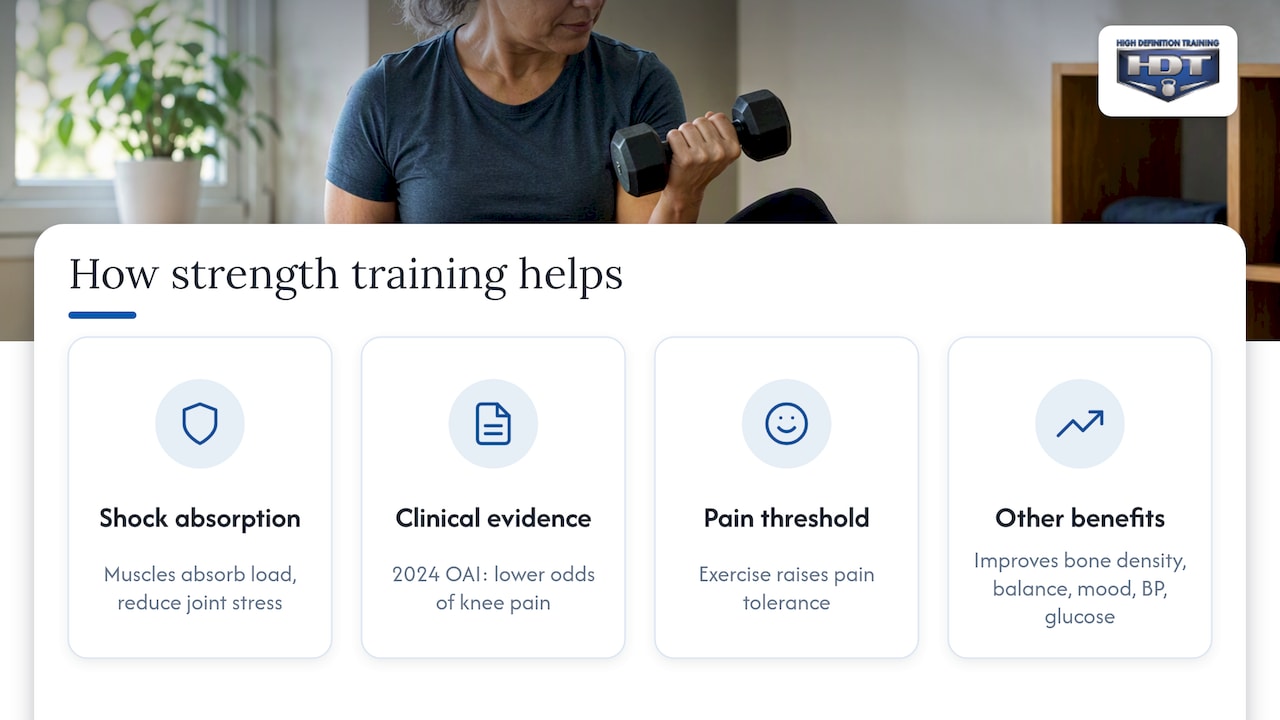
Stronger muscles act like shock absorbers around a joint.
When the quadriceps, glutes, hip muscles, and other supporting muscles become stronger, they can share more of the load placed on your joints during activities such as walking, squatting, and climbing stairs.
That unloading effect is one reason resistance training is included in many arthritis-management recommendations.
The evidence is not just theoretical.
A 2024 retrospective analysis from the Osteoarthritis Initiative found that lifelong strength training was associated with lower odds of frequent knee pain and structural knee osteoarthritis.
People with a history of strength training had notably lower odds of frequent knee pain and structural knee osteoarthritis in that analysis, even after other factors were taken into account.
That gives us another reason to think about strength training as more than exercise.
Building and maintaining muscle may influence how well your joints tolerate the demands of everyday life as you age.
Exercise also appears to increase the body’s tolerance to pain, which may partly explain why people who stay active often report lower levels of pain even when imaging shows similar amounts of joint wear.
Beyond the joint itself, regular resistance training supports bone density, improves balance and fall resistance, supports mood, and contributes to cardiovascular and metabolic health.
And none of these benefits require extremely heavy lifting.
They require consistency and a program designed around the joints you actually have.
Strength Training for Arthritis: Normal Soreness vs. a Flare
New exercise often produces muscle soreness.
That alone does not mean you have damaged a joint or made your arthritis worse.
The important skill is learning how to separate normal muscular soreness from joint pain that signals that something is being aggravated.
Muscle soreness commonly appears a day or two after training, improves with light movement, and gradually fades within several days.
Joint pain that becomes worse the longer you move or is accompanied by new swelling, warmth, redness, or instability should be treated differently.
That is a reason to back away from that particular movement or loading pattern.
During arthritis flare days, gentler exercise can allow you to remain active without aggressively loading an irritated joint.
Arthritis-Friendly Options During a Flare
Isometric holds: Pressing against resistance without moving the joint through a large range of motion can keep muscles active while reducing movement at a painful joint.
Water-based exercise: Water reduces joint loading while still providing resistance for your muscles.
Low-resistance stationary cycling: Cycling can help maintain circulation and mobility around the knee and hip without impact.
Pro Tip
If a joint is noticeably swollen, red, or warm, stop loading the area and have it evaluated before resuming strength training.
Certain symptoms go beyond a routine flare.
A fever accompanying joint pain, sudden severe swelling in a previously stable joint, a joint that repeatedly gives way, or pain that regularly wakes you at night should be evaluated by a medical professional.
These are situations in which pushing through the discomfort, or simply modifying the workout yourself, may not be appropriate.
A physician or physical therapist may need to rule out infection, structural injury, or an inflammatory flare that requires medical management.
How to Start Strength Training for Arthritis Safely
National physical activity guidelines recommend at least 150 minutes of moderate aerobic activity per week along with muscle-strengthening activity for all major muscle groups at least two days per week.
For knee osteoarthritis specifically, clinical guidance may recommend supervised programs performed approximately three times per week, particularly when maximizing strength and function is the goal.
Beginners experiencing significant discomfort may first spend several weeks emphasizing range-of-motion exercises before gradually introducing resistance.
A properly structured strength-training session usually follows a predictable sequence.
1. Warm Up
Spend approximately five to ten minutes performing light cardiovascular activity such as walking or cycling.
The goal is to increase circulation and tissue temperature before loading the joints.
2. Perform Joint-Specific Mobility Work
Use mobility exercises that prepare the joints involved in your workout.
For example, hip mobility exercises can help prepare the body before lower-body training.
3. Perform Your Main Strength Exercises
A typical strength program may include two to three exercises for the major muscle groups being trained.
Many programs use approximately two to three sets of eight to twelve repetitions, although this should be individualized.
4. Cool Down
Finish with gentle movement or stretching to help maintain the range of motion you trained during the session.
How Quickly Should You Progress?
Progression with strength training for arthritis should be conservative.
Once you can complete your target repetitions with good technique and manageable effort, resistance can gradually increase.
Increasing the load or resistance by approximately 10% to 20% may be reasonable in some situations, depending on the exercise and the individual.
Jumping the weight too quickly is one of the easiest ways to turn a productive strength-training program into an unnecessary flare.
If you are completely new to resistance training, our beginner’s guide to starting strength training after 40 can help you establish a starting point without simply guessing.
Best Strength Training Exercises for Arthritis
The best exercise is not necessarily the most advanced exercise.
It is the exercise you can perform with control, good technique, and without sharp joint pain.
Almost every major movement pattern can be modified to make strength training for arthritis more comfortable.

Lower-Body Exercises
The sit-to-stand, or a box squat using a chair or bench, is one of the most practical lower-body movements.
It mirrors something you do repeatedly throughout the day.
Start by standing from a higher surface and gradually progress to a lower surface as your mobility and strength improve.
The glute bridge builds hip strength while placing relatively little stress on many joints.
Low step-ups can build single-leg strength and balance.
They can be made easier by reducing step height or progressed by gradually adding resistance.
For knee arthritis, reducing range of motion during exercises such as leg extensions can reduce discomfort while still strengthening the quadriceps.
Resistance bands and water-based exercises can provide additional joint-friendly options.
Upper-Body Exercises
Upper-body strength matters for everyday activities such as carrying groceries, pushing doors, improving posture, and getting up from the floor.
Good options can include:
Seated row: A band or cable row strengthens muscles involved in posture and shoulder stability.
Band chest press: This develops pushing strength without requiring the same loading as a traditional heavy bench press.
Neutral-grip shoulder press: Keeping the palms facing each other may feel more comfortable for certain sensitive shoulders.
Band pull-aparts and scapular control drills: These strengthen muscles around the shoulder blades and can improve shoulder mechanics.
Hand and Wrist Arthritis
For people with arthritis affecting the hands and wrists, traditional gripping exercises can sometimes become uncomfortable.
Open-grip resistance bands, isometric grip exercises, thicker handles, and grip-assistance tools may reduce the amount of squeezing required during upper-body training.
Core and Balance Training
A joint-friendly program should also include exercises that improve core control and balance.
Options may include:
- Standing marching
- Bird-dog variations
- Supported single-leg balance
- Anti-rotation exercises
- Controlled carries
Better balance and trunk control can help improve how the knees, hips, and other joints respond during everyday movement.
Pro Tip
Rather than trying to perform every possible exercise in one session, choose one lower-body exercise, one upper-body exercise, and one core or balance exercise and perform them well.
When joints are involved, quality matters more than unnecessary volume.
Strength Training for Osteoarthritis vs. Rheumatoid Arthritis
Not every type of arthritis should be approached exactly the same way.
An important distinction exists between osteoarthritis and inflammatory forms of arthritis such as rheumatoid arthritis.
During an active rheumatoid arthritis flare, heavy or high-volume training may not be appropriate.
The emphasis may temporarily shift toward range-of-motion exercises, isometric work, and gentler activity.
With osteoarthritis, a different challenge often occurs.
People sometimes avoid loading the joint because they are afraid exercise will make the condition worse.
However, gradual progressive strengthening is often an important part of improving strength and function.
Knee and Hip Arthritis
Exercises emphasizing the quadriceps and glutes can be useful, especially when performed with controlled ranges of motion rather than fast, deep repetitions.
Shoulder Arthritis
Scapular-control exercises may be introduced before increasing overhead range.
Painful overhead positions can initially be limited and gradually expanded as tolerance improves.
Hand Arthritis
Alternative grips, thicker-handled equipment, resistance bands, and isometric exercises can reduce repetitive gripping stress.
No single strength-training program works for everyone.
The joint involved, the severity of symptoms, medical history, exercise experience, and what someone can realistically perform consistently all influence the program.
When Strength Training for Arthritis Should Be Supervised
Home programs can work well for many people.
However, there are situations where professional supervision can provide an important additional layer of safety and structure.
Consider supervised training when:
- You are recovering from joint surgery.
- You have joint-replacement hardware or another repair affecting movement.
- A joint feels unstable or regularly gives way.
- Inflammation remains difficult to control.
- You are unsure how hard you should exercise.
- You have attempted a self-directed program without improvement.
- Exercise repeatedly causes significant flare-ups.
A supervised strength program can track measurable changes in strength, range of motion, mobility, and pain rather than relying entirely on how you happened to feel during one workout.
Supervision can also improve technique and consistency.
Before beginning a program, ask the professional about their experience training people with joint limitations, how exercises will be progressed, and what measurements will be used to determine whether you are improving.
Combining Strength Training for Arthritis With Cardio and Mobility
Joint health should not be treated as a strength-training-only goal.
A balanced program can include resistance training, aerobic activity, mobility work, and recovery.
A realistic week may include:
Monday: Strength training
Tuesday: Walking, cycling, or other aerobic exercise
Wednesday: Mobility and recovery
Thursday: Strength training
Friday: Walking or cycling
Weekend: Recreational movement, mobility, or additional low-impact cardiovascular exercise
Low-impact cardiovascular exercises such as swimming, cycling, and elliptical training can improve cardiovascular fitness while reducing the repetitive impact associated with activities such as running.
Even five minutes of daily mobility work can help maintain the joint range of motion you develop through strength training.
During an arthritis flare, strength workouts may shift toward isometric exercises while cardiovascular activity remains comfortable and low-impact.
For people managing bone density along with arthritis, our guide to strength training and bone density after 40 explains how resistance training can support both goals.
A Realistic 60-Day Strength Training Plan for Arthritis
A structured 60-day strength training for arthritis program should not begin by testing how much weight you can lift.
It should begin with an assessment.
A first assessment can establish baseline strength, mobility, range of motion, and pain patterns.
Those measurements provide something concrete to compare against later.
Early Weeks: Build Tolerance
During the beginning of a 60-day program, the emphasis should be on movement quality and joint tolerance rather than the amount of weight being lifted.
A client may begin with exercises such as:
- Higher box squats
- Short-range leg presses
- Band-assisted exercises
- Supported balance work
- Controlled upper-body movements
Middle Weeks: Gradually Progress
As joints tolerate the program, small increases in resistance or range of motion can be introduced.
Progress should occur only while technique remains controlled and pain remains stable or improves.
Later Weeks: Measure the Changes
Progress should be evaluated through repeat strength, mobility, and movement assessments rather than simply asking whether the workout felt difficult.
For example, someone with knee discomfort may begin with a partial-range box squat and band-resisted leg extension.
Over several weeks, the squat depth or resistance may gradually increase as strength improves and discomfort decreases.
That is progressive strength training.
Not random workouts.
A Trainer’s Perspective on Strength Training With Arthritis
One of the biggest barriers I see with joint pain is not always motivation.
It is fear.
People are afraid that lifting weights will make the problem worse.
That fear can cause someone to avoid strength training completely.
On the other end of the spectrum, some people go into programs that are too aggressive for their current ability.
Neither extreme is ideal.
The goal is controlled progression.
Technique and consistency matter far more in the early stages than how much weight is on the bar.
Meaningful changes in how a joint feels usually happen through consistent weeks of training—not overnight.
People who stay consistent with manageable, progressive exercise usually have a better chance of building lasting strength than someone constantly chasing quick results.
How High Definition Training Supports Safe Strength Training for Arthritis
Strength training for arthritis works best when your program can adjust as your joints respond.
That is exactly how we approach training at High Definition Training.
Our 60-Day Transformation Program gives adults over 40 in Throgs Neck, Pelham Bay, and the East Bronx a structured starting point with hands-on coaching from day one.
Our personal training, semi-private training, and small-group training programs allow us to modify exercises based on your strength, mobility, joint limitations, and training experience.
Your first session establishes a baseline.
We look at:
- Current strength
- Mobility
- Movement quality
- Joint limitations
- Pain patterns
- Exercise history
- Individual goals
From there, we create a structured progression instead of handing you a generic workout.
We tailor exercises around joint limitations rather than forcing everyone into the same program.
We track strength and mobility so progress is measurable.
We can also pair your exercise program with nutrition coaching when weight management is part of reducing unnecessary stress on the hips, knees, and other weight-bearing joints.
If arthritis or joint discomfort has kept you from getting stronger because you are unsure where to begin, you do not have to figure it out alone.
Schedule a Discovery Call with High Definition Training and let’s have an honest conversation about where you are now, what your joints are allowing you to do, and what you want your body to be capable of 60 days from today.

Frequently Asked Questions About Strength Training for Arthritis
Can You Still Strength Train With Arthritis?
Yes.
Most adults with arthritis can strength train safely.
Research has associated a history of strength training with lower odds of frequent knee pain and structural knee osteoarthritis.
Key factors include starting with manageable resistance, prioritizing control, and modifying or temporarily avoiding specific exercises during a flare.
What Exercises Are Good for People With Arthritis?
Low-impact exercises performed through a comfortable and controlled range of motion are often useful.
Examples include:
- Sit-to-stand squats
- Glute bridges
- Band-resisted rows
- Low step-ups
- Supported balance exercises
- Water-based exercise
Beginners experiencing significant discomfort may start with range-of-motion exercises before progressing to resistance training.
What Is the Fastest Way to Relieve Arthritis Pain Through Exercise?
There is no single workout that instantly eliminates arthritis pain.
Regular physical activity may improve pain tolerance and reduce pain intensity over time.
Consistency across weeks matters more than one unusually hard workout.
Should Diet Change Alongside Strength Training for Arthritis?
Nutrition is not a replacement for exercise.
However, weight management may reduce some of the load placed on weight-bearing joints such as the hips and knees.
Combining a structured strength program with appropriate nutrition coaching may therefore support both body-composition and joint-health goals.
How Often Should Someone With Arthritis Strength Train?
General physical activity guidelines recommend muscle-strengthening activity for the major muscle groups at least two days per week.
They also recommend approximately 150 minutes of moderate aerobic activity per week.
Some supervised knee-osteoarthritis programs may use approximately three strength-training sessions per week depending on the individual.
Sources
- Physical activity guidelines summary (PubMed entry)
- Retrospective analysis linking strength training with lower knee pain and structural OA (PMC10922276)