
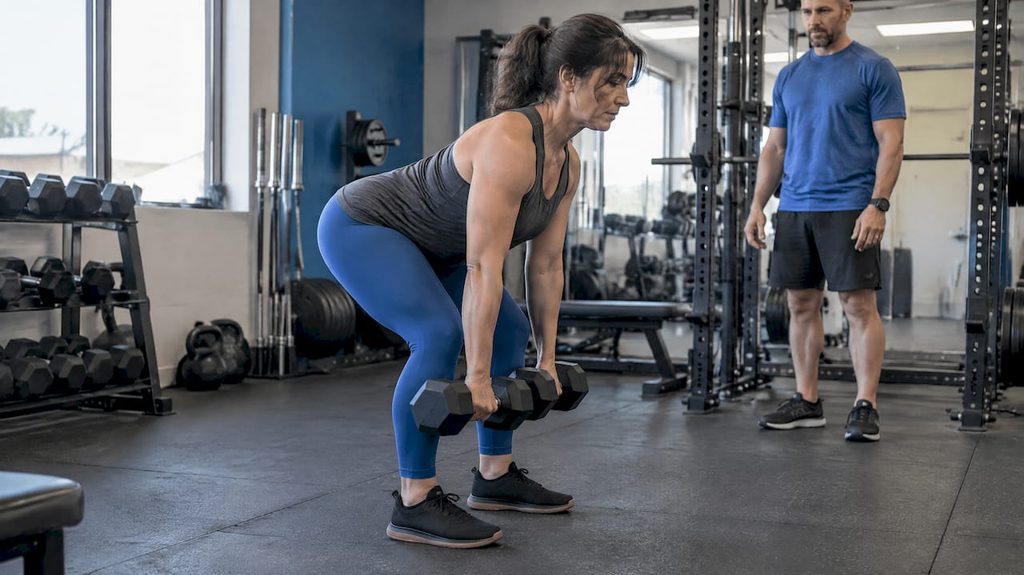
A women over 40 gym schedule should help you build strength, improve cardiovascular health, maintain mobility, and recover properly without making exercise feel like a second job.
The best schedule combines strength training 2 to 3 days per week, aerobic activity across 2 to 5 sessions, and short balance or mobility sessions 2 to 3 times weekly.
The key is progressive overload, consistency, and smart sequencing so your body has enough time to recover between workouts.
Below, I’ll show you practical weekly templates, a beginner-friendly 4-week plan, and a longer progression you can use to build strength safely and consistently after 40.
TL;DR:
- Women over 40 should perform strength training at least twice a week, focusing on progressive overload and avoiding back-to-back muscle group workouts.
- A typical beginner plan involves three full-body strength sessions, two cardio days, and one mobility workout weekly, with session length averaging 30 minutes.
- A 4-week progression increases load gradually, moving from light full-body workouts to more structured split routines over 10 weeks, emphasizing movement quality.
- Proper starting weights allow completion of 8 to 12 reps with the last two challenging but manageable, and tracking progress helps prevent injury and plateaus.
- Incorporating regular rest, deload weeks, flexibility, and mobility exercises supports recovery and maintains movement quality in women over 40.
High Definition Training
Build Strength With Personal Coaching
High Definition Training creates tailored fitness plans for adults over 40 in Throgs Neck and Pelham Bay, with safe, supportive coaching.
Table of Contents
- Choosing the Best Women Over 40 Gym Schedule
- 4-Week Women Over 40 Gym Schedule for Beginners
- Building a Phased 10-Week Strength Program
- How to Choose Starting Weight and Progress Safely
- Recovery in a Women Over 40 Gym Schedule
- Warm-Ups and Modifications for Common Limitations
- How HDT Applies This in the First 60 Days
- Eating to Support Strength and Recovery After 40
- Why Flexibility and Stretching Deserve a Place on the Schedule
- The Mental Lift That Comes With Consistent Training
- Tracking Progress Without Overcomplicating It
- Consistency Beats Complexity
- How HDT Builds Your Women Over 40 Gym Schedule
- Sources
- FAQ
Choosing the Best Women Over 40 Gym Schedule
Most women over 40 do better picking one structure and sticking with it than bouncing between routines. Two templates cover almost everyone starting out.

The time-efficient template works for busy weeks: three 30 to 40-minute strength sessions, two 20 to 30-minute cardio sessions, and one 15 to 20-minute mobility session. It fits around work and family without feeling like a second job.
The classic split suits people with slightly more time and a bit of training history: four days split between upper body, lower body, and full-body work, with cardio and mobility layered in on the remaining days.
- Beginners usually do better with the time-efficient template because it lowers the barrier to consistency.
- Intermediate exercisers with a year or more of regular training often get more from the four-day split.
- Session length matters less than frequency: three focused 30-minute sessions beat one exhausting 90-minute workout.
- Cardio can be a brisk walk, cycling, swimming, or a group class, whatever you will actually repeat.
The CDC’s physical activity guidelines recommend muscle-strengthening work for all major muscle groups on 2 or more days weekly, and multicomponent activity that blends aerobic, strength, and balance training for older adults. Either template satisfies that baseline; the right one is whichever you’ll actually finish each week.
4-Week Women Over 40 Gym Schedule for Beginners
A simple four-week block gets most beginners moving safely while building the habit of showing up.
- Week 1: three strength days (full-body, light to moderate load), two cardio days, one mobility day, focusing on learning form over lifting heavy.
- Week 2: repeat the structure, adding one set to each main lift once the first week feels manageable.
- Week 3: add a small weight increase on the main lifts and extend cardio sessions by 5 minutes.
- Week 4: hold the volume steady as a practice week, sharpening technique before moving into a longer program.
Each strength day follows the same shape: a 5 to 10 minute warm-up, two or three compound lifts (squat pattern, hinge pattern, push, pull), one or two accessory moves, then a short cooldown. Squats can be boxed or goblet-style for anyone with knee sensitivity, and rows can move from cable to seated machine depending on shoulder comfort; see this dumbbell workout for women for beginner-friendly exercise alternatives and progressions. The goal across these four weeks is not maximum weight. It’s proving the schedule is sustainable before adding complexity.
Building a Phased 10-Week Strength Program
Once the four-week foundation feels routine, a 10-week program adds structure without overcomplicating things.
- Weeks 1 through 4 (adaptation phase): moderate loads, full-body sessions three times weekly, focus on movement quality and consistent attendance.
- Weeks 5 through 8 (strength phase): slightly heavier loads, a shift toward upper/lower splits, and the addition of a second weekly mobility session.
- Weeks 9 and 10 (deload and test phase): reduced volume to let the body recover, followed by a light retest of starting movements to measure change.
Weekly structure shifts as the phases progress: volume rises through week 8, then drops sharply in weeks 9 and 10 to allow recovery. Exercise selection also evolves, moving from basic squat and hinge patterns toward slightly more advanced variations once form is solid.
Track three simple markers across the program: reps completed at a given weight, how controlled the last two reps of each set feel, and whether movement quality (depth, posture, balance) holds up as fatigue sets in. If energy dips or joints feel cranky in weeks 5 through 8, that’s often tied to normal hormonal shifts during perimenopause or menopause, and it’s a signal to hold the current load steady rather than push through.
How to Choose Starting Weight and Progress Safely
Starting weight comes down to one question: can you complete the prescribed reps with the last two feeling genuinely hard, but not impossible? If the final two reps of an 8 to 12 rep set feel easy, the weight is too light.ACSM resistance training guidance recommends starting most adults with 1 to 3 sets of 8 to 12 repetitions per exercise, adjusting load so those final reps feel challenging but controlled.
One to three sets of 8 to 12 reps is the standard starting prescription for building muscle function, according to ACSM guidance. That range gives enough volume to drive progress without overwhelming a new routine.
Progress happens in small steps. For more detail on the math behind starting weights, see our guide to starting strength training over 40.
Pro Tip: Log your weights and reps every session. A simple notes app entry takes 10 seconds and tells you exactly when it’s time to add load.
Recovery in a Women Over 40 Gym Schedule
Recovery matters more after 40 because connective tissue and hormonal shifts change how quickly the body bounces back from training stress.
- Never train the same muscle groups on consecutive days; alternate upper, lower, and full-body focus.
- Keep at least one full rest day every week, even during a strength-focused phase.
- Plan a deload week (lighter loads, fewer sets) every 4 to 8 weeks, especially after a strength block.
- Use deloads when soreness lingers past 48 hours, sleep quality drops, or motivation dips for no clear reason.
- Prioritize protein at each meal and consistent hydration, both of which support muscle repair between sessions.
A rest day doesn’t mean doing nothing. A short walk or gentle stretching counts as active recovery and keeps the habit of daily movement alive without adding training stress.
Warm-Ups and Modifications for Common Limitations
A 5 to 10 minute dynamic warm-up, covering hip circles, leg swings, shoulder rolls, and a light cardio pulse-raiser, reduces injury risk before strength work, according to the NIA’s guidance for older adults.
- Knee discomfort: swap back squats for box squats or goblet squats to reduce joint strain while keeping the movement pattern.
- Shoulder limitations: trade barbell presses for landmine presses or cable rows at a pain-free range of motion.
- Low back sensitivity: replace conventional deadlifts with hip hinges using a kettlebell or trap bar for a shorter lever arm.
- Any sharp or radiating pain, numbness, or joint swelling that doesn’t settle within a day is a reason to check with a physician or physical therapist before continuing.
Pro Tip: If a movement causes pain rather than fatigue, that’s your body asking for a substitution, not more effort.
How HDT Applies This in the First 60 Days
At High Definition Training, every new client starts with a movement screen and baseline strength and mobility markers, not a generic intake form. The first two weeks focus on teaching patterns (squat, hinge, push, pull) at low load. From there, coaching adjusts to each person: a client with knee discomfort might spend weeks 3 through 5 on box squats before progressing to a loaded squat, while others add weight faster. Most clients notice better movement confidence and strength by weeks 6 through 8.
Eating to Support Strength and Recovery After 40
Nutrition doesn’t need to be complicated to support a strength schedule. The basics matter most: enough protein spread across meals to support muscle repair, enough total food to fuel training without constant fatigue, and consistent hydration, especially on strength days.
Women managing hormonal shifts during perimenopause or menopause often notice changes in hunger, recovery, and sleep that affect how training feels week to week. ACSM’s guidance on exercise during the perimenopausal years points out that strength training supports bone health and counters age-related muscle loss during this stage, and that consistency matters more than intensity when starting out.
Rather than chasing a specific diet plan, focus on a few repeatable habits: a protein source at each meal, vegetables or fruit at most meals, and water throughout the day rather than only around workouts. On heavier training days, a slightly larger meal beforehand tends to support better performance than training on an empty stomach. None of this requires tracking every gram. It requires doing the basics consistently enough that they become automatic, which matters more long-term than any single week of perfect eating.
Why Flexibility and Stretching Deserve a Place on the Schedule
Flexibility work often gets skipped because it doesn’t feel like “real” exercise, but it directly supports the strength and balance goals in the templates above. Tight hips and shoulders limit squat depth and overhead reach, which makes compound lifts harder to perform with good form.
A short stretching routine after strength sessions, targeting hips, hamstrings, chest, and shoulders, helps maintain the range of motion those lifts require. Dynamic stretching before training and static stretching after training serve different purposes: one prepares the muscles to work, the other helps them return to resting length.
Balance and mobility work also belongs in the weekly schedule rather than as an occasional extra. The Physical Activity Guidelines midcourse report notes that balance and mobility training should be integrated into weekly plans for older adults, with short, frequent sessions proving more sustainable than occasional long ones. A 10 to 15-minute mobility block twice a week, covering hip openers, ankle mobility, and simple single-leg balance drills, fits easily into either weekly template without adding real time pressure.

The Mental Lift That Comes With Consistent Training
Strength training over 40 does more than build muscle. Regular sessions give structure to the week, create a sense of visible progress, and often improve sleep quality, which in turn affects mood and energy the next day.
Motivation tends to fade when goals are too big or too vague. Breaking a 10-week program into smaller phases, as outlined earlier, gives built-in checkpoints that make progress feel real rather than distant. Training alongside others, whether in a small group or with a coach, also makes consistency easier; showing up for a scheduled session with another person involved tends to beat relying on willpower alone.
Confidence tends to build gradually rather than all at once. The first weeks are about proving the schedule fits real life, and the sense of capability that follows, lifting a heavier weight, holding a balance pose longer, walking up stairs without noticing, tends to matter more day to day than any number on a scale.
Tracking Progress Without Overcomplicating It
The three templates and plans above only work if progress gets tracked somewhere, even loosely. A simple log of weights, sets, and reps for each strength session shows exactly when it’s time to add load, matching the progression cues described earlier.
Beyond the numbers, pay attention to how sessions feel: whether the last two reps of a set are genuinely hard, whether a previously difficult movement now feels manageable, and whether recovery between sessions feels complete rather than draining. Behavior-change research summarized in the Physical Activity Guidelines literature review points to goal-setting and simple self-monitoring, like an activity tracker or a basic workout log, as effective ways to support adherence over time.
Adjust the schedule based on what the log shows rather than a fixed calendar. If strength gains stall for two or three weeks running, that’s a signal to add a deload or revisit form before pushing harder. If a goal shifts, say from general strength to training for a specific event, the weekly template can shift too, since the frameworks above are meant to be adapted, not followed rigidly forever.
Consistency Beats Complexity
The biggest mistake I see is women skipping the basics to chase advanced routines before they’re ready. Start conservative, nail your form, and get a trainer to check your technique early. Simple, repeated well, beats fancy every time.
— Angel Perez
How HDT Builds Your Women Over 40 Gym Schedule

- The 60-Day Transformation gives new clients a structured starting point with an assessment, coached sessions, and built-in progression. Pricing details are available on our 60-Day Transformation page.
- Personal, semi-private, and small-group formats let you choose how much individual attention fits your budget and goals. See all formats on our classes page.
Sources
- CDC: Physical activity guidelines for adults
- ACSM resistance training guidance (PubMed entry)
- NIA: Tips for getting and staying active as you age
- Physical Activity Guidelines for Americans midcourse report
FAQ
How many times a week should a 40 year old woman workout?
Most women over 40 do well with 2 to 3 strength sessions, 2 to 5 cardio sessions, and 2 to 3 short balance or mobility sessions weekly. The CDC recommends muscle-strengthening activity for all major muscle groups at least 2 days a week alongside aerobic and balance work.
What is the 3-3-3 rule in gym?
Definitions of this rule vary across fitness sources and it isn’t part of official exercise guidance. A common informal version suggests 3 strength sessions, 3 cardio sessions, and 3 mobility sessions weekly, which overlaps closely with the frequency ranges recommended by national health authorities.
What weight should a 40 year old woman be able to lift?
There’s no universal weight target since it depends on training history, body size, and the specific lift. A better guide is the rep-based cue from ACSM: choose a weight where the last two reps of an 8 to 12 rep set feel genuinely challenging but controlled.
Is the gym good for a 40 year old woman?
Yes. Structured strength and aerobic training supports muscle mass, bone health, and metabolic health during and after the hormonal shifts of midlife, according to ACSM guidance on the perimenopausal years. Starting conservatively and progressing gradually, as outlined in the templates above, keeps the gym a sustainable habit rather than a short-term push.
Recommended
- Home Workout Plan for Women Over 40 That Works
- Beginner Strength Workouts for Women Over 40: A Guide
- How to Start Strength Training over 40: Women’s Guide
- 12 Weeks to Safer Strength: Progressive Overload for Women Over 40