
TL;DR:
- Ergonomics aligns exercises and environments with the body’s mechanics to increase safety and effectiveness. It reduces injury risks by ensuring proper body alignment, controlled movement, and a safe workout space. For women over 40, ergonomic strategies support joint health and help prevent fatigue and stiffness.
Ergonomics in fitness is defined as the practice of aligning exercises, equipment, and training environments with the body’s natural mechanics to maximize safety, comfort, and results. The role of ergonomics in a fitness plan goes far beyond posture at a desk. For women over 40, it determines whether a workout builds strength and resilience or quietly accumulates joint stress and fatigue. Age-related changes in bone density, connective tissue elasticity, and muscle recovery time make ergonomic fitness strategies not optional but necessary. High Definition Training builds every program around these principles because the goal is a body that performs better next month than it does today.
How does ergonomics improve safety and prevent injuries during exercise?
Ergonomics reduces injury risk by ensuring the body moves through exercises in alignment with its natural joint mechanics. When form breaks down, peak forces concentrate on vulnerable structures like the knees, lumbar spine, and rotator cuff. Optimizing your training environment with proper flooring, buffer zones, and visual feedback can reduce peak joint loads by 20–30%. That single number explains why two women doing the same squat can have completely different outcomes over a year of training.
Body alignment is the foundation of ergonomics for injury prevention. Neutral spine, stacked joints, and controlled breathing patterns are not coaching clichés. They are the mechanical conditions under which muscles absorb force rather than transfer it to cartilage and tendons. Safe workout biomechanics prioritize completing movements with the least effort, which means the right muscles fire in the right sequence rather than compensating structures taking over.
The environment itself is part of the equation. Cluttered spaces, slippery surfaces, and poor lighting all increase the risk of falls and collisions, especially during dynamic movements like lunges or lateral steps. Maintaining at least a 3-foot clearance zone around exercise equipment is critical to avoid falls during home workouts.
Key ergonomic safety factors to address before every session:
- Floor surface: Use shock-absorbing material to cushion impact on joints during jumps or step work.
- Lighting: Dim spaces reduce spatial awareness and increase misstep risk.
- Mirror placement: A full-length mirror gives real-time form feedback without needing a spotter.
- Equipment spacing: Clear at least 3 feet on all sides of any piece of equipment you use.
- Footwear: Supportive shoes with lateral stability reduce ankle and knee torque during lateral movements.
Pro Tip: Mark a 3-foot bail zone around your workout area with tape on the floor. This simple visual cue prevents you from drifting into furniture or walls during high-effort sets when spatial awareness drops.
What are the key ergonomic considerations for women over 40?
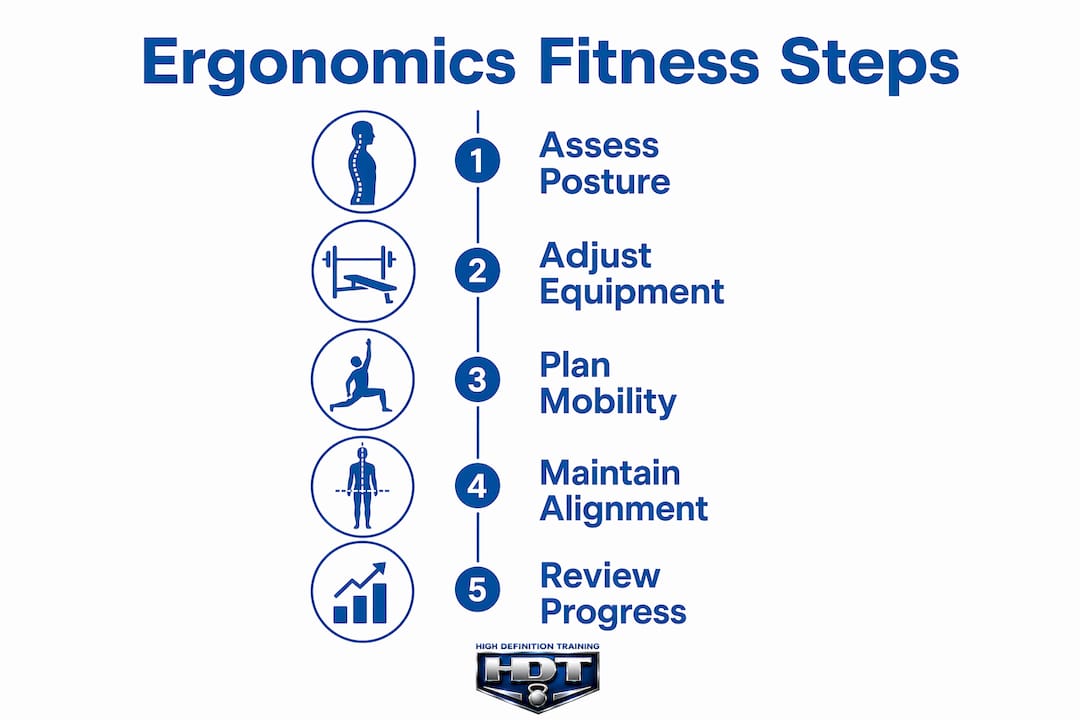
Women over 40 face specific anatomical shifts that change how ergonomic principles apply to their fitness plans. Declining estrogen affects collagen synthesis, making tendons and ligaments less elastic. Bone remodeling slows. Muscle recovery takes longer. These are not reasons to train less. There are reasons to train with more attention to how the body is positioned and loaded.
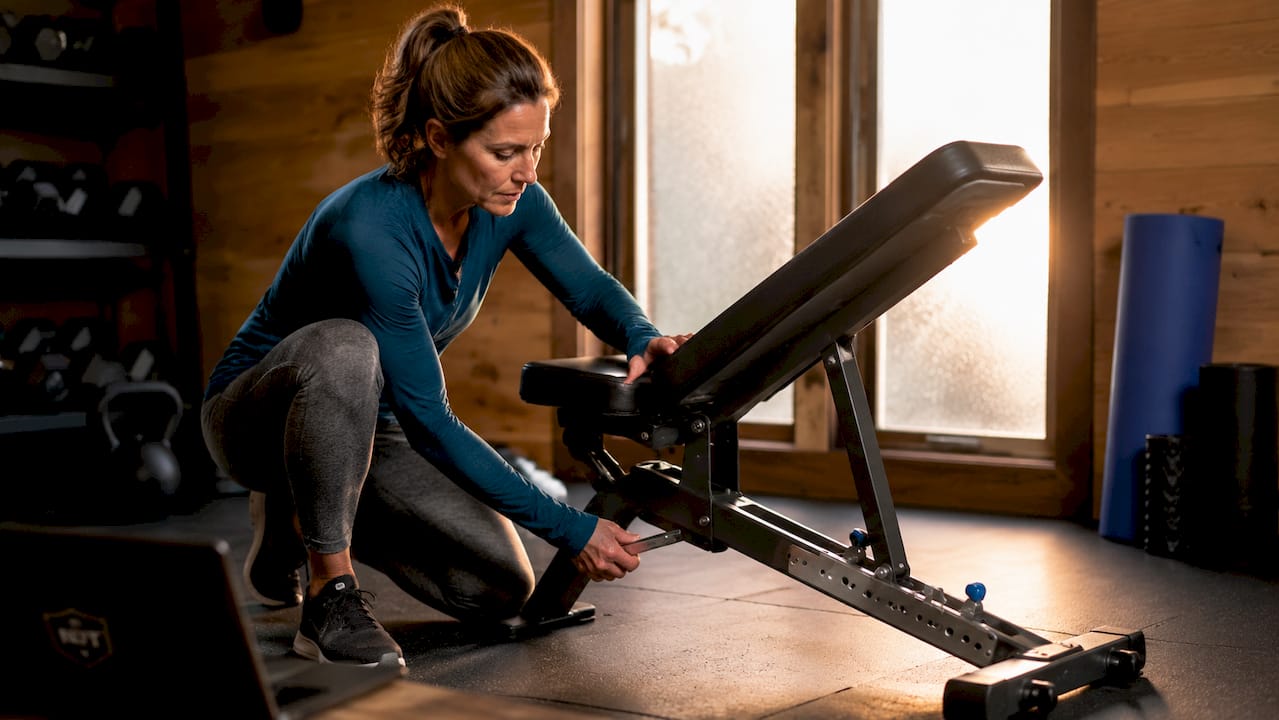
The most underrated ergonomic consideration for this group is variety in position. Changing position every 20–30 minutes during training helps maintain neutral spinal alignment and prevent muscular stiffness. Static holds and prolonged postures in one position create low-grade compression that accumulates over the course of a session. Rotating between standing, seated, and floor-based exercises is not just variety for variety’s sake. It is a deliberate ergonomic strategy.
A well-designed fitness plan for women over 40 addresses four ergonomic priorities in sequence:
- Mobility first: Begin each session with joint mobility work targeting the hips, thoracic spine, and shoulders. These are the areas most affected by desk posture and age-related stiffness.
- Posture-based strength: Prioritize exercises that reinforce upright posture, such as rows, deadlifts, and glute bridges, over those that load a flexed spine.
- Position rotation: Alternate between standing, seated, and floor-based movements every 20–30 minutes to prevent fatigue in any one postural pattern.
- Daily movement pairing: Short, frequent movement activities paired with daily work triggers are more sustainable than rigid hour-long sessions for women over 40.
Pro Tip: Attach a 5-minute mobility flow to an existing daily habit, like your morning coffee or the end of your lunch break. Habit stacking removes the decision-making barrier and builds consistency without adding a separate workout block.
The goal is a fitness plan that fits into real life without requiring perfect conditions. Ergonomic design makes that possible by reducing the physical cost of each session and building a body that recovers well between them.
How can ergonomic equipment and environment enhance your workouts?
Equipment and environment are the physical infrastructure of any fitness plan. Choosing and arranging them with ergonomic principles in mind directly affects how well the body performs and how quickly it recovers. This is where the importance of ergonomics in exercise becomes visible and measurable.
Flooring and lighting standards
Gym flooring must be at least 1 inch thick and shock-absorbing to protect joints during impact exercises. Lighting should meet a minimum of 300 lux to support spatial awareness and safe movement. These are not luxury upgrades. They are baseline requirements for a safe training space.
Visual feedback and layout
Mirrors serve a functional purpose in ergonomic training. They allow real-time self-correction of form without breaking movement flow. Equipment layout should follow a logical flow from warm-up to strength to cool-down, reducing the need to step over or around gear mid-session.
| Environment factor | Ergonomic standard | Why it matters |
|---|---|---|
| Flooring thickness | At least 1 inch, shock-absorbing | Reduces joint impact during jumps and step work |
| Lighting level | Minimum 300 lux | Supports spatial awareness and safe footing |
| Equipment clearance | 3-foot bail zone on all sides | Prevents falls and collision injuries |
| Mirror placement | Full-length, at eye level | Enables real-time form monitoring |
| Storage | Off the floor, organized by use | Eliminates trip hazards between sets |
Equipment design
Ergonomic equipment supports the body’s natural movement arcs rather than forcing it into fixed positions. Adjustable benches, resistance bands with comfortable handles, and kettlebells with smooth, balanced grips all reduce compensatory strain. When equipment forces awkward wrist, shoulder, or knee angles, the body adapts by recruiting the wrong muscles. Over time, that pattern leads to overuse injuries. Selecting equipment that supports alignment is one of the most direct ways to protect joints across hundreds of training sessions.
What practical ergonomic strategies work in daily fitness routines?
Embedding ergonomic habits into daily routines is where the benefits of ergonomic training become lasting. A well-designed session means little if the other 23 hours of the day undo the work. The following strategies address both workout time and the movement patterns that surround it.
- Apply the 20-20-20 rule: Every 20 minutes of focused activity, shift your position and take 20 seconds to look at something 20 feet away. This reduces neck and eye strain from screen-based workout videos or tracking apps.
- Use dynamic posture: Frequent small shifts in body position reduce muscle fatigue more effectively than searching for one perfect static posture. Micro-adjustments keep circulation moving and prevent stiffness from setting in.
- Schedule movement breaks: A 3-minute walk or standing stretch every 30–45 minutes of sedentary time maintains the postural gains made during formal workouts. Short, consistent movement snacks build fitness sustainably for women with busy schedules.
- Check posture at transitions: Use natural transition points, like standing up from a chair or picking up a bag, as posture check-ins. Are your shoulders back? Is your core lightly engaged? These micro-corrections add up over the course of a day.
- Increase standing time gradually: If you are building more standing into your day, add 15–20 minutes per week rather than switching abruptly. Use a supportive mat and rotate footwear with adequate arch support to prevent plantar and knee fatigue.
The consistency of these habits matters more than any single session. Ergonomic fitness strategies work because they reduce the friction and physical cost of showing up every day.
Key Takeaways
Ergonomics in fitness works by aligning movement, equipment, and environment with the body’s natural mechanics, reducing injury risk and making consistent training sustainable for women over 40.
| Point | Details |
|---|---|
| Ergonomics reduces joint load | Optimized environments and form can cut peak joint loads by 20–30%. |
| Position variety prevents fatigue | Changing positions every 20–30 minutes maintains spinal alignment and reduces stiffness. |
| Environment standards matter | Flooring of at least 1 inch and lighting of at least 300 lux are baseline safety requirements. |
| Movement snacks build consistency | Short, frequent activity paired with daily triggers is more sustainable than rigid long sessions. |
| Ergonomics supports, not replaces, exercise | Ergonomic adjustments improve comfort but do not substitute regular, targeted training for long-term health. |
What I have learned about ergonomics after 40
Most women who come to High Definition Training have tried programs that worked for someone else. They followed the plan, pushed through discomfort, and ended up with a sore knee or a nagging shoulder that made them stop. The problem was rarely effort. It was fit.
Ergonomics is not a soft concept. It is the reason two people can do the same exercise for a year and have completely different outcomes. When the movement fits the body, training compounds; when it does not, the body compensates, and compensation always has a cost.
What I have found working with women in the Throgs Neck and Pelham Bay areas of the Bronx is that the biggest ergonomic mistake is not bad form. It is ignoring the signals the body sends before the form breaks down. Tightness in the hip flexors before a squat. Fatigue in the upper traps during a row. These are not signs to push harder. There are signs to adjust the setup.
Ergonomic adjustments improve comfort but do not replace the necessity of regular exercise for long-term spine and joint health. That distinction matters. Ergonomics is the vehicle. Consistent, progressive training is the destination. You need both.
The mindset shift I encourage is to stop thinking of workouts as events and to start thinking of movement as a lifestyle. Ergonomics supports that shift by making you feel better, which makes you more likely to keep doing it. That is the real benefit.
— Angel
Personal training built around how your body actually moves
Women over 40 in the Bronx deserve a fitness plan that accounts for how their bodies actually work, not a generic program designed for someone half their age. High Definition Training builds every session around ergonomic principles, from the way exercises are sequenced to the environment where training happens.
At High Definition Training, the focus is on personal training classes in Throgs Neck and Pelham Bay that address joint health, posture, and sustainable movement from day one. Whether you are returning to fitness after a break or looking to train smarter without risking injury, the program is built to fit your body and your life. Visit High Definition Training to learn more about getting started.
FAQ
What is the role of ergonomics in a fitness plan?
Ergonomics in a fitness plan means designing exercises, equipment, and training environments to match the body’s natural mechanics. The goal is to reduce injury risk, improve comfort, and make workouts more effective over the long term.
How does ergonomics help prevent workout injuries?
Proper body alignment and an optimized training environment can reduce peak joint loads by 20–30%. Factors like shock-absorbing flooring, adequate lighting, and a clear 3-foot bail zone around equipment all lower the risk of falls and overuse injuries.
Why is ergonomics especially important for women over 40?
Women over 40 experience changes in collagen elasticity, bone density, and muscle recovery that increase the risk of injury when form and environment are ignored. Ergonomic fitness strategies address these changes directly by reducing joint stress and supporting postural strength.
How often should I change positions during a workout?
Changing position every 20–30 minutes maintains neutral spinal alignment and prevents low-grade muscle fatigue from building up. Rotating between standing, seated, and floor-based movements is a simple way to apply this principle.
Can ergonomics replace regular exercise for back pain prevention?
Ergonomic adjustments improve comfort and reduce fatigue, but do not replace regular, targeted exercise as the primary method for long-term spine health. Both are needed: ergonomics reduces the physical cost of movement, while consistent training builds the strength that protects the spine.