Menopause shifts fat toward your belly and makes weight easier to gain, but hormones alone rarely explain the whole story. The fastest path back to control combines progressive resistance training, tighter but not extreme calorie management, more protein at every meal, and better sleep. If symptoms are severe or weight is climbing fast, a clinician visit belongs on that list too.
TL;DR:
- Menopause-related weight gain primarily results from aging, muscle loss, and lifestyle changes, with hormones mainly redistributing fat rather than increasing overall weight.
- Visceral fat increases around the abdomen and raises cardiometabolic risk, even if scale weight remains stable, making waist measurement and strength tests better health indicators.
- Combining moderate calorie deficits, higher protein intake, resistance training, daily movement, and improved sleep effectively targets menopause belly fat and muscle preservation.
- Weight stabilization often occurs after the initial rapid gain around menopause, but shifting fat distribution and muscle loss can continue without targeted intervention.
- Routine blood tests and bone density scans are crucial for monitoring health changes during menopause and safely guiding weight and health management strategies.
Table of Contents
- What Causes Weight Gain During Menopause?
- Why Does Menopause Belly Fat Feel So Stubborn?
- What Actually Works for Menopause Belly Fat Loss?
- Can Hormone Therapy or Weight-Loss Drugs Help?
- When Does Menopause Weight Gain Happen, and Does It Stop?
- An 8 to 12 Week Plan That Actually Moves the Needle
- How Does Menopause Weight Gain Affect You Emotionally?
- Why Regular Checkups Matter More Now
- What Twenty Years of Coaching Women Over 40 Has Taught Me
- Get Hands-On Coaching Built for Your Body Right Now
- Sources
- FAQ
What Causes Weight Gain During Menopause?
Menopause and aging happen at the same time, which makes it easy to blame hormones for everything. In truth, declining estrogen and shifting FSH levels mainly redistribute fat toward your midsection rather than causing weight gain on their own. Mayo Clinic’s review of menopause and weight points to aging, falling activity levels, and muscle loss as the bigger drivers of the number on the scale.
Several factors compound the problem at once:
- Slower resting metabolism from age-related muscle loss
- Lower daily movement as joints, energy, or schedules change
- Medications for blood pressure, mood, or sleep that carry weight-related side effects
- Poor sleep from night sweats, which increases hunger hormones the next day
- A protein gap: many women eat less protein than their changing body needs, which drives up total appetite through a mechanism researchers call protein leverage
That last point matters more than most women realize. When protein intake as a share of total calories drops, appetite often rises to compensate, pushing you to eat more of everything else just to hit your protein needs.
Why Does Menopause Belly Fat Feel So Stubborn?
The stubbornness is real, and it has a name: visceral fat. This is fat packed around your organs, distinct from the subcutaneous fat under your skin, and research on midlife weight changes confirms menopause pushes fat storage toward the abdomen even when total body weight barely moves.
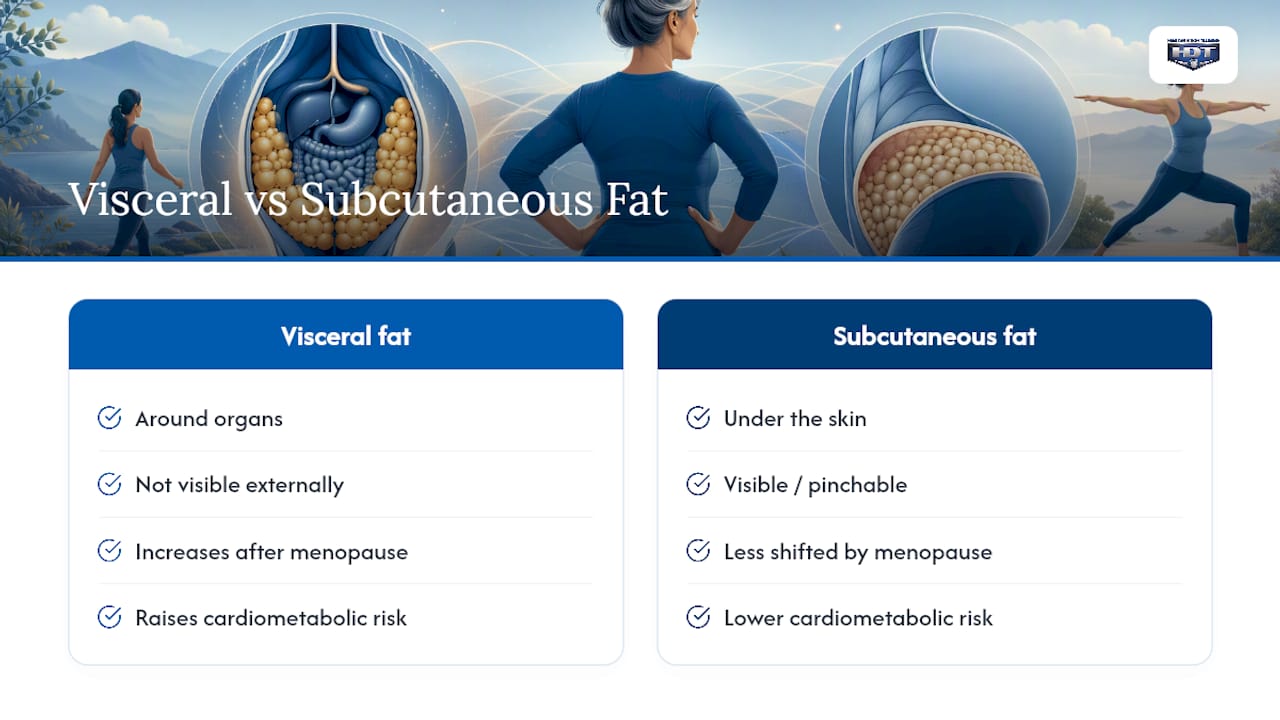
Menopause is associated with measurably higher visceral and pericardial fat, raising cardiometabolic risk even in women whose scale weight looks unchanged.
Pair that with sarcopenic obesity, a combination of rising fat mass and falling muscle mass that can hide behind a “normal” body mass index. A woman who weighs the same as she did at 35 can carry meaningfully more visceral fat and less muscle at 50. That’s why your waist measurement and a simple strength test (can you still do a bodyweight squat, carry groceries without strain, or do a modified push up) tell you more about your health trajectory than the scale ever will.
What Actually Works for Menopause Belly Fat Loss?
None of these strategies work in isolation, but stacked together they address every driver covered above.
- Run a modest calorie deficit, not a crash diet. Extreme restriction accelerates muscle loss, which makes the belly fat problem worse in the long run. Mediterranean-style eating, heavy on vegetables, fish, olive oil, and whole grains, gives you a sustainable framework.
- Raise your protein target. Research on protein leverage during menopause recommends pushing protein to roughly 18 to 20 percent of daily energy, close to 1.1 to 1.3 grams per kilogram of body weight, spread across three or four meals rather than loaded into dinner.
- Lift weights two to three times a week. Progressive resistance training is widely considered the single most effective tool for fighting the muscle and bone losses that come with menopause, according to clinical guidance on bone health and exercises that protect bone density. Squats, rows, hip hinges, and carries cover the movements that matter most.
- Add daily movement outside the gym. Walking, taking stairs, and general fidgeting (what researchers call NEAT) burn more cumulative calories than most people expect.
- Protect your sleep. Night sweats and poor sleep disrupt appetite regulation and recovery, making every other step harder.
A landmark five-year lifestyle intervention trial tested exactly this combination: a 1,300 calorie daily target plus 1,000 to 1,500 calories of weekly activity. That’s not a diet fad, that’s a five-year, controlled outcome.
Pro Tip: Split your protein across meals instead of saving it for dinner. Twenty-five to thirty grams at breakfast does more for appetite control and muscle retention than the same amount crammed into one evening meal.
If you want a structured place to start, a beginner strength program built for women over 40 removes the guesswork around exercise selection and progression.
Can Hormone Therapy or Weight-Loss Drugs Help?
Menopausal hormone therapy (MHT) is not FDA-approved as a weight-loss treatment, but it can ease hot flashes and night sweats and may help shift fat distribution away from the belly in some women. That’s a meaningful difference. Better sleep and fewer vasomotor symptoms make every other habit on this list easier to stick to, according to research linking vasomotor symptoms to sleep and metabolic changes.
GLP-1 receptor agonists produce real fat loss, but they also tend to reduce lean muscle mass unless paired deliberately with resistance training and adequate protein, based on findings on muscle and fat interaction during menopause. Stop the medication without a strength foundation in place, and much of the weight tends to return.
Before starting either option, ask your provider about:
- Baseline bloodwork (thyroid, glucose, lipids)
- Bone density screening if you’re at risk for osteoporosis
- A clear plan for pairing any medication with strength training, not replacing it
When Does Menopause Weight Gain Happen, and Does It Stop?
Most women gain weight gradually rather than suddenly. Research on weight regulation during the menopausal transition puts the average gain at about 1 pound per year, though roughly 20% of women gain 10 pounds or more during this window.
The heaviest gain tends to cluster in the year or two around your final menstrual period, then weight typically stabilizes once hormone levels settle.
That stabilization doesn’t mean the fight is over, since fat distribution and muscle loss can keep shifting even when the scale holds steady. The good news: obesity research in postmenopausal women shows that even a modest 5 to 10 percent weight loss meaningfully improves cardiometabolic risk. You don’t need to chase a number from your twenties. You need a body that’s strong, mobile, and metabolically healthier than it was last year.
An 8 to 12 Week Plan That Actually Moves the Needle
Coaching women over 40 in the Bronx since 2006 has taught us that the plan matters less than the sequencing. Here’s the framework High Definition Training uses with new clients:
- Weeks 1 to 2: Assessment and onboarding. Baseline strength testing, waist measurement, and a movement screen to catch knee or shoulder limitations before loading anything heavy.
- Weeks 3 to 6: Three coached sessions a week, building from bodyweight and box squats toward light external load. Protein targets get set individually, usually 90 to 110 grams a day depending on body weight.
- Weeks 7 to 9: Progressive overload increases. Deadlift patterns get introduced for beginners using light, controlled loading. A planned recovery week goes in here for clients who need more rest between sessions, which is common and not a setback.
- Weeks 10 to 12: Re-test strength and waist measurements. Load progresses further for clients hitting benchmarks; others get more technique work before adding weight.
Knee discomfort gets a modified squat depth and box height, not a skipped exercise. Shoulder limitations get trained around with landmine presses or altered grip angles instead of forced through pain.
Pro Tip: If a client can’t recover between two sessions in the same week, that’s a signal to add a rest day, not push harder. Under recovery undoes strength gains faster than almost any other mistake we see.
A strength training guide for women starting after 40 walks through the same progression in more depth if you want to see it before your first session.
How Does Menopause Weight Gain Affect You Emotionally?
Weight changes during menopause rarely stay physical. Clothes that used to fit suddenly don’t, energy dips make workouts feel harder to start, and the frustration of “doing everything right” without seeing scale movement wears on confidence. That frustration is legitimate, not a character flaw, and it deserves a real coping strategy rather than a pep talk.

The first shift that helps most clients is redefining the win. If your only success metric is the scale, menopause will hand you a losing streak no matter how consistent you are with training and nutrition. Track strength numbers, waist measurement, sleep quality, and energy levels instead, and progress becomes visible even during weeks when your weight doesn’t budge.
Talking to other women going through the same transition also matters more than most people admit. Isolation makes body frustration worse; a group of people facing the same hormonal shifts, without judgment, makes it easier to stay consistent. Group and small-group training environments give you that built-in accountability without needing to explain your situation from scratch every time.
If low mood, anxiety, or body image struggles start interfering with daily life rather than just showing up as occasional frustration, that’s worth raising with a doctor or therapist directly. Menopause-related mood shifts have a real hormonal component, and they’re treatable.
Why Regular Checkups Matter More Now
Menopause is exactly the window where routine bloodwork earns its place on your calendar, not because something is necessarily wrong, but because your risk profile is quietly shifting. Cholesterol, blood glucose, and blood pressure all tend to move in the wrong direction during this transition, often before you feel any symptoms at all.
A yearly checkup that includes fasting glucose, a lipid panel, and blood pressure gives you and your doctor a baseline to compare against as you make changes to training and diet. Bone density screening deserves a place on that list too, especially if you’re carrying less muscle than you used to, since bone and muscle loss tend to track together during menopause.
These checkups also give you a safety net if you decide to explore hormone therapy or a GLP-1 medication. Your provider needs a clear picture of your metabolic health before recommending either option, and skipping that step means flying blind on a decision that affects both your weight and your long-term health.

Think of these visits as data collection for a body that’s changing in ways you can’t always feel day to day. The scale tells you almost nothing about what’s happening to your bones, your heart, or your blood sugar. A checkup does.
What Twenty Years of Coaching Women Over 40 Has Taught Me
Crash diets fail this population almost every time, because they strip away the muscle mass menopause is already eroding. What works instead is boring but reliable: consistent protein, progressive strength work, and enough recovery between sessions. The biggest mistake I see is not laziness. It’s too much cardio, too little protein, and skipping rest days out of guilt. Success in our gym looks like a tighter waistband, a heavier deadlift, and fewer hot flashes disrupting sleep, usually all three at once.
— Angel Perez
Get Hands-On Coaching Built for Your Body Right Now
High Definition Training is the alternative to figuring this out alone through trial and error. Instead of piecing together workouts from articles and hoping they account for your joints, your hormones, and your schedule, you get a coach who has spent nearly two decades working with women over 40 in the Bronx and knows exactly how to modify a squat for a bad knee or progress a deadlift safely for a true beginner.

The 60-Day Transformation starts with a real assessment, not a generic intake form: baseline strength testing, a movement screen for your knees and shoulders, and a nutrition conversation that sets your protein target instead of guessing at it. From there you get coached small-group or semi-private sessions built around progressive overload, the same approach the research in this article points to as most effective for preserving muscle and controlling weight through menopause. If you’re in Throgs Neck or Pelham Bay and ready to stop guessing, check the class schedule or review current pricing options to book your first assessment.
This article is general information, not a substitute for advice from a qualified doctor. Consult a qualified healthcare professional about your own circumstances before acting on anything here.
Sources
- PubMed: Lifestyle intervention RCT (1999)
- Protein leverage and menopause – PMC
- Weight gain in midlife women – PMC
FAQ
How Do You Lose Weight Gained From Menopause?
Combine a modest calorie deficit with higher protein intake (around 1.1 to 1.3 grams per kilogram of body weight), progressive resistance training two to three times a week, and better sleep habits. This four-part approach is the same combination backed by a five-year lifestyle intervention trial that prevented weight gain in more than half its participants.
Does Menopause Weight Gain Eventually Go Away On Its Own?
Weight gain typically slows and stabilizes once hormone levels settle after the menopausal transition, but it rarely reverses without deliberate changes to activity and diet. Fat distribution can keep shifting toward the belly even after total weight stabilizes.
At What Stage of Menopause Do You Gain the Most Weight?
Weight gain tends to accelerate in the one to two years surrounding your final menstrual period, the perimenopause to early postmenopause window. Research on menopausal weight regulation puts average gain at roughly 1 pound per year during this transition.
What Natural Remedies Help With Menopause Weight Gain?
There’s no supplement or single food that reverses menopausal weight changes, but raising dietary protein, prioritizing resistance training, and improving sleep are the most evidence-backed non-medical approaches. Reducing alcohol intake also helps, since alcohol adds calories with no nutritional benefit and can worsen sleep quality during a time when sleep is already fragile.
Can a Personal Trainer Help With Menopause Belly Fat?
Yes, particularly one experienced with the specific muscle and joint considerations of women over 40. High Definition Training builds programs around progressive strength work and nutrition coaching designed for exactly this stage of life, rather than generic workouts borrowed from younger clients.