TL;DR:
- A customized workout program tailors exercises, intensity, and progression to individual goals and physical limitations.
- It emphasizes assessment, tracking, and regular updates to improve adherence, reduce injuries, and produce real results for women over 40.
- Proper structuring and including deload weeks are essential for long-term progress and joint health.
A customized workout program is defined as a structured training plan built around your specific goals, fitness level, physical limitations, schedule, and available equipment, with built-in rules for progression and adjustment over time. Generic fitness templates ignore the variables that matter most, especially for women over 40, where joint health, hormonal shifts, and recovery capacity all affect what works. A personalized fitness plan accounts for those variables from day one. Understanding what a customized workout program means gives you the foundation to choose training that actually fits your life and produces real results.
What does a customized workout program mean for your training?
A customized workout program is a structured training plan tailored to individual goals, fitness level, physical limitations, schedule, and equipment availability, with data-driven progression for continuous improvement. The industry term for this approach is “individualized exercise prescription,” and it is the standard used by certified personal trainers and sports medicine professionals. Both terms describe the same core idea: your program is built for you, not borrowed from someone else.
The difference between a personalized plan and a generic one shows up fast. A generic plan tells everyone to do the same exercises at the same intensity. A personalized plan starts with where you are right now, what your body can handle, and what you actually want to achieve. That gap in starting point is exactly why so many women over 40 get hurt or quit within the first few weeks of a standard program.
Successful personalized plans track measurable benchmarks, such as squat capacity and body fat percentage, over 12 weeks. That tracking is not optional. Without it, there is no way to know whether the program is working or whether it needs to change.
What are the key components of a customized workout program?
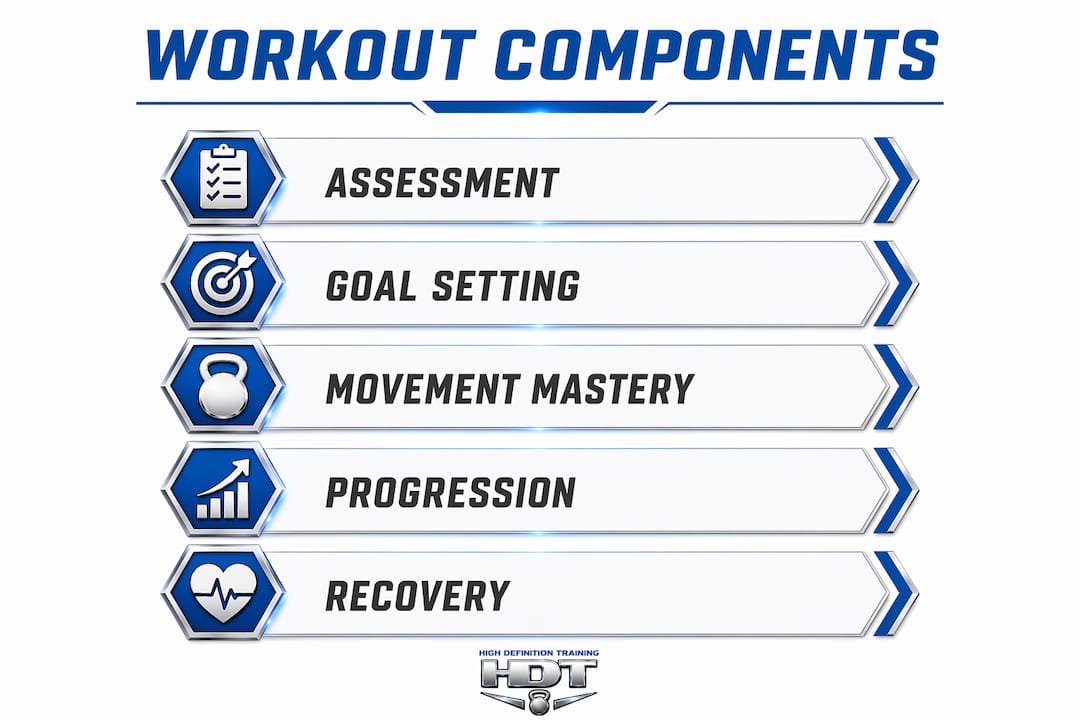
Every effective individualized plan shares five core components. Each one serves a specific purpose, and removing any one of them weakens the whole structure.
- Exercise selection: Movements are chosen based on your goals, available equipment, and physical limitations. A woman with knee pain does not do the same lower-body work as someone without it.
- Sets, reps, and intensity: Load, rate of perceived exertion (RPE), and percentage of maximum effort are prescribed specifically for your current fitness level. This is not guesswork. It is calculated dosage.
- Training frequency and schedule: The number of sessions per week is built around your actual life, not an ideal one. A 3-day plan followed consistently beats a 5-day plan skipped regularly.
- Rest and recovery periods: Recovery is programmed, not left to chance. Deload weeks, rest days, and sleep targets are part of the plan.
- Progression rules: The plan includes clear rules for when and how to increase difficulty. Without progression, results plateau.
Pro Tip: Ask your trainer to show you the progression rule in your plan before you start. If they cannot explain when and how your workouts will get harder, the plan is not truly customized.
The most effective programs for women over 40 use a small, repeatable set of movements mastered over 8–12 weeks rather than constant variety. Variety feels exciting but slows skill development and makes progress harder to measure. Mastery of a limited set of movements builds real strength and confidence.
How does a customized workout program specifically benefit women over 40?
The benefits of customized workouts go well beyond preference. The science is specific, and the results are measurable.
A clinically studied 3-month individualized program with moderate intensity 2–3 times per week reduced body fat, blood pressure, and blood lipid levels in adults. Those are markers that matter enormously for women over 40, where metabolic health becomes a primary concern. A generic plan does not target those outcomes with the same precision.
Personalized plans also reduce injury risk by 25–35% by considering somatotypes and individual recovery capacity. That number reflects a real difference in how the body responds when exercise is matched to its current state rather than forced into a template. For women over 40, that protection is not a luxury. It is a requirement for staying in the game long enough to see results.
The specific advantages for this age group include:
- Bone density support: Correct resistance training dosage stimulates bone remodeling without overloading joints.
- Reduced injury risk: Exercises are selected to respect existing mobility limitations and joint health.
- Improved adherence: Personalized plans increase adherence by up to 40% compared to generic ones, because the plan fits real life.
- Metabolic health gains: Targeted intensity management supports fat loss and cardiovascular markers.
- Functional strength: Movements are chosen to improve daily life capacity, not just gym performance.
Women over 40 benefit most from programs that prioritize recovery and progressive overload over volume or maximal effort. Working harder is not the goal. Working at the right level, consistently, is.
How is a customized workout program created and adjusted over time?
Building a personalized fitness plan follows a clear process. Skipping any step produces a weaker result.
- Initial assessment: A qualified trainer evaluates your goals, current fitness level, health history, available equipment, and schedule. This assessment takes 30–60 minutes and forms the foundation of everything that follows.
- Program design: The trainer selects exercises, sets, reps, intensity levels, and a weekly schedule targeting specific adaptations. Every choice connects back to your assessment data.
- Progress tracking: You track measurable benchmarks at regular intervals. Strength numbers, body measurements, and energy levels all count as data points.
- Scheduled reviews: Programs are reviewed and updated every 4–8 weeks to reflect your strength gains and changing needs. Without reviews, even a great plan becomes stale.
- Ongoing adjustment: Life changes. Stress levels, sleep quality, and work demands all affect recovery. A good plan adjusts to those realities rather than ignoring them.
Pro Tip: Keep a simple training log, even just notes on your phone. When your trainer reviews your program, that log gives them real data to work with instead of guesses.
AI-generated workouts can serve as an initial framework but require human expertise to adjust for burnout signs, stress levels, and individual nuances. Technology is useful for tracking and structure. It cannot replace a coach who watches you move, reads your energy, and knows when to push and when to pull back. For women over 40, that human element is especially valuable because daily fluctuations in energy and recovery capacity are more pronounced.
High Definition Training builds every program through this exact process, starting with a pressure-free assessment and moving into a plan that evolves with you. That structure is what separates a one-on-one training relationship from a generic class or app.
What practical tips help women over 40 get the most from their plan?
Knowing what a tailored workout is matters less than actually sticking to one. These practices make the difference between a plan that works and one that collects dust.
- Prioritize consistency over complexity. A manageable workout done three times a week produces better results than an ambitious program done once. The most important success factor in any fitness plan is adherence, not perfection.
- Schedule deload weeks. Reducing training volume by about 40% every 3–4 weeks prevents burnout and joint fatigue. Deload weeks are not rest weeks. They are recovery weeks that let your body absorb the work you have done.
- Adjust to your daily state. On high-stress days, reduce intensity rather than skipping entirely. A lighter session still builds the habit and keeps momentum going.
- Master a small movement set. Focus on 6–8 exercises and get genuinely good at them before adding new ones. Mastery builds strength faster than variety.
- Use coaching or tracking tools. Whether that means a personal trainer, a fitness journal, or a wearable device, external feedback keeps you honest and motivated.
Pro Tip: If you miss a week, do not try to make up for lost time by doubling your next session. Return to where you left off. Overcompensating after a break is one of the most common causes of injury for women over 40.
Sustainable fitness routines share one trait: they are built around real life, not an idealized version of it. The goal is a plan you can follow for years, not one that burns you out in months.
Key Takeaways
A customized workout program works because it matches exercise selection, intensity, and progression to your specific body, goals, and life, producing better adherence, fewer injuries, and measurable results.
| Point | Details |
|---|---|
| Personalization drives adherence | Tailored plans increase consistency by up to 40% compared to generic programs. |
| Assessment comes first | A 30–60 minute initial evaluation shapes every exercise, set, and schedule decision. |
| Deload weeks are non-negotiable | Reducing volume by about 40% every 3–4 weeks prevents burnout and protects joints. |
| Reviews keep progress moving | Programs need updates every 4–8 weeks to reflect strength gains and life changes. |
| Consistency beats complexity | A manageable 3-day plan followed reliably outperforms an ambitious plan skipped often. |
Why I think most women over 40 are sold the wrong kind of “personalized” fitness
The word “personalized” gets used loosely in the fitness industry. A quiz that spits out a workout template is not a customized program. A class that offers modifications is not individualized exercise prescription. Real customization requires someone who knows your history, watches you move, and adjusts the plan when your life changes.
What I have seen consistently at High Definition Training is that women over 40 do not need more intensity. They need better structure. The clients who make the most progress are not the ones who train the hardest in the first month. They are the ones who train at the right level, recover properly, and show up again next week.
The other thing most articles get wrong is the role of deload weeks. Women over 40 often feel guilty for taking an easier week. They should not. A scheduled reduction in volume is not a sign of weakness. It is a sign that the program is designed by someone who understands physiology. Skipping deloads is one of the fastest ways to accumulate joint fatigue and lose motivation.
Efficiency matters more than effort. A home workout plan built around six well-chosen movements, done consistently, will outperform a complicated program done sporadically every single time. The best plan is the one you actually follow.
— Angel
Personalized training at High Definition Training in the Bronx
High Definition Training works with women over 40 in the Throgs Neck and Pelham Bay area of the Bronx who want a fitness plan built around their actual life, not a generic template.
Every client starts with a pressure-free assessment that covers goals, health history, fitness level, and schedule. From there, a coach builds a plan with clear progression rules, scheduled reviews, and hands-on guidance to keep you safe and moving forward. The focus is on building strength, improving metabolic health, and creating habits that last. Women who train at High Definition Training track real benchmarks and see measurable results within weeks. If you are ready to work with a coach who specializes in personal training for women over 40, the first step is a conversation.
FAQ
What does a customized workout program mean?
A customized workout program is a training plan built specifically around your goals, fitness level, physical limitations, schedule, and equipment. It uses structured progression and regular reviews to keep results moving forward.
How is a personalized workout different from a generic plan?
A personalized workout accounts for your individual recovery capacity, joint health, and lifestyle constraints. Generic plans apply the same exercises and intensity to everyone, which increases injury risk and reduces adherence.
How often should a customized workout program be updated?
Programs should be reviewed and adjusted every 4–8 weeks to reflect strength gains, life changes, and evolving goals. Without regular updates, even a well-designed plan stops producing results.
Why do women over 40 need a tailored workout plan?
Women over 40 face specific challenges including hormonal shifts, changes in bone density, and longer recovery times. A tailored plan addresses those factors directly, reducing injury risk and supporting long-term metabolic health.
What is a deload week and why does it matter?
A deload week reduces training volume by about 40% to allow the body to recover from accumulated fatigue. Scheduled every 3–4 weeks, deloads prevent burnout and protect joint health, especially for women over 40.