
TL;DR:
- Personal trainers create flexible, efficient workout plans that accommodate the busy schedules of women over 40. They adapt sessions for stress, travel, and sleep, ensuring consistency and progress despite life disruptions. Regular accountability and personalized scheduling help women maintain healthy habits and achieve results long-term.
A personal trainer is a certified fitness professional who designs, adjusts, and delivers workout programs based on your real life, not an idealized version of it. For women over 40 juggling careers, family, and everything in between, the role of personal trainer in a busy schedule goes far beyond counting reps. It means building a system that fits your actual week, not the one you wish you had. The industry standard of 30–60-minute sessions two to three times per week shows that effective training does not require hours at the gym. High Definition Training, based in the Throgs Neck and Pelham Bay areas of the Bronx, NY, specializes in exactly this kind of practical, results-driven fitness coaching for women over 40.
How personal trainers design workouts around a busy schedule
Flexible programming is the foundation of the benefits of personal training for busy schedules. A skilled trainer does not hand you a fixed six-day plan and expect you to make your life fit around it. The program bends to your week, not the other way around.

Scheduling around your real windows
Flexible session windows like 6–8 AM and 7–8:30 PM are standard practice for trainers who work with busy clients. Early morning sessions get the workout done before the day’s demands pile up. Evening slots serve women whose mornings are consumed by school drop-offs or early meetings. The key is that your trainer identifies which windows are genuinely available to you, not which ones sound good in theory.
Shorter formats that still deliver results
Consistent results in strength, energy, and body composition come from two to three focused sessions per week lasting 30–60 minutes. That finding matters because it removes the excuse that you need ninety-minute workouts to make progress. A trainer uses formats like circuit training, supersets, and compound movements to pack real stimulus into a short window.
Here is what a time-efficient session structure looks like in practice:
- 5 minutes: Dynamic warm-up targeting the joints you will use most
- 20–30 minutes: Compound strength work (squats, deadlifts, rows, presses)
- 10–15 minutes: Metabolic finisher or core work
- 5 minutes: Cool-down and mobility
Pro Tip: If you have only 30 minutes, tell your trainer before the session starts. A good trainer will already have a modified plan ready rather than cutting the session short mid-workout.
Adjusting intensity week to week
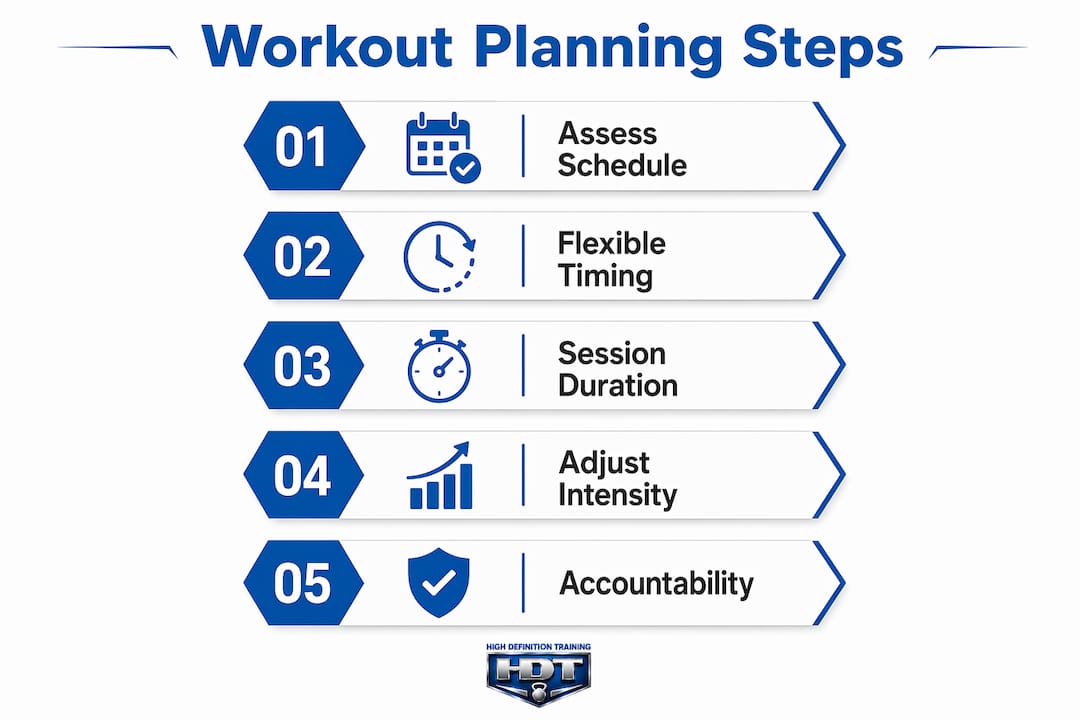
No two weeks are the same when you are managing a full life. A trainer tracks your schedule changes and adjusts volume accordingly. A heavy travel week calls for a lower-volume plan. A lighter week at work is the right time to push harder. This dynamic adjustment is what separates personal training for busy professionals from a generic gym program that ignores your life entirely.
How accountability keeps you consistent when motivation fades
Accountability is the primary driver of consistency for busy women, and it works by eliminating decision fatigue. Having a trainer creates a non-negotiable commitment that removes the daily question of whether you will work out. That question is already answered.
Decision fatigue is real and measurable. By the time a busy woman reaches 6 PM after a full workday, she has made hundreds of small decisions. The mental energy needed to choose to exercise, plan the workout, drive to the gym, and push through it is often depleted. A scheduled appointment with a trainer eliminates all of those decisions at once.
“The goal is enough good choices consistently, rather than rigid adherence to complex plans.” — Sweat Society Fitness
Accountability works through several specific mechanisms:
- Scheduled appointments function like work meetings. You do not cancel a client call without a reason. Your training session carries the same weight.
- Progress tracking gives you visible evidence of forward movement. Seeing strength numbers climb week over week is a powerful motivator on days when energy is low.
- Structured plans remove the guesswork. You arrive knowing exactly what you are doing, which shortens the mental ramp-up time.
- Regular check-ins let your trainer catch early signs of burnout or schedule drift before they become a full lapse.
Women who build consistency through personal training report that the relationship itself becomes part of the habit. The trainer knows your history, your stressors, and your goals. That context makes every session more efficient and more motivating than working alone.
Adapting workouts for stress, sleep, and travel demands after 40
Personal trainers who work with women over 40 act as what fitness professionals call a “chief of staff” for your health. Effective fitness management for time-poor clients means adjusting workout volume based on stress, sleep quality, and travel rather than following a rigid plan regardless of circumstances. That approach prevents the burnout and injury that rigid programs cause.
Here is how a skilled trainer adapts your program across four common scenarios:
- High-stress work week. The trainer reduces session volume by 30–40% and shifts the focus from intensity to movement quality. You still train. You do not dig a deeper recovery hole.
- Poor sleep or illness. Strength work is replaced with mobility, light cardio, or restorative movement. Skipping entirely is rarely the right call. Showing up in a modified form keeps the habit alive.
- Travel. Your trainer builds a minimum viable routine using bodyweight exercises that require no equipment. A 20-minute hotel room circuit beats a missed week every time.
- Family peak periods (school breaks, holidays, caregiving demands). Sessions may be shortened to 30 minutes or moved to the early morning. The trainer reconfigures the week’s plan in advance rather than reacting after you have already missed two sessions.
Pro Tip: Tell your trainer about upcoming stressors at the start of each week, not after you have already missed a session. Proactive adjustment keeps your momentum intact.
Recovery management is especially relevant for women over 40 because hormonal changes affect how quickly the body bounces back from hard training. A trainer who understands this will periodize your program to include planned lighter weeks, which actually accelerate long-term progress rather than slowing it down.
Practical strategies for fitting workouts into your daily routine
The most effective fitness coaching for busy women treats workout scheduling the same way a good executive treats their calendar: protect the time, reduce friction, and plan for disruptions. Integrating workouts into a busy life means identifying power hours and removing low-value tasks or logistical friction, such as long commutes to a gym.
Finding your power hours
A power hour is a block of time in your day when energy is naturally higher, and interruptions are lower. For many women over 40, this is early morning before the household wakes up, or a lunch break that is rarely used for actual rest. Your trainer helps you identify these windows through an honest audit of your weekly schedule.
Reducing logistical friction
| Friction source | Trainer-led solution |
|---|---|
| Long commute to gym | In-home training or nearby private studio |
| Packing a gym bag | Trainer brings equipment to your location |
| Deciding what to do | Pre-written session plan sent the night before |
| Skipping due to fatigue | Modified 20-minute session instead of canceling |
| Schedule conflicts | Same-week rescheduling policy built into your agreement |
- In-home training removes the commute entirely. The time you save traveling is time you can spend recovering or sleeping.
- Nearby private studios like those used by High Definition Training in the Bronx reduce the friction of a large commercial gym without sacrificing equipment quality.
- Advance scheduling means your workout is on the calendar before the week starts. Reactive scheduling almost always loses to competing demands.
When you hire a personal trainer with experience working with busy women, ask specifically about their rescheduling policy and how they handle weeks when life goes sideways. The answer tells you everything about whether their program will actually work for your life.
Key takeaways
A personal trainer’s core value for busy women over 40 is building a flexible, accountable system that fits real life, not an ideal one, so that consistent progress happens regardless of schedule disruptions.
| Point | Details |
|---|---|
| Flexible scheduling matters | Sessions at 6–8 AM or 7–8:30 PM protect workout time without conflicting with work. |
| Short sessions deliver results | Two to three sessions of 30–60 minutes per week produce consistent strength and body composition gains. |
| Accountability removes decision fatigue | Scheduled trainer appointments eliminate the daily choice of whether to work out. |
| Adaptive programming prevents lapses | Trainers adjust intensity in response to stress, travel, and sleep rather than sticking to a rigid plan. |
| Reducing friction builds habits | In-home training and advance scheduling remove the logistical barriers that cause women to skip. |
What 10 years of working with busy women over 40 taught me
The most common thing I hear from new clients is some version of “I know what to do, I just can’t seem to do it.” That sentence used to frustrate me. Now I recognize it as the most honest thing a person can say about fitness.
The problem is rarely knowledge. Women over 40 who come to me are smart, capable, and fully aware that exercise matters. The problem is that their system, or lack of one, cannot survive contact with a real week. One canceled session becomes two. Two becomes a month. The habit dissolves not from laziness but from a program that was never built for their actual life.
What I have found actually works is treating fitness like a non-negotiable appointment rather than a preference. The women who make the most progress are not the ones who are most motivated. They are the ones who show up even when the session is shortened to 25 minutes because that is all the day allows. Consistency over perfection is not a motivational slogan. It is the literal mechanism by which results happen.
The other thing I have learned is that women over 40 often need permission to train less intensely during hard weeks. There is a guilt around “easy” sessions that does not serve anyone. A lighter week is not a failure. It is sustainable fitness in practice. The goal is to be still training at 60, 70, and beyond. That requires protecting the habit above all else.
— Angel
Personal training in the Bronx built for your real schedule
High Definition Training serves women over 40 in the Throgs Neck and Pelham Bay areas of the Bronx, NY, with personal training designed around demanding schedules, not despite them.
Every program at High Definition Training starts with an honest look at your actual week, energy patterns, stress load, and goals. Sessions are available in flexible morning and evening windows, and the training itself is built to deliver results in 30–60 minutes. Whether you prefer a private studio setting or need the convenience of training close to home, the focus is always on building a system that holds up when life gets complicated. Explore training options and find a schedule that works for you.
FAQ
What does a personal trainer do for a busy schedule?
A personal trainer designs flexible, time-efficient workout programs that fit around your real weekly demands, including early morning or evening sessions, shorter high-intensity formats, and adaptive planning for travel or high-stress periods.
How many sessions per week do busy women over 40 need?
Two to three sessions per week lasting 30–60 minutes each produce consistent improvements in strength, energy, and body composition for most busy women.
How does a personal trainer help with motivation and consistency?
A trainer creates scheduled appointments that function as non-negotiable commitments, removing decision fatigue and providing progress tracking that keeps adherence high even when schedules fluctuate.
What should I look for when hiring a personal trainer with a busy schedule?
Prioritize trainers who offer scheduling flexibility, have experience working with busy professionals, and have a clear rescheduling policy for weeks with conflicts.
Can a personal trainer help if my schedule changes every week?
Yes. Adaptive programming is a core part of what skilled trainers do. They adjust session length, intensity, and timing based on your current week rather than following a fixed plan that ignores real-world demands.