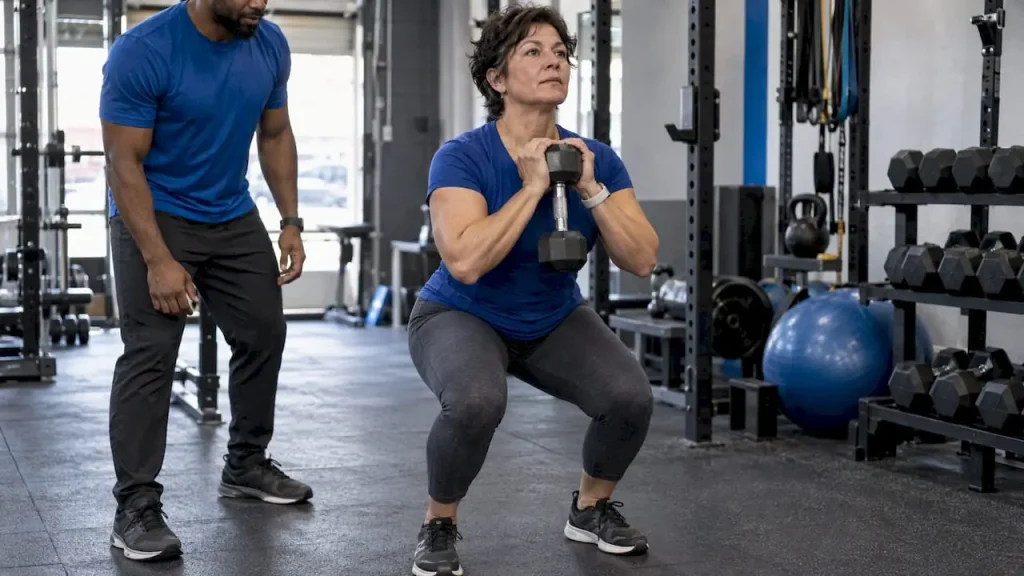
Power training over 40 develops your ability to combine strength with movement speed. For women, that can mean standing up briskly from a chair, driving up a low step, or moving a manageable weight with purpose and control. Appropriately selected exercises can fit into a regular strength routine without requiring advanced athletic skills.
Think about the life you want to keep living. Getting off the floor. Climbing the stairs with confidence. Keeping up with your family. Feeling capable when a movement needs a little more speed.
This guide explains how power training over 40 works, what the research supports, and how to introduce it with sensible progressions. Your starting point should reflect your movement skills, health history, and recovery.
TL;DR
- Power = force x speed. Use moderate loads (roughly 30-70% of your one-rep max), lift fast, lower slowly.
- A meta-analysis of older adults found power training beat traditional strength training for improving muscle power and function.
- Build a base of basic strength first. Plyometrics (jumps, throws) come later and start small.
- Leave at least 48 hours before training the same big muscle groups again.
- Pelvic floor symptoms, joint pain or a new exercise plan after a health event call for a clinician’s input and a coach who modifies, not pushes.
What is Power Training Over 40?
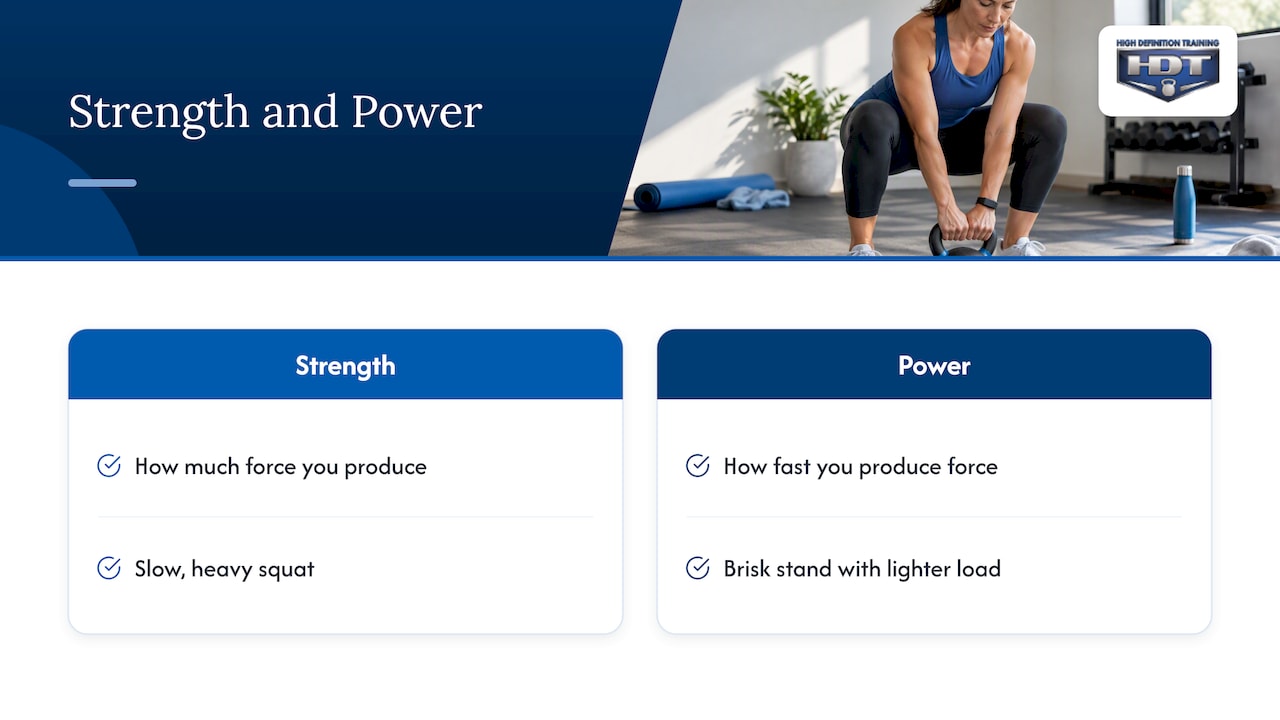
Strength is your ability to produce force. Power combines force with the speed of movement. In simple terms, power = force × velocity.
A challenging squat performed at a steady pace can develop strength. Using a lighter, appropriate load and standing up with fast intent places more emphasis on power. The squat pattern stays controlled; the purpose of the repetition changes.
For exercises such as squats and step-ups, lower smoothly, establish your position, then drive up briskly. Throws, swings, and jumps have different movement demands and need their own coaching cues.
You use this combination of strength and speed when rising from a low seat or moving quickly up a step. Power training over 40 gives you a structured way to practice that quality alongside regular resistance exercise.
Why women should pay attention to muscle power
Research in older adults suggests that muscle power often declines faster than maximal strength. That makes it a useful quality to train as part of an active, independent life.
A 2022 systematic review and meta-analysis included 15 trials and 583 participants. Power training produced greater improvements in muscle power and pooled functional-test performance than traditional strength training.
The studies involved populations with an average age over 65. Their findings support the approach, but they do not predict a particular result for every woman in her 40s. The review also did not establish that these programs prevent falls.
For power training over 40, the practical lesson is to include some appropriately coached speed work while continuing to build strength, balance, and endurance.
Menopause and bone health
The menopause transition can involve changes in body composition and bone health. The Menopause Society identifies perimenopause as an important time to address physical activity and other lifestyle habits.
One year-long trial in postmenopausal women found that faster resistance training better maintained bone density at the lumbar spine and total hip than slower training. This was a small study within a broader exercise program, so the result should be interpreted carefully.
Power training over 40 can be one part of a broader exercise plan. It is not a substitute for osteoporosis assessment, treatment, or an individualized loading plan when bone fragility is present.
Build strength before adding speed
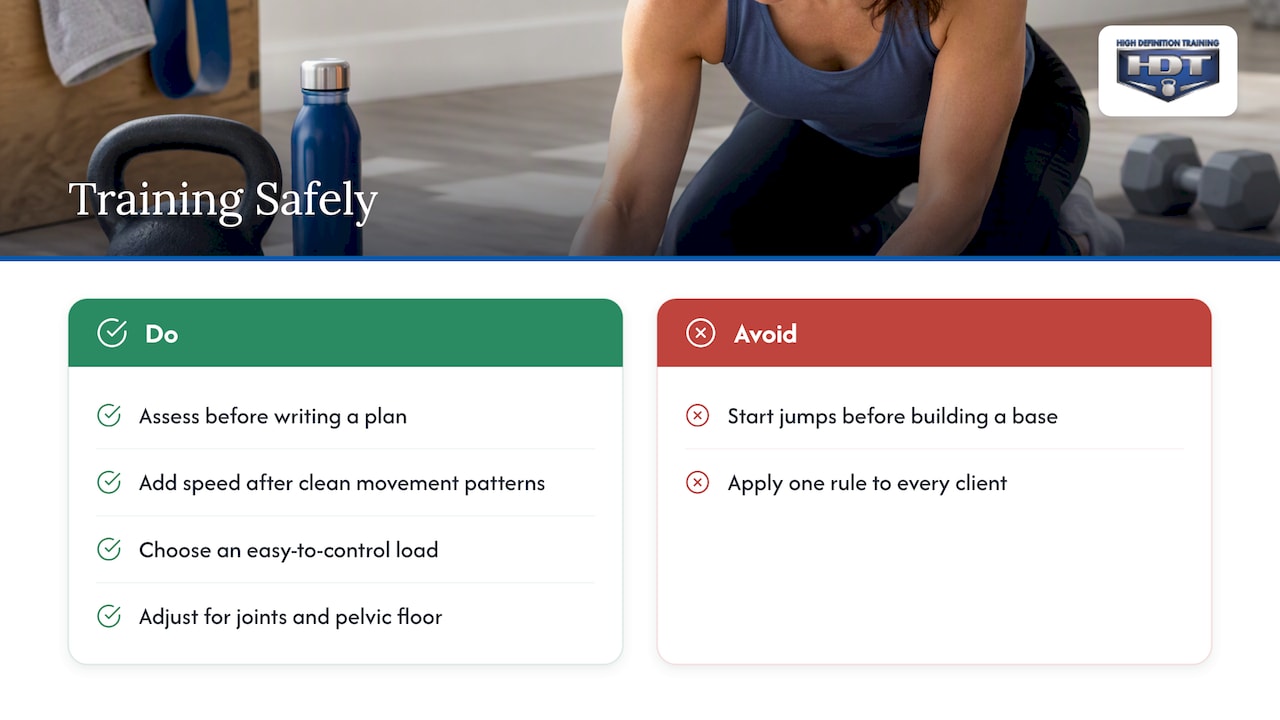
Before starting power training over 40, establish movements you can repeat confidently. You should be able to control your squat, hinge at the hips, push and pull against resistance, and maintain a stable position during each exercise.
There is no universal rule that everyone must train for exactly four weeks before adding speed. Your movement quality and response to exercise matter more than a date on the calendar.
If you are returning after a long break, use our guides to starting strength training over 40 and beginner strength workouts to understand the foundation.
A practical readiness check
Discuss these points with your coach:
Can you rise from a suitable chair or box without losing balance?
Can you control the lowering phase of your squat?
Can you perform a light hip hinge without your position breaking down?
Do your selected exercises feel comfortable during the session and afterward?
Can you stop a repetition deliberately instead of relying on momentum?
These are coaching prompts, not a medical screening test. Power training over 40 should begin with the version of an exercise that fits your current ability.
How to start power training over 40
Choose a load you can move well
The 2026 ACSM resistance-training update recommends roughly 30–70% of one-repetition maximum for power development, with an emphasis on moving the weight quickly during the lifting phase.
You do not need to test your heaviest possible lift to begin. A coach can select a conservative starting load and adjust it based on control, effort, and movement speed.
During power training over 40, a repetition should look purposeful and coordinated. If you must grind, twist, or strain to finish, reduce the load or stop the set.
Keep repetitions short and rest properly
For a familiar, controlled lifting exercise, one practical starting example is:
2–3 sets of 3–5 repetitions.
A brisk lifting effort and a controlled return.
About 2–3 minutes between loaded sets, with more time when needed.
Finish before speed or technique noticeably deteriorates.
This is an adjustable example, not a prescription for every exercise. The ACSM guide to power for older adults gives rest periods of 2–5 minutes for weighted power exercises and 60–120 seconds for medicine-ball drills and jumps.
The purpose of rest is to let you repeat a high-quality effort. A shorter break is not automatically a better workout.
Fit it into your week
Start by including one or two suitable power movements near the beginning of your strength sessions, after warming up. You can organize power training over 40 within two weekly sessions rather than adding another demanding workout day.
The Physical Activity Guidelines for Americans recommend strengthening all major muscle groups on at least two days each week. The National Institute on Aging advises avoiding consecutive days for the same muscle groups.
Often that means allowing about 48 hours between similar sessions. Adjust the spacing when soreness, poor sleep, or reduced performance tells you that you need more recovery.
Exercises and progressions
Choose exercises based on your balance, movement skills, symptoms, and available supervision. This is a menu of options, not a ladder everyone must complete.
| Starting point | Exercise | Main coaching cue |
| Foundation | Sit-to-stand or box squat | Stand briskly; sit back down with control. |
| Foundation | Light dumbbell or kettlebell deadlift | Establish the hinge, then stand with a purposeful hip drive. |
| Foundation | Low step-up with support available | Keep the whole foot on the step; drive up and lower smoothly. |
| Coached progression | Goblet squat with fast lifting intent | Use a manageable weight and keep the trunk steady. |
| Coached progression | Light medicine-ball chest pass | Throw toward a suitable wall or partner; reset between repetitions. |
| Skill-dependent option | Kettlebell swing | Use a well-practiced hip hinge; learn the rhythm with coaching. |
| Optional impact work | Small hop or low jump | Practice stable takeoffs and landings before adding height or volume. |
Power training over 40 does not require you to master every exercise on this list. A few well-chosen movements can serve your goals.
Do you need plyometrics?
Plyometrics use a rapid stretch-and-shortening action, often through hops, jumps, or bounding. They can be useful, but jumping is optional in power training over 40.
Start with movements that keep your feet supported, such as brisk sit-to-stands or low step-ups. If impact work becomes appropriate, your coach can introduce a small number of low jumps and assess how you land and recover.
Keep the landing stable, with knees and hips bending comfortably. The height, surface, footwear, and your previous training all influence the demands. Landing sound alone does not tell you whether a drill is suitable.
Progress gradually. A jump should earn its place in your program by matching your goals and capacity.
Pelvic floor, joint, and bone considerations
If lifting or jumping brings on leaking, pelvic heaviness, pressure, or a bulging sensation, modify the activity and seek guidance from your gynecologist or a pelvic floor physical therapist before progressing. ACOG discusses pelvic support symptoms and treatment options.
Those symptoms do not mean you have failed at exercise. They give you information about what needs attention. You can also read our pelvic floor fitness guide.
Power training over 40 should also be adapted when you have osteoporosis, a current injury, persistent joint pain, or restrictions after a health event. Coordinate with your clinician when your condition affects which exercises or loads are appropriate.
A sample week of power training over 40
This example is for someone who already tolerates basic strength exercises. It uses two full-body sessions so the main muscle groups receive regular attention. Adjust the exercises, volume, and rest to the individual.
Monday — Full-body strength with a lower-body power focus
Warm-up and movement practice: 5–10 minutes.
Box squat with a brisk stand: 2–3 sets of 3–5.
Romanian deadlift at a controlled pace: 2 sets of 8.
Supported dumbbell row: 2 sets of 8 per side.
Incline push-up: 2 sets of 6–10.
Supported calf raise: 2 sets of 8–12.
Side plank or another suitable trunk exercise: 2 comfortable sets.
Thursday — Full-body strength with an upper-body power focus
Warm-up and movement practice: 5–10 minutes.
Light medicine-ball chest pass: 2 sets of 5, with a suitable wall or partner.
Goblet squat or sit-to-stand: 2 sets of 8.
Light hip hinge or glute bridge: 2 sets of 8.
Resistance-band or cable row: 2 sets of 8–10.
Dumbbell chest press: 2 sets of 8.
Supported calf raise: 2 sets of 8–12.
A comfortable carry or trunk exercise: 2 short sets.
Use the rest guidance above for the power exercises. For the remaining strength work, rest until you can repeat the exercise with control.
On other days, include walking, balance practice, mobility, and recovery as appropriate. Power training over 40 works within this wider routine. It does not need to dominate every session.
For equipment options and structure, see our home workout plan for women over 40.
Common mistakes to avoid
Choosing too much weight. If the intended fast movement turns into a slow grind, adjust the load.
Rushing the setup. Start from a position you can control.
Letting fatigue dictate technique. Place power work early and stop when quality drops.
Turning every set into conditioning. Give yourself enough recovery to move well again.
Adding impact too quickly. Jumping is one option, not a requirement.
Ignoring your response afterward. Persistent pain or steadily declining performance calls for an adjustment.
With power training over 40, progress can mean cleaner repetitions, better control, or an appropriate increase in resistance. Our guide to progressive overload for women explains how to build a longer-term progression.
My approach as a coach
I have been coaching in the Bronx since 2006, and I founded High Definition Training in Throgs Neck in 2009. My priority is helping you build a routine that supports the life you want to keep living.
When I introduce power training over 40, I want the exercise to make sense for the person in front of me. That means looking at movement quality, choosing a suitable load, and paying attention to how the work feels during the session and afterward.
Sometimes the right change is a lower box. Sometimes it is a lighter weight, more rest, or a different exercise altogether. Those decisions are part of coaching.
You deserve a plan that challenges you at an appropriate level and gives you room to grow. Confidence develops as you understand your exercises and see what you can do.
— Coach Angel Perez, CSCS, CPT
Personal coaching in Throgs Neck and Pelham Bay
If you want help adding power training over 40 to your routine, High Definition Training offers personalized coaching for adults over 40 in the Bronx, including women who want to build strength and move with more confidence.
Our 60-Day Transformation Program provides a structured starting point with an assessment, personalized strength and mobility work, progress tracking, and accountability.
Contact HDT to arrange your complimentary assessment. We will discuss your goals and help you find an appropriate next step.
Frequently asked questions
Is power training over 40 suitable for beginners?
It can be, when the exercise and progression fit your current ability. Start with familiar, controlled movements and introduce speed gradually. A brisk sit-to-stand may be appropriate before more technical exercises such as swings or jumps.
How often should I include power exercises?
A practical starting point is a few sets within two nonconsecutive strength sessions each week. Frequency and volume should reflect your recovery, experience, and the exercises you choose.
Can I do power training over 40 without jumping?
Yes. Brisk sit-to-stands, low step-ups, and appropriately coached medicine-ball throws can train power without repeated jumping. Select movements that suit your balance and joint tolerance.
Is power training the same as HIIT?
No. HIIT alternates vigorous exercise with recovery periods, often to improve cardiorespiratory fitness. Power training emphasizes producing force at speed, with enough rest to maintain the quality of each effort.
Should power training replace regular strength training?
For most readers, power training over 40 is an addition to a balanced program. Keep building strength while also making room for walking or other aerobic activity, balance, mobility, and recovery.
Sources
- Effectiveness of power training compared to strength training in older adults (systematic review and meta-analysis)
- Power for Older Adults, ACSM
- Working with Older Adults? Don’t Skimp on Strength Training, ACSM
- ACSM Publishes Updated Resistance Training Guidelines
- Power training vs. strength training for bone mineral density in postmenopausal women
- Metabolic effects of menopause, The Menopause Society
- Physical Activity Guidelines for Americans, 2nd edition
- 5 things I wish all women knew about pelvic organ prolapse, ACOG