
Progressive Fitness Programs for Women Over 40
TL;DR:
- Progressive overload involves gradually increasing training demands to promote continuous adaptation in women over 40.
- Structured programs emphasizing volume, tempo, and exercise variation lead to strength gains and fat loss while minimizing the risk of injury.
- Regular deload weeks, smart progression methods, and program variation ensure sustainable progress and long-term results.
Progressive overload is defined as the systematic increase of training demands over time to force continued physical adaptation. For women over 40, examples of progressive fitness programs built on this principle deliver measurable gains in strength, fat loss, and overall well-being without the injury risk associated with random, high-intensity effort. The American College of Sports Medicine endorses structured frequency and recovery as the foundation of any effective program. The key insight: progression is not just about lifting heavier. Volume, tempo, and exercise variation all count.
1. What do progressive fitness programs for beginners over 40 look like?
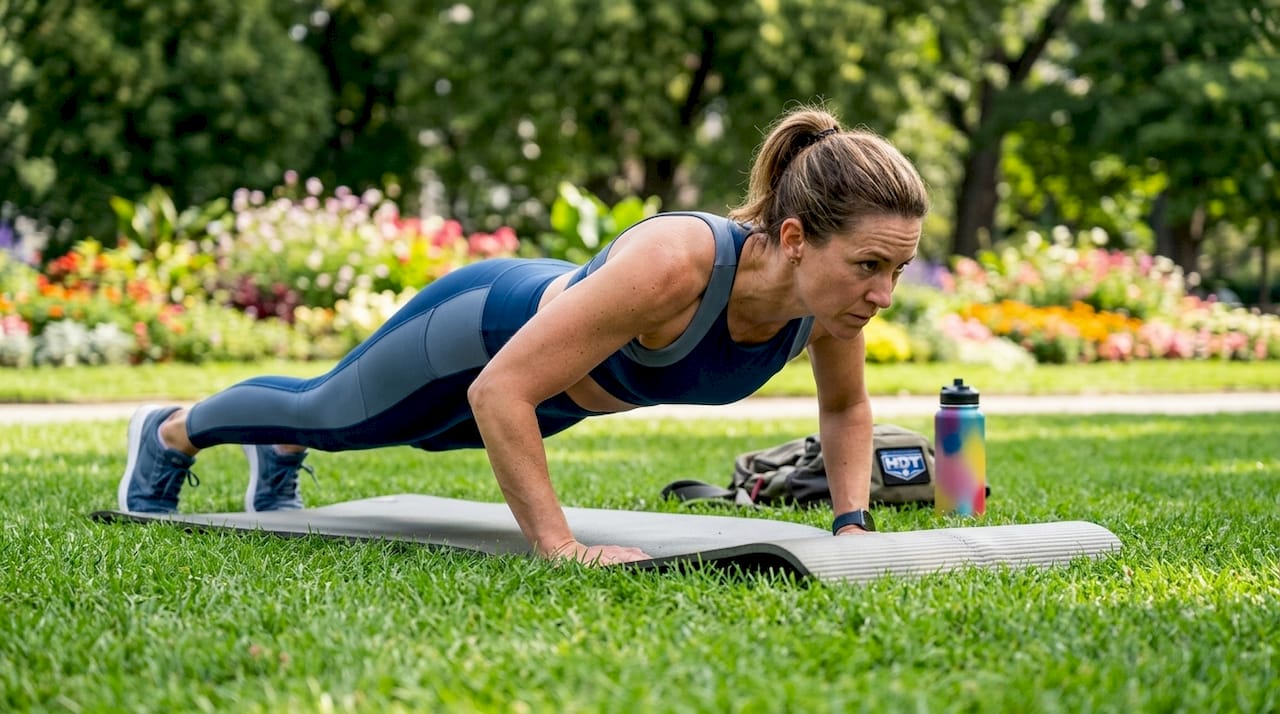
The most effective starting point for women over 40 is a 3-day full-body program built around compound movements. Three sessions per week, with 48 hours of rest between sessions, maximize neuromuscular adaptation while keeping injury risk low. Sessions run 30–60 minutes and center on movements like squats, push-ups, and glute bridges.
A well-structured 8-week beginner program moves through four clear phases:
- Foundation (weeks 1–2): Learn movement patterns. Keep reps moderate and focus on form over load.
- Volume (weeks 3–4): Add one extra set per exercise. Total weekly volume increases without touching intensity.
- Intensity (weeks 5–6): Increase weight slightly while reducing reps. The body adapts to heavier demands.
- Integration (weeks 7–8): Combine volume and intensity at a manageable level. Consolidate gains before moving to an intermediate program.
Full-body 3-day programs deliver strength gains comparable to 5-day splits for beginners, with significantly less fatigue. That means you get results without burning out in the first month.
Pro Tip: Track every session in a notebook or app. Seeing your reps and weights increase week over week is the single most motivating factor for long-term consistency.
2. How to use double progression to build strength without stalling
Double progression is the most practical method for women over 40 who want steady strength gains without having to guess. The method works by choosing a target rep range, typically 8–12 reps, and a starting weight you can lift with solid form.
Here is how it works in practice:
- Start at the bottom of the range. If your target is 8–12 reps, begin with 8 reps at your chosen weight.
- Each session, add one rep. Move from 8 to 9 to 10 to 11 to 12 over successive workouts.
- Once you hit 12 reps with good form, add 2.5–5 lbs and drop back to 8 reps.
- Repeat the cycle. Progress is automatic and measurable.
This method manages fatigue well because you are not pushing maximum weight every session. It also protects joints by keeping loads controlled during the rep-building phase. For a practical example, apply double progression to three exercises per session: a squat pattern, a push pattern, and a hinge pattern. That structure covers the full body in every workout.
Pro Tip: If you miss a rep target for two consecutive sessions, do not add weight. Stay at the same load until you hit the top of the range cleanly. Patience here prevents injury.
3. Fitness program variations: dumbbell splits, upper/lower splits, and bodyweight progressions
Once you move past the beginner stage, program variations keep your body adapting and your motivation high. Three proven structures work well for women over 40.
Dumbbell push/pull/legs (PPL) split: This format divides training by movement type. Push days cover chest, shoulders, and triceps. Pull days target back and biceps. Leg days focus on quads, hamstrings, and glutes. A 3-day version trains each pattern once per week. A 6-day version trains each pattern twice. For women over 40 managing recovery, the 3-day option is the smarter starting point.
Upper/lower 4-day split: This structure pairs upper- and lower-body sessions on alternating days. A typical week looks like: upper Monday, lower Tuesday, rest Wednesday, upper Thursday, lower Friday. The 4-day format increases weekly volume compared to a 3-day program while still building in two full rest days. It suits women who have built a solid base and want to increase training frequency without overloading any single muscle group.
Bodyweight progressions: The American College of Sports Medicine supports bodyweight resistance training as a valid method for beginners and intermediates. Progression occurs by advancing to more advanced exercise variations rather than adding weight. Push-ups progress from wall to incline to floor to archer variations. Squats progress from chair-assisted to bodyweight to single-leg. This approach works well for women who train at home or travel frequently.
Switching between these variations every 8–12 weeks prevents adaptation plateaus and keeps training fresh. The key is maintaining progressive overload within whichever structure you choose.
4. How structured variability and deload weeks enhance long-term progress
Periodization is the formal term for organizing training into planned phases. For women over 40, a 4-week progression cycle is the most practical and sustainable format.
| Week | Phase | Focus |
|---|---|---|
| Week 1 | Baseline | Establish working weights and movement quality |
| Week 2 | Volume | Add sets or reps; keep load the same |
| Week 3 | Intensity | Increase load; reduce volume slightly |
| Week 4 | Deload | Cut volume by 30–40% and reduce weight by 10% |
The deload week is not optional. Deloading after 4–6 weeks of progressive overload allows the nervous system and connective tissue to recover fully. Skipping it leads to accumulated fatigue that shows up as stalled progress, poor sleep, or nagging joint pain.
Beyond load, three other variables drive adaptation without stressing joints:
- Density: Shorten rest periods by 15–30 seconds per cycle.
- Volume: Add one working set every two weeks before increasing weight.
- Eccentric tempo: Slow the lowering phase of each rep to three or four seconds. This increases muscle tension without adding load.
"Progression is not only about adding weight. Density, volume, and tempo manipulation are key tools for joint safety and sustainable progress, especially for women over 40 managing recovery alongside life demands."
Tracking Rate of Perceived Exertion (RPE) alongside reps in reserve (RIR) gives you a reliable daily read on your recovery status. Aim for 1–2 reps left in the tank at the end of each set. That target keeps training stress productive without pushing into territory that raises injury risk.
5. Practical tips for maintaining progress and adapting programs over time
Long-term results come from consistency, not from any single perfect program. These principles keep women over 40 moving forward across months and years.
- Perfect form before adding load. Movement quality protects joints and builds the neuromuscular patterns that make heavier training safe later. A rep done poorly does not count.
- Accept maintenance phases. Not every training block should be about chasing new personal records. Solidifying strength during high-stress periods, hormonal shifts, or busy seasons of life is a legitimate and productive goal.
- Switch exercises to break plateaus. If goblet squats have stalled, try Bulgarian split squats. The new stimulus forces adaptation without requiring heavier weight.
- Use RPE to manage daily readiness. If your RPE on a warm-up set feels unusually high, reduce the session load by 10–15%. Pushing through fatigue accumulates injury risk over time.
- Balance frequency with life demands. Frequency and total weekly volume matter more than split complexity. Two solid sessions per week beat four inconsistent ones every time.
- Track multiple progress metrics. Weight on the bar is one measure. Reps completed, rest time needed, and how a movement feels are equally valid signs of progress.
The women who make the most consistent gains are not the ones who train hardest. They are the ones who train smartly, recover well, and show up week after week.
Key takeaways
Progressive overload, applied through structured phases and smart recovery, is the most reliable path to strength and fat loss for women over 40.
| Point | Details |
|---|---|
| Start with 3-day full-body training | Three compound sessions per week, with 48-hour rest intervals, maximize adaptation and safety for beginners. |
| Use double progression | Increase reps before adding weight to build strength steadily without overloading joints. |
| Rotate program variations | Switch between dumbbell splits, upper/lower formats, and bodyweight progressions every 8–12 weeks. |
| Deload every 4–6 weeks | Reduce volume by 30–40% to let the nervous system recover and prevent plateaus. |
| Track RPE, not just weight | Keeping 1–2 reps in reserve each set protects joints and sustains long-term training viability. |
What I have learned coaching women over 40 through progressive programs
The biggest mistake I see is treating every training session like a test. Women come in wanting to prove something, and they push past the point where the session is productive. That approach works for a few weeks. Then the shoulder starts aching, sleep gets worse, and motivation drops. The program gets blamed when the real issue was the pace.
Structured progression fixes this. When you follow a sustainable fitness routine with planned phases and built-in deloads, you stop guessing and start trusting the process. The progress feels slower at first. Then you look back after 12 weeks and realize you are squatting weight you could not have imagined lifting in week one.
The other thing I have seen repeatedly is that women over 40 respond exceptionally well to visible metrics beyond the scale. Rep counts, rest time reductions, and exercise progressions all signal real physical change. When a client moves from an incline push-up to a full floor push-up, that is a strength gain worth celebrating. Tying progress to multiple markers keeps motivation alive through the inevitable weeks when the scale does not move.
Maintenance phases are not failure. They are part of the plan. Hormonal shifts, stress, and life demands are real training variables. A smart program accounts for them instead of fighting them.
— Angel
Personalized progressive training at High Definition Training
High Definition Training works with women over 40 in the Throgs Neck and Pelham Bay area of the Bronx who want a program built around their actual life, not a generic template. Every client starts with a pressure-free introductory process that identifies current fitness level, recovery capacity, and specific goals.
Coaches at High Definition Training apply the same principles covered in this article: compound movement foundations, phased progression, planned deloads, and form-first coaching. The personalized training classes are designed to fit busy schedules while delivering measurable results. Many clients report significant gains in strength and confidence within the first few weeks. If you are ready to follow a program built specifically for where you are right now, High Definition Training is the place to start.
FAQ
What is progressive overload in fitness?
Progressive overload is the practice of gradually increasing training demands, such as weight, reps, or volume, to force continued physical adaptation. It is the core principle behind every effective strength-and-fat-loss program.
How many days per week should women over 40 train?
Three full-body sessions per week, with 48 hours of rest between sessions, is the most effective starting point. Frequency and total weekly volume matter more than training split complexity.
What are the best examples of progressive fitness programs for beginners?
A beginner strength program built on compound movements like squats, push-ups, and glute bridges, and progressed through 8-week phases, delivers strong results with a low risk of injury.
What is a deload week and why does it matter?
A deload week reduces training volume by 30–40% and weight by 10% to allow the nervous system and connective tissue to recover. Deloading every 4–6 weeks prevents plateaus and protects the viability of long-term training.
Can you progress without adding weight?
Yes. Advancing to harder exercise variations, adding sets, shortening rest periods, and slowing the eccentric phase of each rep all drive adaptation without increasing load. These methods are especially useful for women training at home.