

Structured Workout Program Explained: Your Complete Guide
TL;DR:
- A structured workout program is a planned system that links daily sessions to long-term fitness goals and promotes steady progress.
- Its core value lies in eliminating guesswork, ensuring each session has a purpose and builds on previous efforts.
- For adults over 40, personalized programs that prioritize movement quality and recovery yield better results and reduce the risk of injury.
A structured workout program is a planned, progressive, and measurable training system that maps daily sessions to long-term goals. Without one, you're essentially making fitness decisions on the fly — which sounds flexible but usually means slower progress, higher injury risk, and a lot of wasted effort.
The core value is simple: structure removes guesswork. Instead of walking into the gym wondering what to do, every session has a purpose, every week builds on the last, and your body adapts predictably. A structured exercise program maps training splits, frequency, exercise order, volume, and progression into a system that actually works.
Every solid program contains these elements:
- Periodization levels: macrocycle (the full plan), mesocycle (4–12 week blocks), microcycle (weekly/daily sessions)
- Session structure: warm-up, primary lifts, accessory work, conditioning, cooldown
- Progression rules: how and when to increase load, reps, sets, or density
- Recovery built in: planned deloads and rest days, not afterthoughts
Pro Tip: When you're short on time, cut isolation work and extra conditioning first. Protect the warm-up and compound lifts — those two elements drive the majority of your adaptation.
How does a workout program break down into cycles?
Periodization is the architecture of any serious training plan. It organizes your program into nested time blocks, each serving a different purpose.
- Macrocycle: The full training year or multi-month plan. A 12-month macrocycle might cycle through a fat-loss phase, a strength-building phase, and a maintenance phase.
- Mesocycle: A focused 4–12 week block with a specific goal — hypertrophy, strength, power, or conditioning. This is where most people actually "live" in their programming.
- Microcycle: The weekly (or daily) training unit. Your Monday/Wednesday/Friday full-body split is a microcycle.
Progression flows upward: you add a rep or a few pounds each microcycle, and those small gains accumulate into a measurable strength or body composition shift by the end of a mesocycle. By the end of the macrocycle, you've completed multiple focused blocks that each fed the next.
| Cycle | Duration | Primary Function | Example |
|---|---|---|---|
| Macrocycle | multi-month | Long-term goal sequencing | Year-long strength and fat-loss plan |
| Mesocycle | several weeks | Phase-specific adaptation | 8-week hypertrophy block |
| Microcycle | about a week | Session-level execution | Mon/Wed/Fri full-body training week |
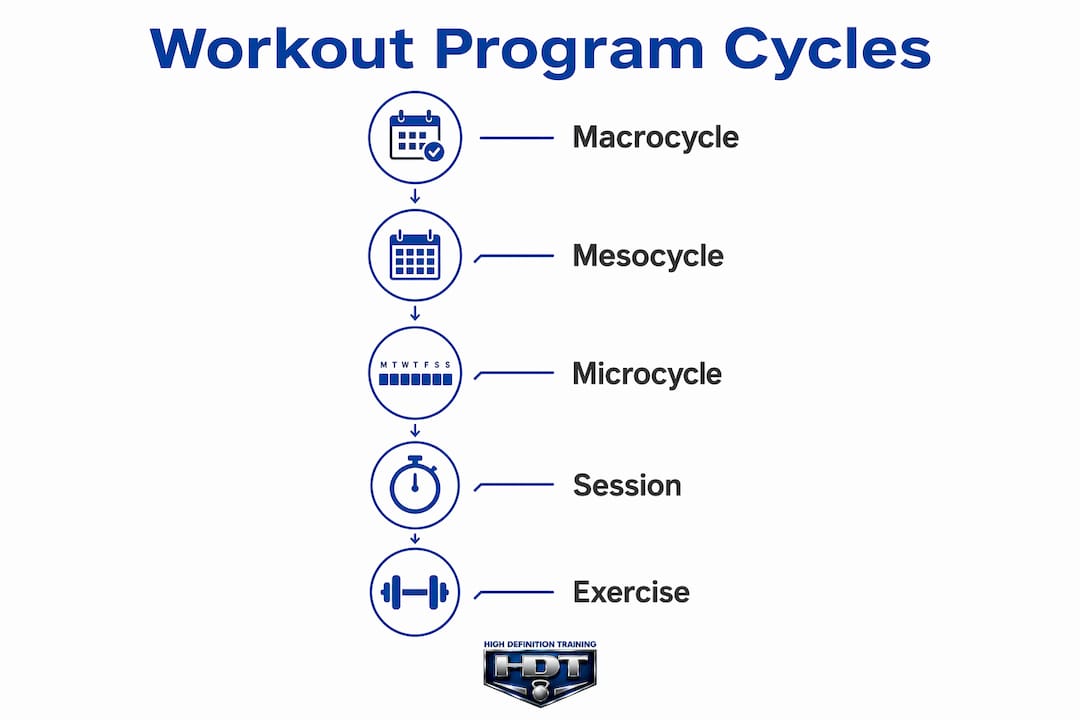
The goal you choose determines how you set cycle length and focus. A beginner aiming to build a strength base might run two consecutive 8-week mesocycles before reassessing. Someone training for a 5K would structure their macrocycle around race day, with mesocycles targeting aerobic base, then speed, then taper.
What are the core principles that make a program actually work?
Five evidence-based principles separate a real program from a random collection of exercises. Core training principles include progressive overload, specificity, individuality, recovery, and reversibility — and the best programs apply all five together.
- Progressive overload: The body adapts only when challenged beyond its current capacity. You can progress by adding weight, reps, sets, or by shortening rest periods. Pick one variable to manipulate per phase.
- Specificity: Your training must match your goal. Doing three miles on the treadmill every day won't build the leg strength you need for squatting. Design sessions around the outcome you want.
- Individuality: Two people following the same program will get different results. Recovery capacity, injury history, sleep quality, and schedule all affect how your body responds. A good program accounts for this.
- Recovery: Adaptation happens between sessions, not during them. Planned deloads every several weeks and adequate sleep are non-negotiable parts of the program, not optional extras.
- Reversibility: Fitness gains disappear faster than they're built. Missing two weeks of training noticeably affects performance. Consistency, not intensity, is the long game.
Pro Tip: Volume and recovery are in constant tension. If you're consistently sore going into sessions, that's not a badge of honor — it's a signal to reduce weekly sets or add a recovery day before you hit a plateau.
What should every workout session actually include?
A complete session has six components, and their order matters. Session sequencing follows this logic: prepare the body, hit the hardest work first, then layer in accessory and conditioning work before cooling down.
- Dynamic warm-up (5–10 minutes): mobility drills, light cardio, activation work
- Compound strength movements: squats, deadlifts, presses, rows — these demand the most from your nervous system and should come when you're freshest
- Accessory/isolation work: single-joint exercises that target weak points or add volume to specific muscles
- Conditioning: cardio intervals or circuits, placed after strength to avoid pre-fatiguing the muscles you need for lifting
- Mobility/flexibility work: static stretching and tissue work belong at the end, when muscles are warm
- Cooldown: light movement and breathing to bring heart rate down
Weekly balance shifts depending on your primary goal. Training each muscle group at least twice per week generally produces superior strength and hypertrophy gains compared to once-weekly frequency, with a total weekly volume of 10–20 sets per muscle group as an effective hypertrophy range.
| Goal | Recommended Split | Weekly Sessions | Key Emphasis |
|---|---|---|---|
| General fitness | 3-day full body | 3 | Compound lifts, moderate cardio |
| Hypertrophy | 4-day upper/lower | 4 | Volume emphasis adjusted for individual variation |
| Strength | 4-day push/pull/legs | 4–5 | Heavy compounds, low rep ranges |
| Fat loss | 3-day full body + 2 cardio | 5 | Strength retention, caloric deficit |
How do you build a structured program from scratch?
Building a program is a five-step process. Skip any step, and you'll likely end up with a plan that doesn't fit your life or your body.

Step 1: Define your goal. Be specific. "Get stronger" is not a goal. "Add 25 pounds to my squat in 12 weeks" is.
Step 2: Assess your baseline. Note your current lifts, movement limitations, available training days, and recovery capacity. This is your starting point, not your identity.
Step 3: Choose your frequency. Most adults can train productively multiple days per week, often around 3 to 4. More isn't always better, especially if sleep and nutrition aren't dialed in.
Step 4: Select primary lifts. Prioritize compound movements early in a beginner mesocycle. Add isolation work as technique and capacity improve.
Step 5: Set your progression method. Linear progression (add weight each session) works well for beginners. Intermediate trainees often need wave loading or double progression (add reps before adding weight).
Sample 12-week beginner strength mesocycle
| Phase | Weeks | Focus | Weekly Sets per Lift | Progression |
|---|---|---|---|---|
| Foundation | 1–4 | Technique + baseline strength | 3 sets × 8–10 reps | Add 5 lbs when all reps are clean |
| Build | 5–8 | Volume increase | 4 sets × 6–8 reps | Add 5 lbs or 1 rep per session |
| Peak | — | Intensity, heavier loads | 4–5 sets × 4–6 reps | Add 5–10 lbs, reduce reps |
| Deload | Week 12 | Recovery and reassessment | 2–3 sets × 8 reps | No progression — active recovery |
Reassess at the end of week 12. Compare your baseline numbers to your current lifts, note how your body feels, and use that data to design your next mesocycle. For beginner strength programming that accounts for the specific needs of adults over 40, the foundation phase often extends to 6 weeks to allow more time for movement quality before loading increases.
What measurable benefits does a structured program deliver?
Structured training produces better measurable progress and reduces wasted time compared to random workouts. The benefits aren't abstract — they show up in specific, trackable ways.
- Strength and load increases: You can measure these session to session. A log showing your squat increase from 95 lbs to 145 lbs over 12 weeks is proof that the program worked.
- Consistent training frequency: Structure makes it easier to show up. Removing daily decision-making is the primary psychological lever for adherence — you don't decide whether to train, only when.
- Reduced injury incidence: Planned progression prevents the "too much, too fast" pattern that causes most overuse injuries.
- Time efficiency: Every session has a purpose. You're not wandering between machines or repeating the same workout because you can't remember what you did last week.
Simple metrics worth tracking: load lifted per exercise, total sets completed, rate of perceived exertion (RPE), training frequency per week, and body composition proxies such as waist measurements or progress photos every 4 weeks.
Pairing a structured program with habit-stacking strategies — attaching your workout to an existing daily trigger — further improves long-term consistency. The program gives you the plan; the habit system makes sure you actually follow it.
What mistakes will derail even a well-designed program?
Most programs fail not because the design was wrong, but because of predictable execution errors.
Red flag checklist — audit any program against these:
No written progression rules? It's not a program, it's a routine.
Skipping warm-ups to save time? You're trading 10 minutes now for weeks of recovery later.
Volume increasing every week with no deload planned? Overreaching is coming.
Changing exercises every session for variety? Novelty feels productive; consistency actually is.
Plateau lasting more than 3 weeks with no program adjustment? Time to reassess.
Skipping the warm-up is the most common time-saving mistake, and the most counterproductive. A proper dynamic warm-up primes the nervous system, reduces injury risk, and improves performance on the lifts that follow.
Chasing novelty disrupts adaptation. Your body needs repeated exposure to the same stimulus to get stronger at it. Swapping exercises constantly means you never accumulate enough volume on any movement to drive real change.
Mismatched volume and recovery is subtler. Persistent soreness going into sessions, declining performance, and loss of motivation are all signs the program is asking for more than your recovery can support.
Pro Tip: If you've plateaued for more than three weeks, the fix is rarely more volume. Check sleep, nutrition, and stress first — those three variables account for most unexpected plateaus.
How High Definition Training structures programs for adults over 40
Adults over 40 face a specific set of physiological realities: longer recovery windows, accumulated movement restrictions, and a lower tolerance for high-volume loading early in a program. A generic beginner plan built for a 25-year-old doesn't account for any of that.
At High Definition Training in the Throgs Neck and Pelham Bay area of the Bronx, program design for this population follows a modified approach:
- Extended foundation phase: 6 weeks of movement prep and technique work before significant loading begins
- Movement screening at intake: identifies restrictions and asymmetries that would cause injury under load
- Volume moderation: starting sets are deliberately conservative; progression is earned, not assumed
- Recovery emphasis: deloads are scheduled every 4 weeks rather than every 6, and sleep and nutrition are addressed as part of the program
- Session compression: for time-limited clients, high-efficiency gym sessions preserve compound lifts and warm-ups while trimming accessory volume
Clients at High Definition Training typically see measurable increases in strength within the first 6–8 weeks, alongside improvements in movement quality and daily energy. The benefits of personalized training compound over time precisely because the program is built around the individual's actual capacity, not a generic template.
Pro Tip: For adults over 40, the single most important session variable isn't load or volume — it's movement quality. A technically sound squat at 95 lbs builds more durable strength than a compromised squat at 145 lbs.
Key Takeaways
A structured workout program works because it combines planned progression, evidence-based principles, and built-in recovery into a system that produces measurable results over time.
| Point | Details |
|---|---|
| Definition | A structured program is a planned, progressive, and measurable system that links sessions to long-term goals. |
| Periodization levels | Macrocycles (6–12 months), mesocycles (4–12 weeks), and microcycles (weekly) nest to drive long-term progress. |
| Core progression rule | Train each muscle group at least twice per week; use 10–20 sets per muscle group for hypertrophy. |
| Biggest mistake to avoid | Skipping warm-ups and ignoring deloads undermines adaptation faster than any other error. |
| High Definition Training | Offers tailored 12-week programs for adults 40+ in the Bronx, with extended foundation phases and built-in recovery. |
Why structure is the most underrated fitness variable
Most people think the secret to better results is a harder workout. The real answer is a smarter one. Structure doesn't constrain your training — it frees you from the mental overhead of deciding what to do every time you walk through the door. That cognitive load is exactly what kills consistency for most adults.
The tension coaches actually manage isn't between hard and easy. It's between rigidity and flexibility. A program that can't bend when life gets in the way gets abandoned. But a program with no fixed rules adapts into chaos. The resolution is to make the principles non-negotiable (progressive overload, recovery, specificity) while keeping the execution flexible. Miss a session? Shift it. Traveling? Compress the week. The structure holds because the rules hold, not because every session went exactly as written.
For adults over 40 especially, this matters more than any specific exercise selection. The program that gets followed consistently — even imperfectly — will always outperform the theoretically perfect program that gets abandoned after six weeks.
High Definition Training: structured coaching for adults 40+ in the Bronx
If you've read this far, you already know what a well-built program looks like. The harder part is building one that fits your actual life, your movement history, and your recovery capacity — and then following it long enough to see real results.
High Definition Training does exactly that for adults over 40 in Throgs Neck and Pelham Bay. Every client starts with a movement assessment and a pressure-free intake process, then receives a personalized 12-week program tailored to their specific goals, schedule, and physical starting point: no generic templates, no guesswork, no pressure to keep up with a room full of 25-year-olds. The coaching is hands-on, the progression is deliberate, and the environment is built for people who are serious about lasting results.
Check out training classes and coaching options to see what a structured, coach-led program looks like in practice, or review pricing and packages to find the right fit for your goals.
FAQ
What is an example of structured exercise?
A 3-day full-body strength program in which each session follows a fixed order (squat, press, row, hinge), with logged weights and a clear rule for adding load each week, is a textbook example of structured exercise.
What is the 3-3-3 rule for workouts?
The 3-3-3 rule is an informal guideline suggesting 3 days of strength training, 3 days of cardio or active recovery, and 3 meals timed around training. It's a general framework, not a formally standardized protocol, and specific applications vary by source.
How do you structure a workout program?
Define your goal, assess your baseline, choose a training frequency (typically 3–4 days per week), select compound primary lifts, and set a progression method. Build in a deload every 4–6 weeks and reassess at the end of each mesocycle.
What does "structured exercise" mean?
Structured exercise means planned, purposeful physical activity with defined goals, a set sequence, and a method for progressing over time — as opposed to spontaneous or random activity with no progression logic.
How long should a beginner mesocycle be?
A beginner mesocycle typically lasts 8–12 weeks, with the first 4–6 weeks focused on movement quality and technique before significant load increases begin.
Ready to Build Your Structured Program?
Stop guessing and start progressing. Join High Definition Training and get a personalized 12-week program designed for your body, goals, and schedule.