
What Does a Personal Trainer Do for Adults Over 40?

TL;DR:
- A personal trainer creates customized exercise programs that improve safety, technique, and consistency for adults over 40.
- They assess, correct form in real time, and adapt workouts based on individual needs, reducing injury risk.
- Investing in a trainer offers better results, accountability, and safety compared to self-guided efforts or AI programs.
A personal trainer is a certified fitness professional who designs and delivers individualized exercise programs to help clients reach their health goals safely and effectively. The role goes far beyond counting reps. Trainers assess your movement, build structured programs, correct your technique in real time, and hold you accountable session after session. For adults over 40, that combination is not a luxury. It is the difference between results that last and injuries that set you back.
What does a personal trainer do in every session?
A personal trainer's core job is to remove guesswork from your fitness routine. Before writing a single workout, a qualified trainer conducts a fitness assessment covering your movement patterns, strength baseline, injury history, and goals. That assessment drives every programming decision that follows.
Certified trainers hold credentials from nationally recognized bodies such as NASM, ACE, ACSM, NSCA, and ISSA. These certifications require 3–4 months of study in anatomy, exercise science, and program design. That depth of knowledge is what separates a qualified trainer from someone who leads you through a workout.
During each session, a trainer watches your form and delivers real-time corrections. This is called biofeedback coaching, and it is one of the most underrated parts of the job. A squat that looks fine to you may reveal a hip shift or knee cave that a trained eye catches immediately.
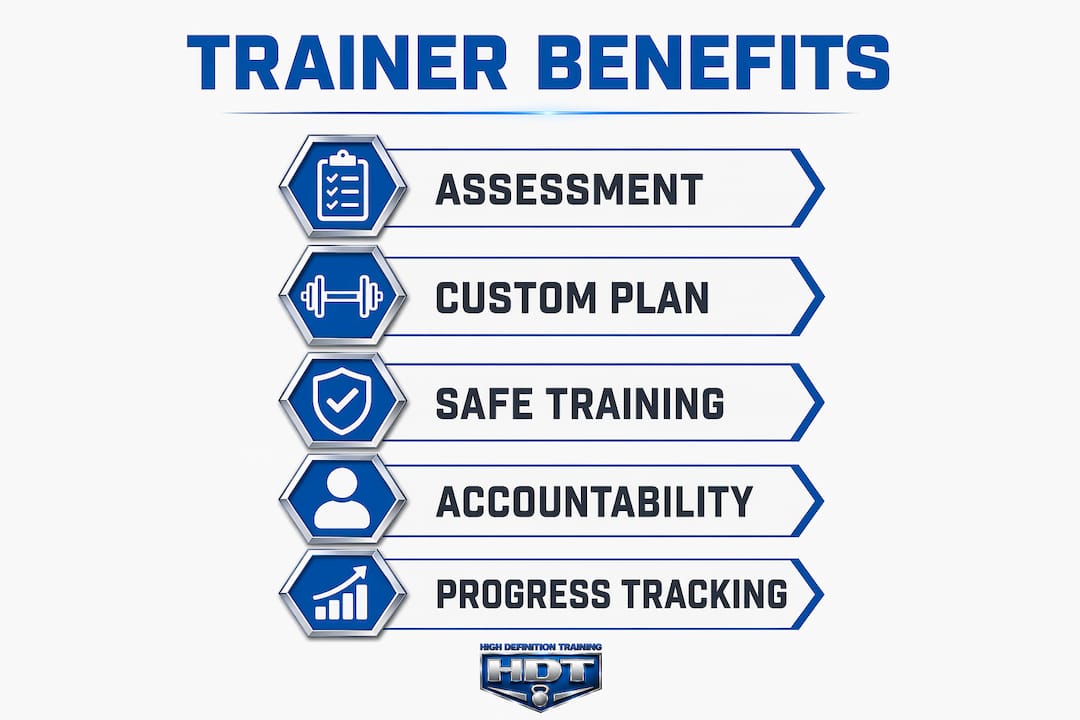
Here is what the role covers in practice:
- Fitness assessment: Evaluating posture, mobility, strength, and cardiovascular baseline before programming begins
- Program design: Writing structured plans that adjust volume, intensity, and exercise selection based on your biomechanics and recovery capacity
- Technique coaching: Correcting movement patterns in real time to prevent injury and build efficient habits
- Progress tracking: Measuring results against your goals and adjusting the plan when progress stalls
- Nutrition guidance: Offering general advice on macronutrients, portion control, and healthy habits without crossing into medical territory
- Motivation and accountability: Keeping you consistent when motivation fades
Pro Tip: Ask your trainer to explain why each exercise is in your program. A qualified trainer can connect every movement to your specific goal or limitation. If they cannot, that is a red flag.
The behind-the-scenes programming work adjusting volume, intensity, and exercise selection based on your biomechanics is where much of the real value lives. Success depends on plan customization, not just workout intensity.
How do personal trainers help adults over 40 train safely?
Adults over 40 face a specific set of physical realities: slower recovery, reduced joint mobility, hormonal shifts, and a higher cost for training errors. A personal trainer addresses all of these directly.

The first tool is a thorough movement assessment. Trainers identify postural imbalances, mobility restrictions, and compensatory patterns that develop over decades of desk work, repetitive movement, or past injuries. Corrective exercises target these weaknesses before they become injuries.
Real-time biofeedback coaching is especially critical for this age group. Proper motor patterns take time to build, and a trainer acts as your external feedback system until those patterns become automatic. This builds a foundation of strength that is safe and sustainable for years, not just weeks.
The data on outcomes is clear:
| Metric | Training with a trainer | Training alone |
|---|---|---|
| Program adherence | 88% | 52% |
| Weight loss over 12 weeks | 30% more | Baseline |
| Injury risk | 30% lower | Baseline |
These outcomes reflect a consistent pattern: structured, supervised training produces better results than self-guided effort. For adults over 40, the injury reduction figure alone justifies the investment.
Gradual progression is another key adaptation. Trainers apply the principle of progressive overload carefully, increasing load or complexity only when your body is ready. That patience prevents the overuse injuries that sideline so many adults who return to exercise after a break.
Pro Tip: Tell your trainer about any joint discomfort, even if it seems minor. Trainers who specialize in adults over 40 will modify exercises around those limitations rather than push through them.
The goal of one-on-one training is not to make you dependent on a trainer forever. High-quality trainers teach fundamental movement patterns and training principles so you build confidence and knowledge over time.
Why does accountability matter more than motivation?
Motivation is unreliable. Accountability is a system. This distinction is the most important thing to understand about what personal trainers offer beyond the workout itself.
A scheduled appointment with a trainer creates a psychological commitment that a solo gym session does not. Clients who train with a trainer show markedly higher consistency than those following self-guided programs. Apps and AI programs have not replicated this effect. The human element, knowing someone is expecting you and tracking your progress, changes behavior in ways that a notification on your phone does not.
Effective trainers also function as behavioral coaches. A great trainer modifies your plan based on your stress levels, sleep quality, and recovery state rather than rigidly following a script. If you had a rough week at work, a skilled trainer adjusts the session intensity rather than pushing you into a hole you cannot recover from.
Here is what behavioral coaching looks like in practice:
- Checking in on sleep and stress before each session
- Scaling intensity down during high-stress periods to prevent burnout
- Celebrating small wins to reinforce consistency over perfection
- Adjusting goals when life circumstances change, such as travel or illness
- Providing structured check-ins between sessions to maintain momentum
Adaptability and accountability are the two qualities that separate effective trainers from average ones. For adults over 40, who often manage careers, family responsibilities, and health concerns simultaneously, a trainer who adapts is not a bonus. It is a requirement.
Accountability from a human trainer acts as training insurance against the inconsistency cycles that derail so many adults over 40. Inconsistency is the primary reason fitness efforts fail, and a trainer is the most reliable solution to that problem.
Is hiring a personal trainer worth the cost?
Personal training is an investment, and the return depends on what you compare it to. In-person training averages $440 per month, while AI-based programs run around $30 per month. The price gap reflects a difference in what you actually receive.
AI programs deliver structured workouts. They do not watch your knee cave during a lunge. They do not notice that your left shoulder is compensating for a weak rotator cuff. They do not call you out when you skip a session. For adults over 40, those real-time corrections and human accountability are not optional extras. They are the core product.
The return on investment also shows up in time. Structured 45-minute sessions with a trainer replace unfocused gym visits that stretch to 90 minutes with unclear results. You spend less time and get more done.
Pro Tip: When evaluating cost, factor in the cost of a single injury. Physical therapy, lost training time, and reduced quality of life add up quickly. A trainer who prevents one injury pays for months of sessions.
The adults who benefit most from personal training are those returning to exercise after a long break, managing chronic conditions or joint issues, working toward a specific goal with a deadline, or struggling to stay consistent on their own. If you fall into any of those categories, the personal training ROI calculation shifts strongly in favor of hiring a professional.
For budgeting, consider starting with two sessions per week and supplementing with independent workouts your trainer designs. This approach captures most of the accountability and coaching benefits at a lower monthly cost than daily sessions.
Key Takeaways
A personal trainer delivers structured, individualized coaching that produces measurably better results, safer movement, and far higher consistency than self-guided training, especially for adults over 40.
| Point | Details |
|---|---|
| Certified expertise matters | Trainers holding NASM, ACE, ACSM, NSCA, or ISSA credentials bring verified knowledge in anatomy and programming. |
| Accountability drives consistency | Clients training with a trainer show 88% adherence versus 52% for those training alone. |
| Safety is the priority for adults over 40 | Real-time biofeedback and corrective exercise reduce injury risk by 30% compared to unsupervised training. |
| Behavioral coaching beats motivation | Effective trainers adjust plans for stress, sleep, and recovery, keeping clients consistent when life gets hard. |
| Cost reflects real value | In-person training at $440 per month delivers accountability and correction that AI programs at $30 per month cannot replicate. |
What I have learned after years of training adults over 40
Most people think a personal trainer's job is to make workouts harder. That is the wrong frame entirely.
The trainers who produce lasting results for adults over 40 are the ones who know when to pull back. They read the room. They notice when a client walks in stiff, distracted, or exhausted, and they adjust. Pushing someone through a maximal effort session when their body is not ready is not coaching. It is a liability.
What clients rarely see is the planning that happens before they arrive. A good trainer spends real time reviewing your last session, your sleep notes, and your upcoming schedule before writing that day's workout. That preparation is invisible, but it is where the results come from.
Certifications matter, but communication matters more. I have seen highly credentialed trainers who cannot explain why an exercise is in a client's program. That is a problem. You should always understand the purpose behind what you are doing; when you understand the "why," you train with more intention and carry those habits outside the gym.
The trainers worth hiring are the ones who are working toward making themselves less necessary over time. They teach you to read your own body, recognize good form, and manage your own progression. That is the real goal. Not dependency. Confidence.
If you are over 40 and considering personal training, stop waiting for the "right time." Your body is not getting easier to train. The best investment you can make right now is in a trainer who respects where you are and builds a plan that meets you there.
— Angel
Personal training for adults over 40 in the Bronx
High Definition Training was built specifically for adults over 40 in the Throgs Neck and Pelham Bay area of the Bronx. Every program starts with a pressure-free assessment, not a hard sell.
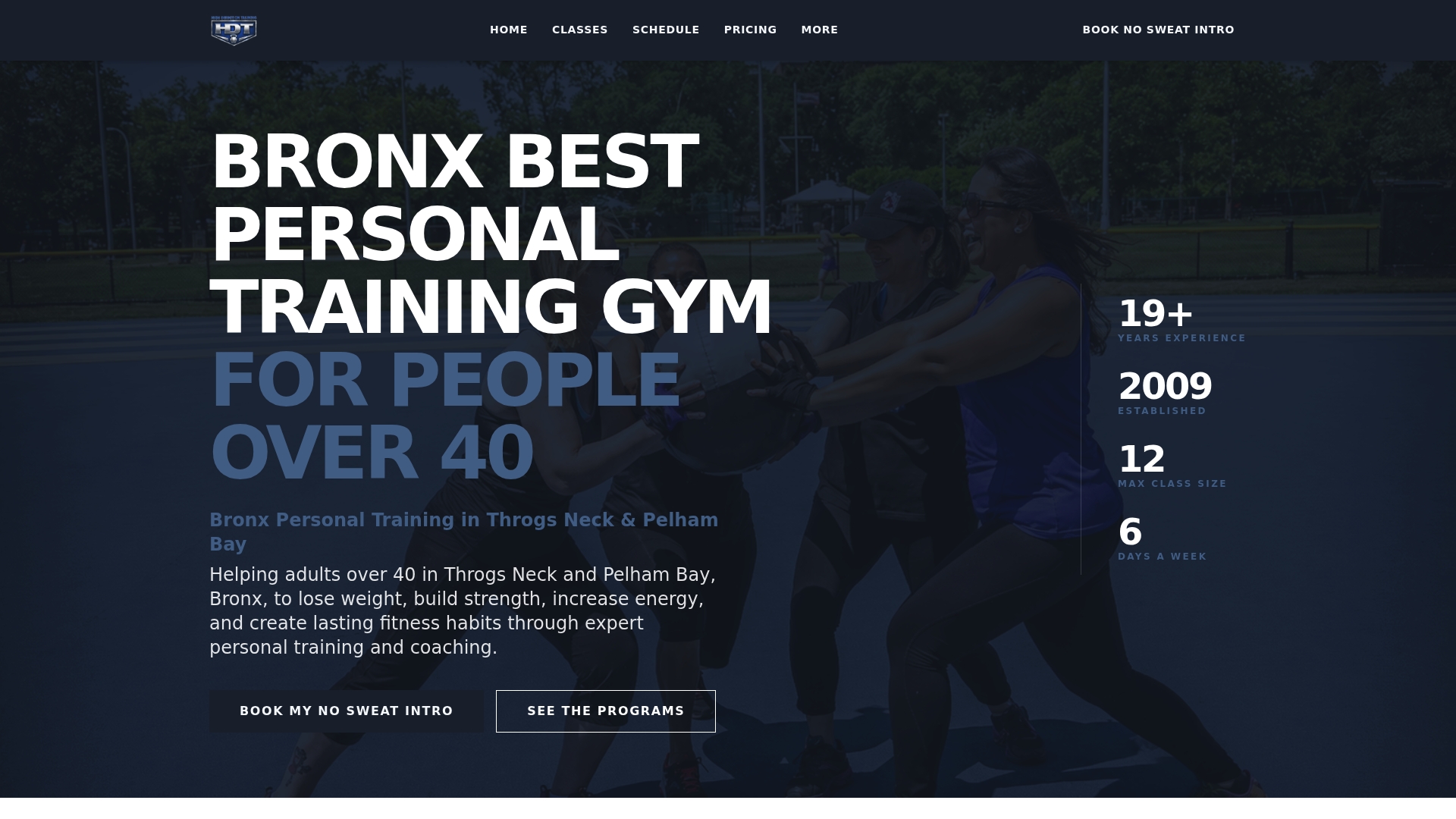
Trainers at High Definition Training design programs around your current fitness level, health history, and real goals, whether that means losing weight, building strength, or simply moving without pain. The coaching is hands-on, the environment is welcoming, and the results are measurable. Many clients report significant health milestones within their first few weeks. Browse the available training programs or review pricing and packages to find the right starting point for you.
FAQ
What does a personal trainer do in a typical session?
A personal trainer leads you through a structured workout tailored to your goals, corrects your form in real time, and tracks your progress. Sessions typically run 45–60 minutes and include warm-up, strength or conditioning work, and a cooldown.
Can a personal trainer customize workouts for adults over 40?
Yes. Qualified trainers assess your mobility, injury history, and recovery capacity to build programs that match your body's current needs. This customization is what makes personal training significantly safer and more effective than generic workout plans.
How do personal trainers help with injury prevention?
Trainers provide real-time biofeedback, catching compensatory movement patterns before they cause injury. Research shows that supervised training reduces injury risk by 30% compared to training without guidance.
Do personal trainers provide nutrition advice?
Trainers offer general nutrition guidance covering macronutrients, portion control, and healthy eating habits. They do not prescribe medical diets or treat conditions. For clinical nutrition needs, a registered dietitian is the appropriate professional.
How often should adults over 40 train with a personal trainer?
Two sessions per week is a practical starting point. Your trainer can design additional independent workouts to complement those sessions, giving you the benefits of hiring a personal trainer while building your confidence to train on your own.