
TL;DR:
- A positive mindset is crucial for long-term fitness success in women over 40, influencing persistence and enjoyment. Building self-efficacy, adopting an iterative approach, and developing resilience help women stay consistent and recover from setbacks. Training the mind with deliberate strategies enhances motivation and fosters lasting habits.
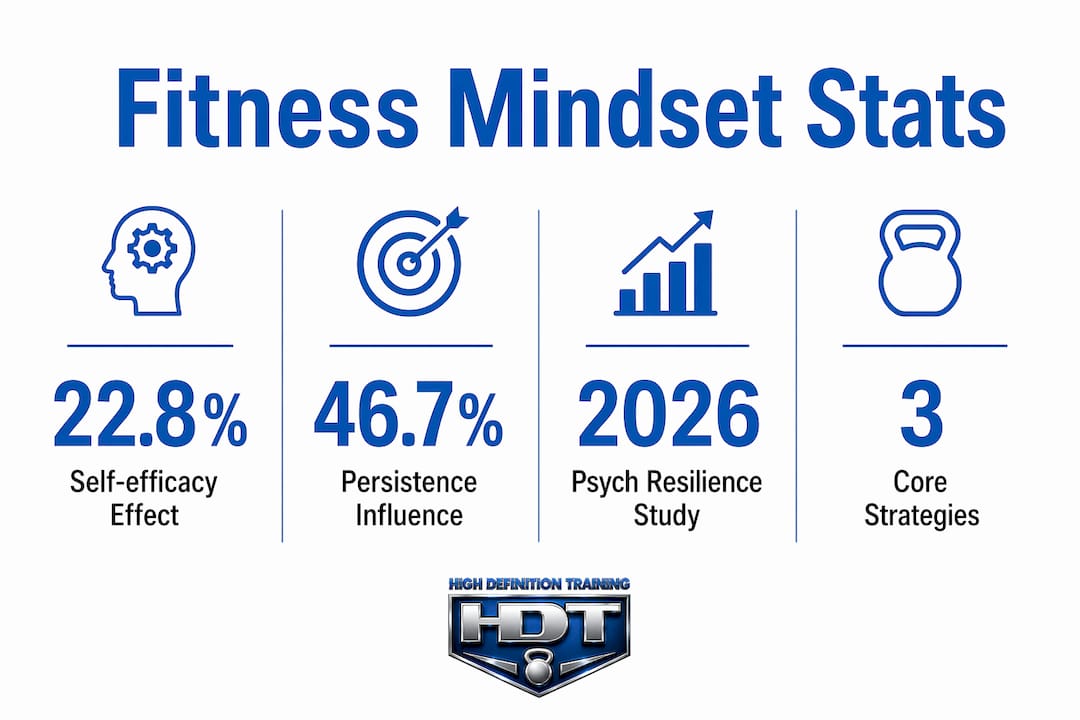
Mindset is the single most powerful predictor of long-term fitness success in women over 40. The role of mindset in women’s fitness goes far beyond motivation. It shapes how you respond to setbacks, how consistently you show up, and how much you actually enjoy the process. Research published in Frontiers in Psychology shows that self-efficacy explains 46.7% of the variance in fitness persistence among women. That number means your belief in your own ability matters more than your workout plan. High Definition Training builds every program around this reality.
How the role of mindset in fitness women shapes persistence
Self-efficacy is the technical term for your belief that you can successfully perform a specific behavior. In fitness, it means believing you can complete a workout, recover from a missed week, or push through a plateau. When that belief is strong, you persist. When it is weak, you quit, even when your body is fully capable.
Self-efficacy accounts for 22.8% of the mediation effect in sustained exercise behavior. That means it is not just one factor among many. It is the central driver. Women who score high on self-efficacy return to the gym after illness, adjust to schedule changes, and stay consistent across months, not just weeks.
Positive body image and self-worth feed directly into self-efficacy. When you feel good about what your body can do, rather than how it looks, your motivation becomes internal and durable. External motivation, like fitting into a dress or impressing someone, fades fast. Internal motivation, rooted in capability and strength, compounds over time.
Here are the core ways self-efficacy shapes your fitness outcomes:
- Persistence after setbacks. Women with high self-efficacy treat a missed week as a pause, not a failure.
- Effort during workouts. Belief in your ability directly increases how hard you push during training.
- Goal-setting behavior. High self-efficacy leads to setting realistic, progressive goals rather than all-or-nothing targets.
- Recovery from injury or illness. Confidence in your body speeds both physical and psychological recovery.
Pro Tip: Before your next workout, write down one thing your body did well last week. That single act builds self-efficacy faster than any motivational quote.
What is an iterative mindset, and why does it build lasting habits?
An iterative mindset means treating your fitness routine as a process you refine over time, not a program you either complete or abandon. It is the direct opposite of all-or-nothing thinking, which is the pattern that sends most women back to square one every few months.
A study of 370 individuals found that people who adopted an iterative mindset showed significantly higher rates of automatic healthy habits and weight loss success compared to those who relied on episodic bursts of effort. Episodic effort looks like going hard for three weeks, burning out, stopping, then restarting from scratch. Iterative effort looks like adjusting, continuing, and improving without drama.
The iterative process has three clear steps:
- Assess setbacks without emotion. When you miss workouts or eat off-plan, analyze what happened factually. Was it stress? Poor scheduling? Lack of sleep? Treat it like data, not a moral failure.
- Stay in-effort status. Sustainable fitness means never fully stopping. Even a 10-minute walk counts. The goal is to keep the habit alive, not to perform perfectly.
- Repeat what works. When a workout format, time of day, or training partner produces results, lock it in. Stop experimenting with what already works.
This approach is especially powerful for women over 40 because life is genuinely complex at this stage. Careers, family, health changes, and shifting hormones all compete for your energy. An iterative mindset lets you adapt without abandoning your goals.
Pro Tip: After any week where you fell short of your plan, ask yourself one question: “What is the smallest version of this habit I can keep?” That question keeps the chain unbroken.
How does mental resilience connect physical activity to body appreciation?
Psychological resilience is your ability to recover from stress, adapt to difficulty, and keep moving forward. In fitness, it is what separates women who train for years from those who cycle through short programs repeatedly.
A March 2026 study found that physical activity self-worth directly predicts psychological resilience, which in turn significantly influences body appreciation. Resilience does not just help you push through hard workouts. It mediates the psychological benefits of exercise, including how you feel about your body over time.
“Physical activity self-worth directly predicts psychological resilience, which significantly influences body appreciation in active women. Resilience mediates the mental benefits of fitness, shaping how women evaluate and relate to their own bodies.”
This matters because body appreciation is not vanity. It is a psychological state that predicts long-term exercise adherence. Women who appreciate their bodies for what they can do, rather than criticizing them for how they look, stay active longer and with more enjoyment.
Building resilience is a skill, not a personality trait. These practices accelerate it:
- Train through discomfort deliberately. Choose workouts that challenge you slightly beyond your comfort zone. Each completion builds evidence that you can handle difficulty.
- Reframe physical challenges as proof of capacity. Soreness, fatigue, and effort are signs your body is adapting, not signs you are failing.
- Connect fitness to women’s mental health. Research consistently shows exercise reduces anxiety and depression. Knowing this gives your training a purpose beyond appearance.
- Celebrate functional wins. Carrying groceries more easily, sleeping better, or climbing stairs without effort are all evidence of progress worth noting.
Practical mindset strategies for women over 40
The most effective mental strength training begins with treating your mindset like a muscle. It requires consistent work, progressive challenge, and recovery. Emotional endurance and patience are the qualities that sustain fitness in the long term, not willpower or motivation alone.
Train with intention. Set a “feeling goal” before every workout. Instead of “I need to burn 400 calories,” try “I want to feel strong and clear-headed.” This shifts your focus from output to experience, which makes training more enjoyable and more likely to continue.
Build flexibility into your routine. Rigid workout plans are the leading cause of abandonment. When life interrupts a fixed schedule, the plan feels broken. A flexible mindset treats Tuesday’s canceled gym session as a reason to walk Wednesday morning, not a reason to quit the week.
Ground your goals in personal values. Women who pursue fitness to meet external standards, like a number on a scale or someone else’s approval, experience instability and often abandon their goals when those standards shift. Women who train because they value energy, independence, or longevity stay consistent because their motivation is internal and stable.
Adopt a growth mindset toward setbacks. Confidence as a mindset asset drives persistence. A growth mindset reframes every plateau, injury, or missed week as information rather than failure. That reframe is not positive thinking. It is a practical tool that keeps you in the game.
- Set process goals, not just outcome goals. “I will train three times this week” is more controllable than “I will lose five pounds this month.”
- Build an emotional support system. Training with a coach or in a community reduces the psychological burden of staying consistent on your own.
- Track non-scale victories. Mood, energy, sleep quality, and strength gains all reflect progress that the scale misses entirely.
Pro Tip: Write your top three personal values on a sticky note and put it where you see your workout gear. When motivation dips, those values pull you back faster than any fitness goal.
Key Takeaways
Mindset is the foundation of fitness success for women over 40. Self-efficacy, iterative thinking, and psychological resilience together determine whether physical training produces lasting results or short-term cycles.
| Point | Details |
|---|---|
| Self-efficacy drives persistence | Belief in your ability explains 46.7% of the variance in long-term fitness behavior. |
| Iterative mindset beats all-or-nothing thinking | Assessing setbacks as data and staying in effort produces lasting habits. |
| Resilience mediates body appreciation | Physical activity self-worth builds resilience, which improves how you relate to your body. |
| Values-based goals create stability | Grounding fitness in personal values prevents abandonment when external motivation fades. |
| Mindset is trainable | Emotional endurance, flexibility, and growth-oriented thinking all improve with deliberate practice. |
What I’ve learned training women over 40 in the Bronx
The women who make the most lasting progress are rarely the ones who start with the highest level of physical fitness. They are the ones who show up with the most self-awareness. That pattern holds across every client I have worked with at High Definition Training in Throgs Neck and Pelham Bay.
The most common challenge I see is not physical. It is the belief that starting over after a gap amounts to failure. Women over 40 carry decades of all-or-nothing fitness experiences. They remember the diets that worked until they didn’t, the gym memberships that expired unused, the programs that felt too hard to maintain. That history creates a mental weight that no amount of physical training can lift on its own.
What actually works is treating the mind as the first muscle to train. Before we talk about reps, sets, or nutrition, I want to know what a woman believes about her own capacity. That belief predicts everything else. A woman who builds fitness confidence through small, consistent wins will outlast any woman chasing a dramatic transformation with no mental foundation.
The research confirms what I see every day. Self-efficacy, resilience, and an iterative approach are not soft skills. They are the hard infrastructure of lasting fitness. If you are over 40 and frustrated with starting and stopping, the answer is rarely a better workout plan. It is a stronger mental framework.
— Angel
Fitness programs at High Definition Training built for your mindset
High Definition Training offers personal training classes in the Throgs Neck and Pelham Bay areas of the Bronx, designed specifically for women over 40. Every program integrates mindset coaching with physical training because results require both.
The approach at High Definition Training starts with where you are mentally, not just physically. Sessions build self-efficacy through progressive wins, teach iterative thinking to handle real-life disruptions, and develop the resilience that keeps you consistent for years, not weeks if you are ready to train your mind and your body together, explore the classes at High Definition Training and find the right fit for your goals.
FAQ
What is the role of mindset in fitness for women over 40?
Mindset directly determines how consistently women exercise, how they respond to setbacks, and how long they sustain fitness habits. Research shows self-efficacy alone explains 46.7% of the variance in long-term fitness persistence.
How does self-efficacy affect workout performance?
Self-efficacy is your belief in your ability to complete and sustain exercise. Women with high self-efficacy push harder during workouts, recover faster from disruptions, and set more realistic progressive goals.
What is an iterative mindset in fitness?
An iterative mindset means treating your routine as a process you refine over time rather than a program you either complete or abandon. It replaces all-or-nothing thinking with continuous, adaptive effort.
How does mental resilience improve body image?
A 2026 study found that physical activity self-worth builds psychological resilience, which then significantly improves body appreciation. Resilience shifts focus from how your body looks to what it can do.
How can women over 40 build a stronger fitness mindset?
Set feeling goals before workouts, ground your training in personal values, adopt a growth mindset toward setbacks, and build flexibility into your routine. These strategies build emotional endurance, which sustains fitness far longer than motivation alone.