TL;DR:
- Proper posture enhances muscle activation, reduces injury risk, and improves breathing during women's exercise routines.
- Targeted exercises like pelvic tilts and wall angels correct common postural issues and support overall fitness and confidence.
- Consistent posture assessment and daily habits prevent imbalances, lowering injury risks and boosting performance.
Good posture is not just about standing straight. For women, body alignment directly determines how well muscles fire, how safely joints handle the load, and how much oxygen reaches working tissue during exercise. The role of posture in women's fitness runs deeper than aesthetics — it shapes every rep, every stride, and every breath.
Here is what proper alignment delivers in practice:
- Muscle recruitment: Neutral spinal and pelvic alignment allows target muscles to engage fully, so a squat actually works your glutes instead of compensating through your lower back.
- Injury risk reduction: Misalignment shifts load onto passive structures like ligaments and cartilage, which is a primary driver of overuse injuries in women who train regularly.
- Respiratory efficiency: Research shows a moderate-to-high correlation between postural variables like head and pelvis alignment and cardiopulmonary function in athletes.
- Core stability: Deep core activation locks the spine and pelvis into neutral, creating an internal brace that protects the body during every movement.
- Psychological performance: Upright posture amplifies the benefits of positive self-talk during physical challenges, connecting alignment to confidence and motivation.
Women also face posture-specific pressures that men typically do not: hormonal fluctuations that affect ligament laxity, pregnancy and postpartum structural changes, and a higher prevalence of anterior pelvic tilt from prolonged sitting. Addressing these through targeted training pays off fast.
Posture exercises that actually work for women's fitness goals
These exercises target the postural deficits most common in women, from tight hip flexors to weak mid-back muscles. Work through them in sequence for best results.
Pelvic tilts. Lie on your back with knees bent. Gently flatten your lower back against the floor by contracting your abdominals, hold for five seconds, then release. This resets anterior pelvic tilt and activates deep core stabilizers before any loaded movement.
Wall angels. Stand with your back flat against a wall, arms bent at 90 degrees. Slowly slide your arms overhead while keeping your entire back and arms in contact with the wall. This directly counters the rounded-shoulder pattern that desk work and phone use create.
Pilates dead bug. Lie on your back, arms extended toward the ceiling, knees bent at 90 degrees. Lower one arm and the opposite leg toward the floor while keeping your lower back pressed down. An 8-week Pilates program produced significant improvements in flexibility and lateral spinal deviation in adult women.
Bird dog. From a tabletop position, extend one arm and the opposite leg simultaneously, hold for three seconds, then switch. The goal is a perfectly level pelvis throughout. This trains the posterior chain and spinal extensors that most gym programs underwork.
Thoracic extension over a foam roller. Place a foam roller horizontally under your mid-back. Support your head with your hands and gently extend over the roller for 30 seconds, moving it up your spine in small increments. Women who sit for long hours accumulate thoracic stiffness that limits shoulder mechanics and breathing depth.
Hip flexor stretch (kneeling lunge). From a kneeling lunge, tuck your pelvis under and shift your weight forward until you feel a stretch at the front of the rear hip. Tight hip flexors pull the pelvis forward and compress the lumbar spine during every lower-body exercise.
Chin tucks. Sitting or standing, gently draw your chin straight back to create a "double chin" position. Hold for five seconds. This counteracts forward head posture, which adds compressive load to the cervical spine and limits shoulder range of motion.
Glute bridges. Lie on your back, feet flat, and drive your hips toward the ceiling by squeezing your glutes. Weak glutes are one of the most common contributors to poor pelvic alignment in women, particularly after pregnancy.
Pro Tip:
Before any strength session, spend three minutes on pelvic tilts and wall angels. Activating your deep stabilizers first means your heavier lifts recruit the right muscles from the first rep.
How good posture prevents injuries and boosts performance in women
Proper alignment distributes load evenly across joints and muscles. When it breaks down, a few structures absorb stress that should be shared across many, and that is where injuries start.
Women are disproportionately affected by certain posture-related injuries, including ACL tears, patellofemoral pain, and stress fractures, partly due to wider hip angles and hormonal effects on connective tissue. Correcting alignment reduces these risks directly. Key mechanisms include:
- Equal load distribution: Neutral spine and pelvis keep force vectors centered over joints, reducing peak stress on any single structure during squats, lunges, and jumps.
- Improved balance and stability: Postural alignment correlates with functional movement scores; women with chronic pain who completed a posture-focused intervention improved their Functional Movement Screen total score from 11.4±1.5 to 15.4±1.7.
- Respiratory gains: Head and pelvis alignment directly influence lung capacity and oxygen delivery, which affects endurance capacity in running, cycling, and circuit training.
- Reduced fatigue: Short periods of poor posture induce upper limb fatigue and degrade subsequent physical performance, even before a workout begins.
- Hormonal and pregnancy considerations: Relaxin, the hormone that increases ligament laxity during pregnancy and postpartum, makes joint stability more dependent on muscular control. Posture training fills that gap when passive structures cannot.
The connection between posture and aerobic capacity is also measurable. Research on women aged 20–21 found a significant correlation between maximal oxygen uptake and lateral spinal deviation, meaning women with better spinal alignment tended to have higher aerobic capacity.
Daily habits that keep your posture working for your fitness
Posture is not something you fix once in the gym. It is a pattern you reinforce or erode every hour of the day.
- Posture checks every 30 minutes: Set a phone reminder. When it goes off, reset: feet flat, hips back in the chair, shoulders down and back, chin level. This interrupts the forward-collapse pattern before it becomes chronic.
- Ergonomic workspace setup: Monitor at eye level, keyboard at elbow height, and a chair that supports the natural lumbar curve. Poor desk posture directly carries over into compromised form during evening workouts.
- Core activation during daily movement: Practice bracing your deep abdominals when you carry groceries, climb stairs, or stand at a counter. Core strength is about stability, not just visible muscle tone, and building that habit outside the gym accelerates progress inside it.
- Balance training as a daily practice: Single-leg stands while brushing your teeth, or a 60-second balance board session, train the proprioceptive system that keeps alignment automatic under load.
- Balanced workout programming: Front-body dominant exercises like chest presses and crunches, without matching posterior chain work, worsen muscle imbalances over time. For every pushing movement, include a pulling movement.
- Sleep position awareness: Side sleeping with a pillow between the knees maintains neutral pelvic alignment overnight. Stomach sleeping forces cervical rotation for hours, which compounds forward head posture.
For women over 40, these habits matter even more. Hormonal shifts reduce muscle mass and bone density, making structural support from good alignment a genuine protective factor. The ergonomics guide for women over 40 at High Definition Training covers how to apply these principles across both your workspace and your training routine.
What research and experts say about posture in women's fitness
The evidence connecting posture to fitness outcomes in women has grown considerably in recent years.
| Research area | Key finding | Source |
|---|---|---|
| Functional movement | Posture-focused exercise improved FMS scores from 11.4±1.5 to 15.4±1.7 in women with chronic pain | PMC study |
| Pilates and spinal health | 8-week Pilates program significantly improved flexibility and reduced lateral spinal deviation in adult women | JER study |
| Cardiopulmonary function | Head and pelvis alignment show moderate-to-high correlation with cardiopulmonary exercise test measures | MMU study |
| Psychology and performance | Upright posture magnifies positive self-talk benefits in push-up and pull-up tests | Psychology of Sport study |
| Aerobic capacity | Spine lateral deviation significantly correlates with VO2max in women | PMC aerobic study |
One finding that surprises many women who train regularly is that focusing exclusively on chest and abdominal exercises, without actively balancing the posterior chain, can worsen posture. As CNN's health reporting on muscle imbalances notes, overemphasizing the front body creates the very rounded-shoulder, forward-head pattern that most women are trying to correct.
"Upright posture does more than protect your spine. It interacts with self-efficacy and motivation during fitness challenges, making alignment psychologically as well as physically foundational. Women who train with attention to posture tend to perform better on strength tests and report higher confidence in their physical capabilities."
— Insight from research on psychological and biomechanical interactions of posture in fitness
The psychological dimension is worth taking seriously. Posture and fitness confidence reinforce each other in a measurable loop, not just a motivational metaphor.
How to assess your posture for fitness purposes
A useful posture assessment looks at the body from multiple planes, not just a mirror glance. In fact, turning your head to check your alignment in a gym mirror disrupts neutral neck position and skews what you see. A more reliable approach involves these methods:
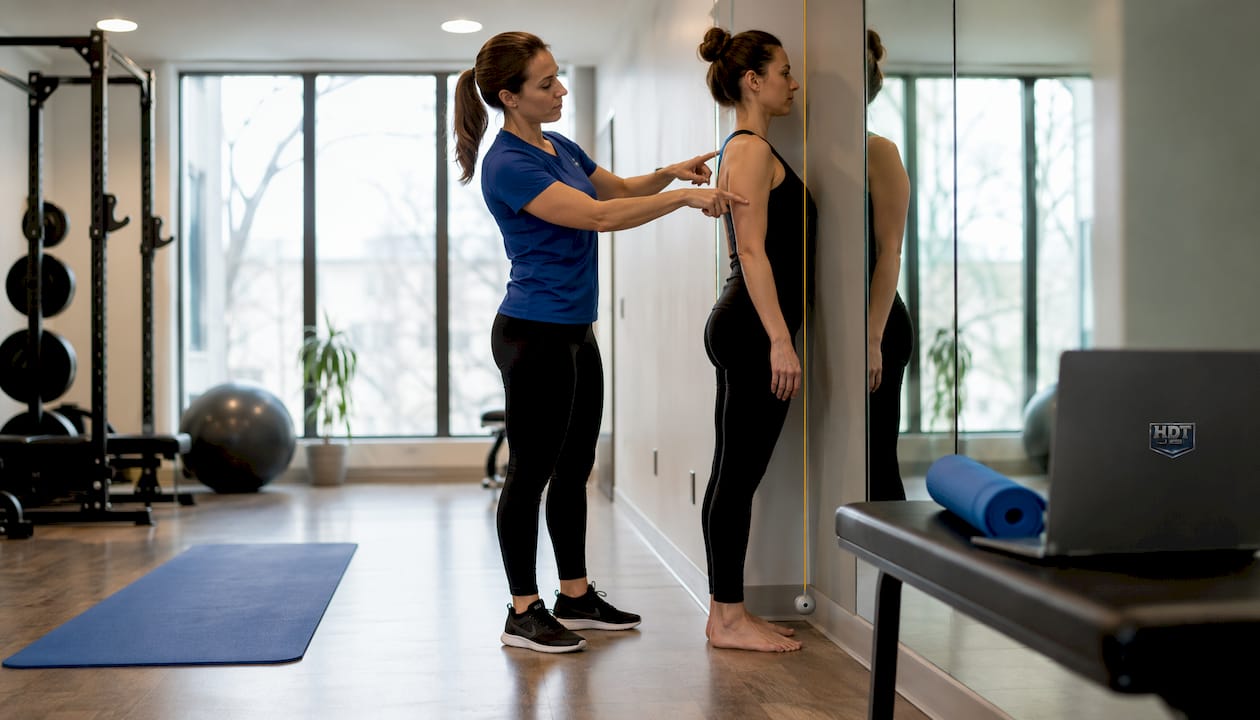
Wall test. Stand with your heels, buttocks, upper back, and head touching a wall. Your lower back should have a small natural gap (roughly enough to slide a hand through). If your head cannot reach the wall without strain, forward head posture is present.
Side-view photo assessment. Have someone photograph you from the side in a relaxed standing position. A plumb line from your ear should pass through your shoulder, hip, knee, and ankle. Deviations at any point indicate where alignment breaks down.
Multi-plane evaluation. Comprehensive postural assessment requires viewing the head, thorax, and pelvis from the front, back, and side. Isolated sagittal or frontal plane checks miss rotational asymmetries that affect how load distributes during exercise.
Functional movement screen (FMS). The FMS uses seven movement patterns to identify asymmetries and mobility restrictions that predict injury risk. A trained coach scores each pattern and identifies which postural deficits need priority attention. High Definition Training's fitness assessment approach incorporates this kind of functional evaluation to build training programs around each woman's actual movement baseline.
For women navigating postpartum recovery or perimenopause, a professional assessment is worth doing before loading any major movement pattern. Structural changes from pregnancy, including diastasis recti and pelvic floor dysfunction, alter how posture should be trained and what exercises are appropriate at each stage.
Key Takeaways
Posture is the single most underleveraged variable in women's fitness: fix alignment and muscle recruitment, injury risk, breathing, and confidence all improve together.
| Point | Details |
|---|---|
| Alignment drives muscle recruitment | Neutral spine and pelvis allow target muscles to fire correctly, making every exercise more effective. |
| Pilates produces measurable results | An 8-week Pilates program significantly improved flexibility and reduced lateral spinal deviation in adult women, demonstrating clear benefits of regular posture-focused exercise. |
| Posture affects aerobic capacity | Spine lateral deviation significantly correlates with VO2max in women, linking alignment to endurance performance. |
| Balanced programming protects posture | Front-body dominant training without posterior chain work worsens muscle imbalances and postural problems over time. |
| Assessment requires multiple planes | Reliable posture evaluation checks head, thorax, and pelvis from front, back, and side, not just a mirror glance. |
FAQ
Why is posture important for women specifically?
Women face posture-specific challenges including hormonal effects on ligament laxity, anterior pelvic tilt from prolonged sitting, and structural changes from pregnancy. These factors make alignment training a direct injury prevention strategy, not just a cosmetic concern.
How does posture affect physical fitness performance?
Poor alignment limits muscle recruitment, reduces respiratory efficiency, and accelerates fatigue. Research shows that postural variables such as head and pelvic position correlate with cardiopulmonary function and aerobic capacity in women.
Why does posture matter during exercise?
During exercise, misalignment shifts the load onto passive structures like ligaments rather than active muscles, increasing injury risk and reducing the effectiveness of each movement. Deep core activation, which depends on neutral alignment, serves as an internal brace that protects the spine and pelvis.
Is it too late to fix posture after 30?
No. Posture responds to targeted training at any age. Women with chronic pain who completed a posture-focused exercise intervention improved their Functional Movement Screen scores from 11.4±1.5 to 15.4±1.7, demonstrating that meaningful change is achievable in adults.
How can I start improving my posture for fitness?
Begin with a wall test to identify your current alignment baseline, then add pelvic tilts, wall angels, and bird dogs to your warm-up. Pairing these with a balanced strength program that includes posterior chain work produces the fastest postural improvement.
Ready to improve your posture and performance?
Join High Definition Training for personalized coaching in the Bronx.