
Discipline vs. Motivation in Fitness: What Actually Works
July 19, 2026

TL;DR:
- Motivation sparks initial engagement but is short-lived and mood-dependent, while discipline is a decision-based skill that sustains long-term habits. Building a structured system with pre-planned minimum workouts and environmental cues helps maintain consistency during motivation dips, especially after six weeks. Focusing on discipline over motivation leads to lasting fitness results by creating routines that are easier to follow regardless of emotional fluctuations.
Motivation gets you started. Discipline keeps you going. Habit eventually makes showing up automatic. That sequence is the whole game, and understanding where you are in it determines what you actually need right now. Your one action for today: open your calendar and block a single 20-minute workout slot for tomorrow. Don't negotiate the time, protect it.
Here's why the distinction matters:
- Motivation is a feeling. It spikes, fades, and cannot be scheduled.
- Discipline is a decision-based skill. You build it through repetition, not willpower.
- Habits are the long-term goal: the point where showing up no longer requires either.
Table of Contents
- What is motivation in a fitness context?
- What does discipline look like inside a training program?
- How do motivation and discipline differ across your training timeline?
- Which matters more for long-term fitness success?
- How to build discipline and use motivation without burning out
- How a coach accelerates discipline-building
- Key Takeaways
- The part most fitness content gets wrong
- High Definition Training builds the system for you
- Useful sources and further reading
- FAQ
What is motivation in a fitness context?
Motivation is the internal or external drive that directs you toward a behavior. It's what makes you sign up for a class, buy new shoes, or feel a surge of energy after watching someone crush a workout. The problem is that it's emotional by nature, which means it rises and falls with your mood, your sleep, your stress level, and a dozen other variables you can't control.
Not all motivation is equal, and that distinction matters more than most fitness content admits. Self-Determination Theory, one of the most replicated frameworks in behavioral psychology, draws a clear line between two types:
- Intrinsic (autonomous) motivation: You work out because it feels good, because you value your health, or because strength training genuinely interests you.
- Extrinsic (controlled) motivation: You work out because someone is watching, because you feel guilty if you don't, or because you're chasing a number on a scale.
Autonomous motivation consistently predicts better well-being and more sustainable behavior than controlled motivation. Externally pressured motivation can actually harm subjective health outcomes over time. That's not a minor footnote. It means the why behind your workouts shapes whether they stick.
"People understand the importance of regular exercise and can be excited to begin, but staying engaged for the long term can be challenging."
— Vijay Daryanani, certified personal trainer, Harvard Health
Fitness-specific examples of motivation doing its job: you feel fired up after a health scare and commit to three sessions a week; you discover a new training style and can't wait to try it; a friend invites you to a group class and the social energy pulls you in. These are real, useful sparks. The mistake is expecting the spark to last.
What does discipline look like inside a training program?
Discipline is not a personality trait you either have or don't. It's a decision-based skill built through routines, rules, and environmental design. Where motivation asks, "Do I feel like it?" discipline has already answered that question.
Concrete signs of discipline in a training program:
- Sessions are scheduled like appointments, not fit in when convenient.
- A minimum-viable workout exists for low-energy days (20 minutes, lighter load, shorter distance).
- Gym clothes are packed the night before, removing one more friction point.
- When life disrupts the full plan, a scaled-down version runs instead of nothing.
Discipline as a system means designing your environment so the disciplined choice is the path of least resistance. That's not a motivational poster idea. It's practical: if your gym bag is in the car, you're more likely to stop. If you've pre-decided that a 20-minute walk counts on a bad day, you won't skip the week entirely.
Here's a short example. Say it's week six of a new program. Work ran late, you're tired, and the last thing you want is a full training session. Motivation is at zero. A disciplined trainee doesn't re-evaluate the goal. They follow the pre-planned minimum session, finish in 25 minutes, and preserve the habit loop. That one decision, repeated over months, is what builds lasting results.
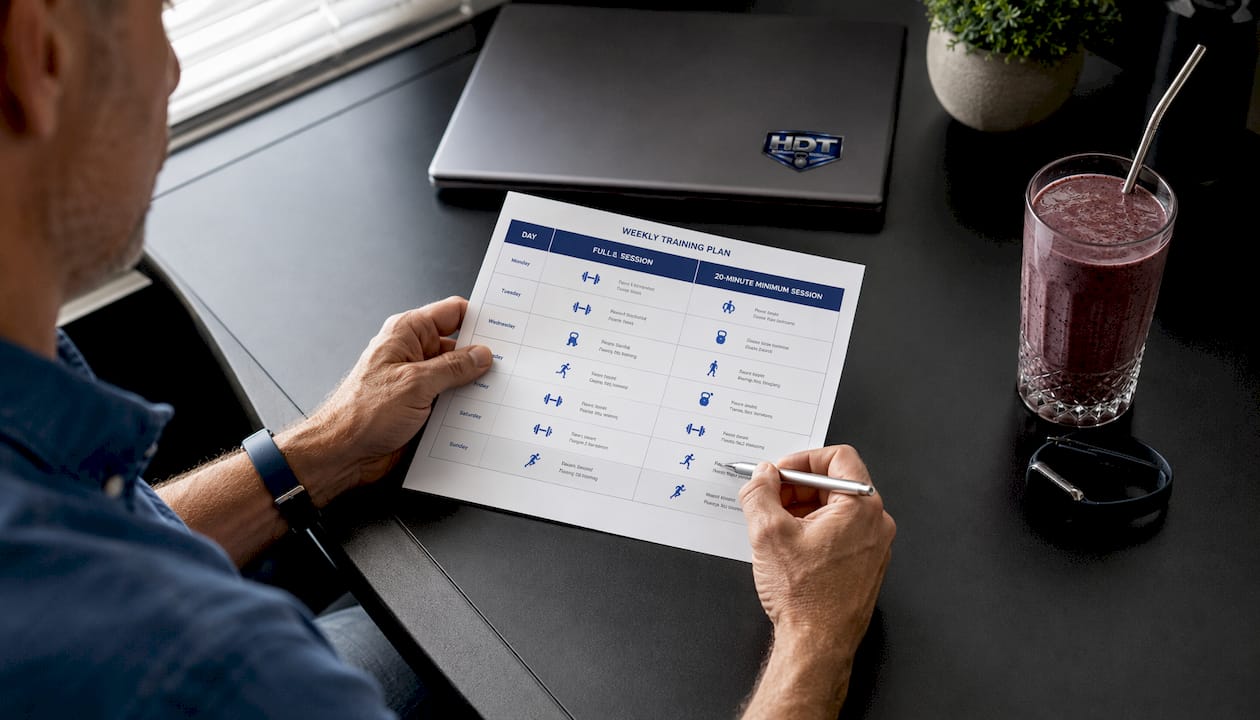
Pro Tip: Prepare two versions of every week's plan: the full session and a 20-minute minimum. On hard days, the minimum is not failure. It's the system working exactly as designed.
How do motivation and discipline differ across your training timeline?
They're not opposites. They're tools for different stages, and confusing them is why most people quit around week six.

Direct contrasts:
| Motivation | Discipline | |
|---|---|---|
| Trigger | Feeling or emotion | Pre-made decision |
| Durability | Short-lived | Builds over time |
| Energy cost | Low at first, then high | High at first, then low |
| Role in habit-building | Initiates | Sustains |
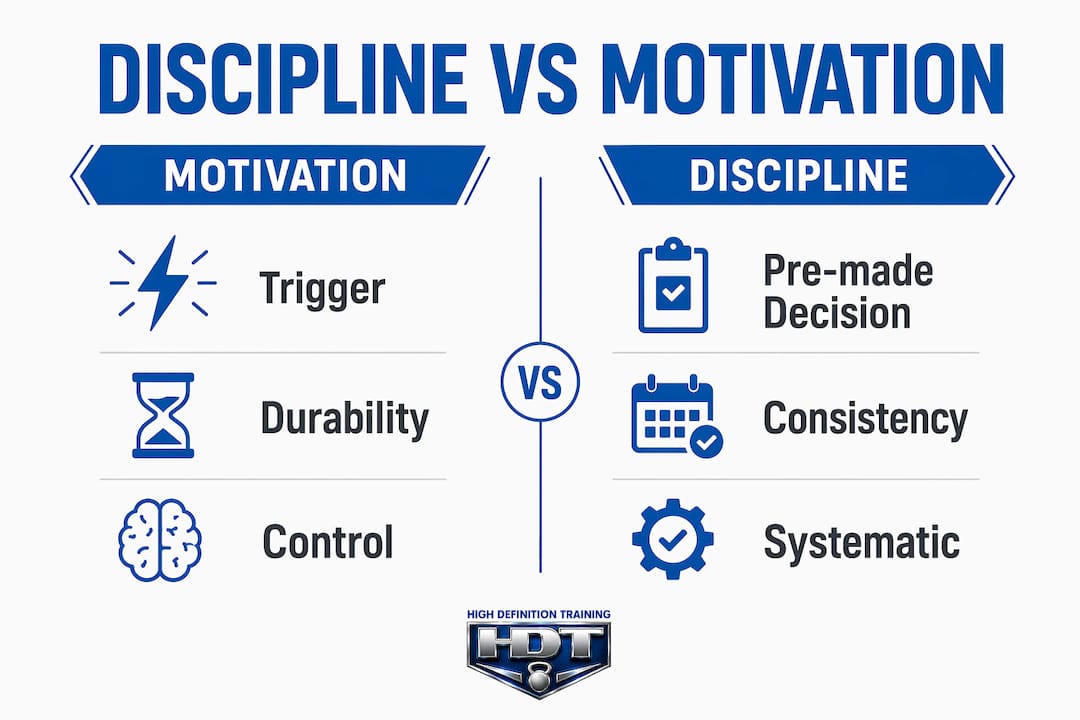
Where they overlap: Motivation is useful for choosing direction. It tells you what kind of training you actually want to do, which matters for autonomous engagement. Discipline executes the plan once the direction is set. You need both, just not at the same time and not in the same way.
The timeline most people experience:
- Week 1 (start): Motivation is high. Everything feels new. Discipline is almost irrelevant because you want to be there. Use this window to lock in your schedule and build the structural habits that will carry you later.
- Week 6 (the middle dip): Novelty has worn off. Results aren't dramatic yet. This is where most people quit. Motivation is unreliable here. Discipline and a pre-planned minimum session are the only things that bridge this gap.
- Month 3 (habit stage): If you've made it through the dip, training starts to feel automatic. You're not relying on motivation or grinding through discipline. The behavior has become part of your identity.
Anticipating the middle dip is one of the most practical things you can do before you start. Plan for it explicitly. Scale the workouts, not the commitment.
Which matters more for long-term fitness success?
Discipline. For sustained results over months and years, discipline creates the continuity that motivation simply cannot. Motivation is episodic. Discipline is structural.
That said, the nuance matters:
- Discipline applied to the wrong goal is just efficient suffering. If you're grinding through a program you hate, that's not discipline working. That's a signal to revisit the goal.
- The quality of your motivation shapes what you're building discipline toward. Autonomous motivation (you genuinely want this) produces better outcomes than guilt-driven compliance.
- Misguided discipline, the "white-knuckling" version, burns people out. Sustainable discipline is quiet continuity, not daily heroics.
Motivation helps you choose the destination. Discipline drives the car. But if you picked the wrong destination, no amount of driving will get you anywhere worth going.
The practical recommendation: use motivation to evaluate whether your goals still fit your life, and use discipline to execute without re-litigating that question every morning.
How to build discipline and use motivation without burning out
The most effective approach combines implementation intentions (pre-planned If→Then responses to common barriers) with environment design and intelligent scaling.
Implementation intentions for common barriers:
- If I don't have time for a full session, then I do the 20-minute minimum instead of skipping.
- If I'm traveling, then I do a bodyweight routine in the hotel room at 7:00 AM.
- If I feel too tired after work, then I go to the gym anyway and reassess after the warm-up.
- If I miss a scheduled session, then I reschedule it within 48 hours, not "next week."
- If motivation is low, then I remind myself the goal is consistency, not performance.
Implementation intentions reduce friction by removing in-the-moment decision-making. You're not deciding whether to go. You already decided.
Daily and weekly discipline habits:
- Lay out gym clothes the night before.
- Schedule sessions at the same time each week.
- Track workouts, even briefly (weight, reps, how you felt).
- Define your minimum-viable workout in advance.
- Review your week on Sunday and adjust; don't abandon.
Pro Tip: Use motivation strategically. When you feel a surge of energy or excitement about training, that's the moment to try something new, set a stretch goal, or add a session. Don't spend that energy on tasks you'd do anyway. Save novelty for when motivation peaks.
A simple weekly structure that uses both tools:
| Day | Session type | Driver |
|---|---|---|
| Monday | Full strength session | Discipline (scheduled) |
| Wednesday | Cardio or mobility | Discipline (scheduled) |
| Friday | Full strength session | Discipline (scheduled) |
| Saturday | Active recovery or bonus | Motivation (optional) |
| Any hard day | 20-min minimum | Discipline (pre-planned) |
For adults building fitness habits after 40, this structure matters even more. Recovery needs are real, and an all-or-nothing approach is one of the fastest routes to injury or burnout. Consistency over intensity, every time.
How a coach accelerates discipline-building
A good coach doesn't just write workouts. They remove the conditions that make discipline collapse.
What a trainer actually does for your discipline:
- Designs a program with built-in progression so you're never guessing what comes next.
- Manages load and recovery to prevent the overtraining that kills motivation.
- Holds you accountable without shame, which is different from a workout buddy who cancels.
- Pre-plans scaling options so a hard week doesn't become a skipped month.
- Tracks your progress so you can see evidence of consistency even when you don't feel it.
Consider a client who starts strong in week one, hits the middle dip around week five, and feels like quitting. With a coach, that dip gets anticipated. The program scales back intentionally. The client finishes a shorter session, feels competent rather than defeated, and keeps the habit alive. By month three, training is part of the routine. The role of personalized coaching is exactly this: converting the discipline gap into a system the client doesn't have to manage alone.
The middle dip isn't a sign you're failing. It's a sign the novelty has worn off, and the real work is beginning. That's when structure matters most.
For adults over 40 especially, intelligent scaling and fitness tracking aren't optional extras. They're what keep training safe, sustainable, and worth continuing.
Key Takeaways
Discipline sustains fitness progress where motivation cannot; building a pre-planned system of minimum sessions and implementation intentions is what bridges the motivation dip and turns workouts into lasting habits.
| Point | Details |
|---|---|
| Motivation initiates | Use it to choose goals and start training, not to sustain daily effort. |
| Discipline sustains | Schedule sessions, pre-plan minimums, and remove friction before you need willpower. |
| The middle dip is predictable | Anticipate week six as the hardest stretch and scale workouts rather than skipping them. |
| Implementation intentions work | Pre-written If→Then plans remove in-the-moment decisions that derail consistency. |
| High Definition Training | Provides structured, personalized coaching for adults over 40 to build discipline-based fitness habits in the Bronx. |
The part most fitness content gets wrong
There's a version of the discipline-versus-motivation conversation that turns into a motivational speech about "showing up every day no matter what." That framing sounds inspiring and is genuinely counterproductive for most adults building a fitness routine after 40.
Here's what actually holds up: discipline is not about grinding harder than everyone else. It's about designing a life where the right behavior is the easiest one. The clients who build lasting fitness habits aren't the ones with the most willpower. They're the ones who stopped relying on it. They packed the bag the night before. They had a 20-minute backup plan. They didn't re-evaluate their goals every time they felt tired.
Motivation has a real role, but it's a signal, not a fuel source. When you feel genuinely excited about a goal, that's information worth acting on. When motivation drops, that's not a sign to quit. It's a sign the system needs to carry you. The all-or-nothing logic, "I'll go hard or skip it," is the single most common reason people lose months of progress over a bad week.
For adults over 40, this is especially worth naming. Recovery takes longer. Life is busier. The margin for error is smaller. A sustainable approach means building a program you can maintain at 70% effort on a hard week, not just one that works when everything is perfect.
High Definition Training builds the system for you
For adults in the Bronx who want to stop relying on motivation and start building a training system that actually holds, High Definition Training offers personalized coaching designed specifically for adults over 40 in Throgs Neck and Pelham Bay.
The difference between a program that lasts and one that doesn't is usually structure, not effort. At High Definition Training, every client gets a plan built around their schedule, their recovery needs, and their real life, including pre-planned scaling options for hard weeks. No pressure to be perfect. No generic programming. Just a training program built to keep you consistent when motivation isn't enough.
Check the pricing and packages or reach out to schedule a no-pressure discovery session and see what a discipline-based program looks like for your specific goals.
Useful sources and further reading
The claims in this article draw from behavioral research, habit-formation science, and practitioner guidance. Key sources:
- Harvard Health: What can you do to maintain exercise motivation? — Practitioner perspective on why motivation fades and how to sustain exercise engagement.
- BMC Public Health: Self-Determination Theory research summary — Primary research on autonomous vs. controlled motivation and well-being outcomes.
- NASM Blog: 5 Fitness Motivation Tips — Implementation intentions and habit-building tactics from a credentialed fitness organization.
- HabitBox Blog: Motivation vs. Discipline — Practical breakdown of motivation and discipline as sequential tools; supports timeline examples.
- GrabGains: Why discipline beats motivation — The middle-dip concept and how anticipating it improves adherence.
- Chris Ryan Fitness: Discipline over motivation — Practitioner evidence for intelligent scaling and minimum-viable workouts.
- Peloton Output: Motivation vs. Discipline — Public-facing definitions and the case for discipline in long-term fitness.
- OneMor: How to start working out with zero motivation — Beginner-focused tactics for starting when motivation is low.
- OneMor: Stay consistent with fitness — Five evidence-informed strategies for building consistency and habit formation.
FAQ
What is the difference between discipline and motivation?
Motivation is an emotional drive that initiates behavior; it's temporary and mood-dependent. Discipline is a decision-based skill built through routine that sustains behavior regardless of how you feel.
Which comes first, motivation or discipline?
Motivation typically comes first. It provides the initial spark to start a fitness program. Discipline develops over weeks of repeated action and eventually replaces the need for motivation to show up.
Does discipline or motivation matter more for fitness results?
Discipline matters more for long-term results because motivation fluctuates with mood, sleep, and stress. Discipline creates the consistency needed for lasting strength, weight management, and habit formation.
What is discipline in fitness, specifically?
Discipline in fitness means following a scheduled training plan regardless of how you feel that day, using pre-planned minimum sessions on hard days, and designing your environment to make skipping harder than showing up.
How do I stay motivated when discipline feels hard?
Use implementation intentions: pre-written If→Then plans that remove in-the-moment decisions. When motivation is low, the plan runs automatically rather than relying on willpower in the moment.